
Listen to this article
Narrated by Charlotte · The Noble House

Executive Orientation
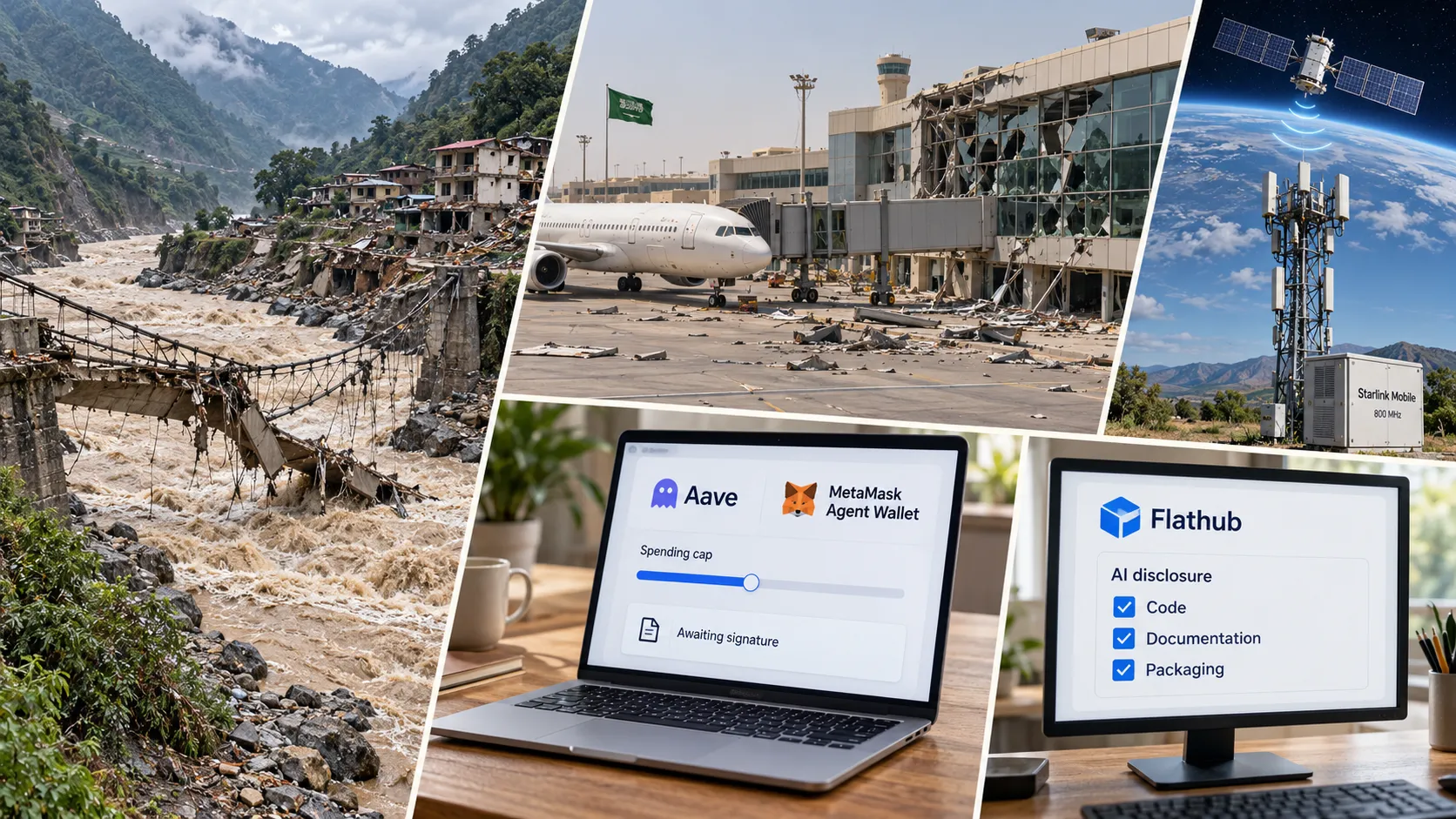
The strategic landscape of October 2026 is defined by five distinct operational signals, each operating with independent momentum and requiring separate analytical frameworks. These signals span humanitarian crises, kinetic geopolitical escalation, telecommunications infrastructure consolidation, decentralized finance protocol evolution, and software governance policy shifts. The flash flood in Nepal demonstrates the rapid degradation of critical civilian infrastructure in high-risk topographies, exposing the fragility of connectivity in the face of geological instability. Simultaneously, the strikes on Saudi Arabian airports indicate an intensification of asymmetric warfare targeting commercial aviation hubs, introducing new variables for international intervention and defense logistics. In the telecommunications sector, SpaceX’s agreement to acquire nationwide low-band spectrum, still subject to FCC approval, could alter the dynamics for legacy carriers as satellite and terrestrial networks converge, though analysts do not expect material impact before 2029. Aave has connected its Model Context Protocol server to MetaMask’s Agent Wallet, linking DeFi’s credit layer with AI agents that prepare Aave transactions for signing. Finally, Flathub’s reversal of its ban on AI-generated content replaces prohibition with disclosure requirements while keeping quality standards in force. Collectively, these events highlight a period of accelerated structural change across physical safety, security architecture, market competition, financial automation, and digital content standards.
Signal 1: Nepal Flash Flood Infrastructure Collapse
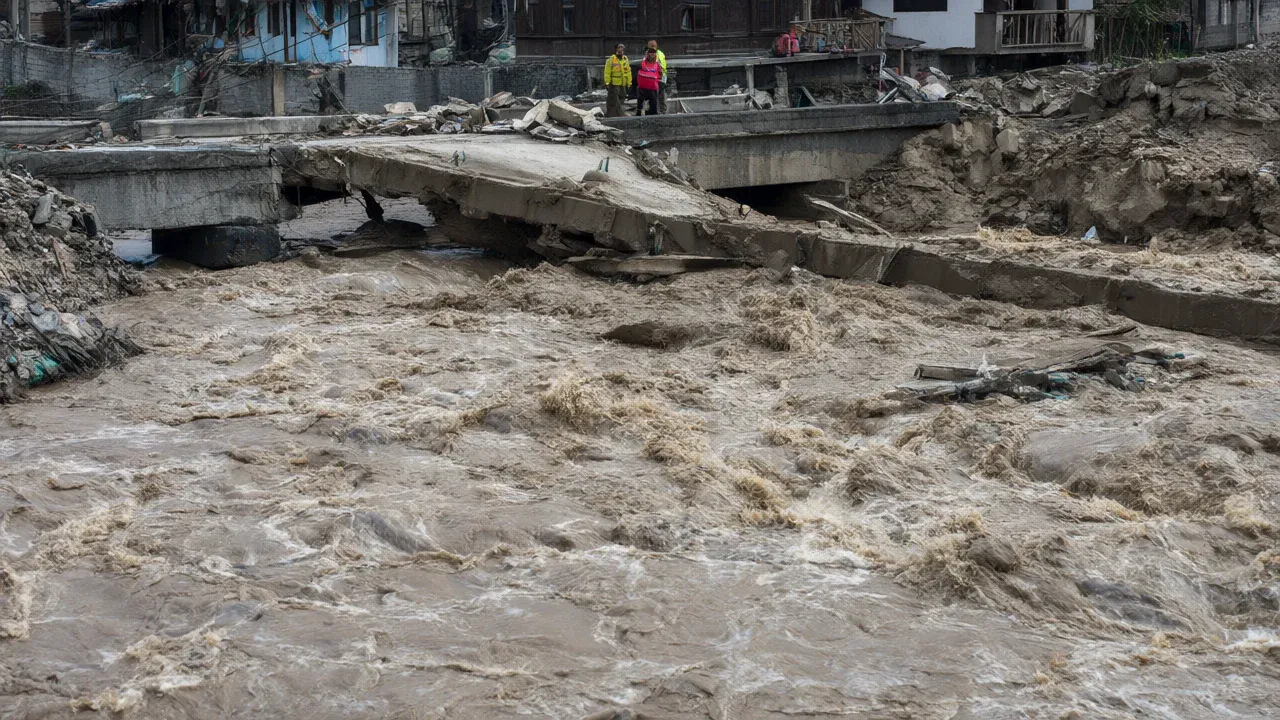
The Record. A sudden flash flood struck the Budhi Gandaki River in central Nepal on Sunday, 11 October 2026, devastating Gorkha and Dhading districts [1]bbc.co.ukHomes and bridges swept away as fresh floods hit NepalReports of approximately 50 people rescued by the Nepali Army; five missing persons from Gorkha district; destruction of a hydrological monitoring station; and expert assessments that this event is smaller than the August disaster.Open source ↗ [2]english.onlinekhabar.comWhat triggered the devastating flood in the Budhi Gandaki river?Details on specific bridge destructions (Nyakchet-Sirdibas, Machhikhola-Kerauja); suspicion of an ice avalanche as the cause; and meteorological data indicating no recorded rainfall in upper reaches.Open source ↗ [3]tbsnews.net5 missing as flash flood sweeps away 65 houses in NepalAttribution of the flood cause to a landslide dam-burst in Chumnubri Rural Municipality; report of 36 people airlifted by the Nepal Army; and confirmation of approximately 65 houses swept away.Open source ↗. The disaster swept away approximately 65 houses across the two districts, according to TBS News, while the BBC's early report cited about a dozen homes [1] [3]. Multiple critical bridges were destroyed, including two motorable bridges, two suspension bridges (Nyakchet-Sirdibas and Machhikhola-Kerauja), and an iron concrete bridge at Soti [2]. A hydroelectric project was damaged with construction equipment swept away, and a hydrological monitoring station was destroyed, cutting off real-time data from Binod Parajuli’s facility [1] [2]. Water levels at one location rose from approximately 2 meters to nearly 8.5 meters within a couple of hours [1]bbc.co.ukHomes and bridges swept away as fresh floods hit NepalReports of approximately 50 people rescued by the Nepali Army; five missing persons from Gorkha district; destruction of a hydrological monitoring station; and expert assessments that this event is smaller than the August disaster.Open source ↗. The Nepal Army said a landslide in Chumnubri Rural Municipality temporarily dammed the river before breaching [3]; the cause has not been confirmed. NDRRMA executive director Dharmaraj Upreti said preliminary information from locals suggests an ice avalanche may have sent snow, mud and debris into the river, though the cause has not been confirmed [2]. Senior hydrologist Binod Parajuli said no rainfall had been recorded in the upper reaches, so the flood could not be attributed to rainfall on the available records [2]. Five people are reported missing, all from Gorkha district, while no confirmed deaths have been reported as of the latest updates [1] [3]. Rescue efforts included approximately 50 people rescued by the Nepali Army and 36 people airlifted to safer locations [1] [3]. Save the Children is mobilizing an emergency team, with Director Tara Chettry noting children are in shock and distress [1]. A Nepali Army helicopter deployed from Kathmandu had difficulty landing because conditions did not allow it [2]english.onlinekhabar.comWhat triggered the devastating flood in the Budhi Gandaki river?Details on specific bridge destructions (Nyakchet-Sirdibas, Machhikhola-Kerauja); suspicion of an ice avalanche as the cause; and meteorological data indicating no recorded rainfall in upper reaches.Open source ↗, and report collection for missing persons remains ongoing [3]. Experts describe this event as smaller and slower-moving than the catastrophic August floods [1], though residents of northern Gorkha told Onlinekhabar they have never witnessed such a severe flood [2]english.onlinekhabar.comWhat triggered the devastating flood in the Budhi Gandaki river?Details on specific bridge destructions (Nyakchet-Sirdibas, Machhikhola-Kerauja); suspicion of an ice avalanche as the cause; and meteorological data indicating no recorded rainfall in upper reaches.Open source ↗. Authorities warn that potential impacts from this flood could extend from Gorkha and Dhading to Tanahun, Muglin, and Chitwan [2].
The Analysis. The destruction of critical connectivity infrastructure, specifically the loss of motorable and suspension bridges, isolates affected communities and hinders rapid response capabilities. The gap between early estimates of about a dozen houses swept away and the later figure of 65 underscores the volatility of information during active disaster phases. The cause has not been confirmed: the Nepal Army points to a landslide dam-burst, while officials suspect an ice avalanche. The flood follows catastrophic floods two months ago that left more than 1,400 people dead [1]. Rainfall records show none in the upper reaches, so rainfall is an unlikely trigger, though the exact cause remains unestablished [2].
Compass Outlook. Continued monitoring of downstream water levels is essential to assess secondary flood risks in Tanahun, Muglin, and Chitwan. The efficacy of aerial rescue operations will likely remain constrained by weather conditions, necessitating ground-based logistical support once access routes are cleared. The long-term recovery of the region depends heavily on the reconstruction of the destroyed bridge network and the restoration of hydrological monitoring capabilities.
Decision Window. Immediate prioritization of missing persons search efforts in Gorkha district remains critical. Resource allocation for bridge reconstruction must be expedited to restore economic and humanitarian access to Dhading and Gorkha. Long-term infrastructure planning should consider resilience against landslide-induced dam bursts and ice avalanches, both of which have been cited as possible triggers.
Compass Strategic Intelligence
Signal 2: Saudi Arabian Airport Strikes and Geopolitical Escalation
The Record. On Sunday, Oct 11, 2026, a projectile struck King Khalid International Airport (RKY) in Riyadh, which was already closed following a missile strike on Saturday, Oct 10; RKY had been struck four times in five days [4]apnews.comSaudi Arabia airport struck again as Trump weighs intervention in Houthi warKing Khalid International Airport (RKY) was struck on Sunday, Oct 11, following a Saturday strike; RKY closed since Saturday after four strikes in five days; King Fahd International Airport (DMM) also attacked; Houthi claims of targeting…Open source ↗. The Saturday attack on RKY killed at least 13 people and injured over 300, with victims including nationals of Saudi Arabia, Bangladesh, Palestine, the U.S., Egypt, Jordan, Syria, and Sudan [5]cbsnews.comHouthis threaten Saudi airspace attack after Riyadh airport strikeCasualties from Saturday attack killed at least 13, injuries exceeded 300; victims included nationals of multiple countries including U.S.; Houthis claimed responsibility via Brig. Gen. Yahya Saree citing retaliation for Saudi aggression…Open source ↗. King Fahd International Airport (DMM) in Dammam was also attacked, confirmed by Saudi civil aviation authorities [4]. The Houthis claimed responsibility for the Riyadh attacks and others, with Brig. Gen. Yahya Saree stating they were retaliation for 'brutal Saudi aggression' citing over 120 Saudi airstrikes in the preceding 24 hours [5]. The Houthis alleged that Saudi forces struck the airport in Sanaa and damaged buildings in Shuaub, with Al-Masirah TV broadcasting footage; these claims are unverified by independent sources [5]. On Saturday, the Houthis threatened new attacks on Saudi airports other than those at Mecca and Medina, saying the airports and airspace 'constitute a theatre of operations for our forces' [5]cbsnews.comHouthis threaten Saudi airspace attack after Riyadh airport strikeCasualties from Saturday attack killed at least 13, injuries exceeded 300; victims included nationals of multiple countries including U.S.; Houthis claimed responsibility via Brig. Gen. Yahya Saree citing retaliation for Saudi aggression…Open source ↗. The UN, EU (Ursula von der Leyen), and Israel (Benjamin Netanyahu) condemned the Riyadh strike; U.S., Britain, Germany, Australia, and Canada issued travel warnings for RKY [5]. Saudi Arabia is reportedly running low on missile interceptors and has asked France, Britain, Pakistan and Egypt to deploy air defense support, regional officials told the Associated Press last month [4]. President Trump has said he is weighing joining the fight against the Houthis, and a U.S. intervention could prompt the Houthis to halt shipping through the Bab el-Mandeb Strait, further restricting the flow of oil out of the Persian Gulf [4].
The Analysis. The targeting of international civilian airports represents a significant escalation in asymmetric warfare, challenging the traditional immunity of commercial aviation hubs. Saudi Arabia's reported shortage of missile interceptors points to a potential defense gap, and Riyadh has already sought air defense support from France, Britain, Pakistan and Egypt. The Houthi attacks and the Saudi-led offensive launched a week ago are feeding each other, and the Houthi claim of more than 120 Saudi airstrikes in 24 hours is unconfirmed. The International Crisis Group's Ahmed Nagi warns the attacks could make Riyadh more determined to continue its campaign, while Iran has said it is ready to help start a Saudi-Houthi dialogue [4]. The potential for U.S. involvement carries substantial risk of broadening the conflict, particularly regarding maritime shipping lanes critical to global energy markets.
Compass Outlook. Watch for further Houthi threats against remaining operational Saudi airports and adjacent regional infrastructure. Track the delivery and deployment of requested interceptor aid from France, Britain, and Pakistan to assess Saudi defense resilience.
Decision Window. Evaluate the strategic cost of intervening in the Houthi conflict against the risk of disrupting global oil flows via the Bab el-Mandeb Strait. Assess the reliability of current Saudi air defense capabilities given reported interceptor shortages. Consider diplomatic channels to de-escalate the cycle of retaliation before further civilian casualties occur at international transit hubs.
Compass Strategic Intelligence
Compass Strategic Intelligence

Signal 3: SpaceX Spectrum Acquisition and Telecommunications Market Shift
The Record. SpaceX announced an agreement to acquire a nationwide portfolio of up to 14 megahertz of paired low-band spectrum in the 800 MHz band from investment firm Grain Management [7]satellitetoday.comSpaceX Moves to Acquire Nationwide Low-Band Spectrum for Starlink MobileSpaceX announced an agreement to acquire a nationwide portfolio of low-band spectrum licenses from investment firm Grain Management, consisting of up to 14 megahertz of paired spectrum in the 800 MHz band. SpaceX describes this spectrum…Open source ↗. SpaceX says the new low-band spectrum will provide a coverage layer that lets Starlink Mobile's signal penetrate walls and other obstacles and serve devices inside buildings [7]. Grain Management acquired the spectrum portfolio from T-Mobile for $2.9 billion in cash and additional spectrum licenses, completing that acquisition in August 2026. Traditional carriers experienced significant stock drops following the announcement: AT&T fell ~7.3%, Verizon dropped ~5.6%, and T-Mobile declined ~8.7% [8]. Tower companies, including Crown Castle and American Tower, saw stock gains as beneficiaries of necessary terrestrial infrastructure deployment [8]. The transaction is subject to FCC approval, and Citi analyst Michael Rollins does not expect SpaceX to materially affect the Big 3 telcos' operating results until at least 2029 [8]. Owning spectrum is distinct from operating a nationwide network; SpaceX must still deploy significant ground infrastructure and secure compatible consumer devices [9]gadgetreview.comSpaceX Spectrum Deal Puts Starlink in Carrier TerritoryThe deal is subject to FCC approval. Analysts note that owning spectrum is distinct from operating a nationwide network; SpaceX must still deploy significant ground infrastructure and secure compatible consumer devices. Full competitive…Open source ↗.
The Analysis. The acquisition of low-band spectrum signals SpaceX's intent to transition Starlink from a niche satellite service to a mainstream mobile carrier competitor. Low-frequency bands offer superior propagation characteristics, enabling indoor coverage that currently requires dense terrestrial infrastructure. The market reaction, with traditional carriers losing value and tower companies gaining, reflects investor anticipation of a new competitive paradigm where satellite and terrestrial networks converge. However, the regulatory hurdle of FCC approval and the extensive capital expenditure required for ground infrastructure deployment create a significant barrier to immediate market disruption.
Compass Outlook. Track SpaceX's progress in securing compatible consumer devices and deploying ground stations, as these are critical prerequisites for competitive viability. Observe long-term pricing strategies and service bundles offered by traditional carriers in response to the perceived threat.
Decision Window. Assess the timeline for full market entry, noting analyst estimates placing significant competitive impact no earlier than 2029. Evaluate the financial health of traditional carriers given stock volatility and potential margin compression from new competition. Consider investment implications for tower companies that may benefit from increased infrastructure demand regardless of network ownership.
Compass Strategic Intelligence
Compass Strategic Intelligence
Compass Strategic Intelligence
Compass Strategic Intelligence

Signal 4: Aave MCP Integration with MetaMask Agent Wallet
The Record. Aave announced an integration connecting the Aave Model Context Protocol (MCP) server to the MetaMask Agent Wallet [12]coinfomania.comAave Launches Integration with MetaMask Agent WalletCoinfomania corroborates the integration announcement and notes that current market volume and price data for Aave were unavailable at the time of writing, indicating potential low trading activity or reporting delays.Open source ↗. Aave Labs launched its MCP server on September 8, 2026, at mcp.aave.com, providing approximately 40 tools for agents to read protocol data, simulate actions, and prepare unsigned transactions for Aave V3 and V4 [10]cryptobriefing.comAave MCP now connects with MetaMask Agent Wallet for AI-driven DeFi actionsCryptoBriefing reports that Aave Labs launched its MCP server on September 8, 2026, at mcp.aave.com, serving as an interface for AI agents to interact with Aave V3 and V4. It also notes MetaMask publicly launched the Agent Wallet on…Open source ↗. The MetaMask Agent Wallet is a self-custodial wallet built specifically for AI agents that allows users to cap spending, configure security protocols, and run simulations, with actions returned as unsigned transactions until signed [11]gate.comAave Integrates MCP with MetaMask Agent Wallet for DeFi | Gate NewsGate News confirms the integration announcement and describes the MetaMask Agent Wallet as a self-custodial wallet built for AI agents, noting that users retain control of private keys and that MCP actions are returned as unsigned…Open source ↗. MetaMask publicly launched the Agent Wallet on August 6, 2026, and Aave announced that Agent Wallet users could interact with Aave while keeping self-custody on the same day [10]. As of September 2026, total deposits on Aave V4 have surpassed $1 billion [10]. The integration links DeFi's credit layer to agentic finance by allowing builders to prepare Aave transactions via the MCP while the MetaMask Agent Wallet signs and submits them [11].
The Analysis.This integration links protocol-level data access with agent-driven transaction preparation, while users keep control of their private keys. By standardizing interaction through MCP, Aave enables developers to build AI-driven financial tools that can operate within secure, self-custodial environments. Aave V4 deposits had passed $1 billion as of September 2026, though V4 currently supports only Ethereum and Avalanche [10].
Compass Outlook. Watch for developer adoption rates of the MCP server as a metric for ecosystem growth. Monitor Aave V4 deposit trends and liquidity depth to assess the stability of the credit layer supporting agentic finance. Track regulatory developments regarding AI agents handling financial transactions, particularly in jurisdictions with strict securities or banking laws.
Decision Window. Evaluate the security implications of allowing AI agents to prepare and submit financial transactions, even with user caps and unsigned transaction requirements. Assess the competitive landscape for other DeFi protocols launching MCP servers to determine if standardization will lead to network effects favoring early movers like Aave. Consider the potential for new financial products that leverage agentic automation for yield optimization or risk management.
Compass Strategic Intelligence
Compass Strategic Intelligence

Signal 5: Flathub Policy Reversal on AI-Generated Content
The Record. Flathub has replaced its blanket ban on AI-generated software with a new policy requiring developers to disclose the use of AI-generated content in submissions [14]linuxiac.comFlathub Reverses AI-Generated App Ban, Now Requires DisclosureConfirms policy reversal and requirement for submitters to identify AI-produced parts and approximate extent of use.Open source ↗. Submitters must now disclose any AI-generated code, documentation, packaging, or other material they know or reasonably believe is included in the application or its Flathub packaging [13]xda-developers.comFlathub just reversed its AI-generated content ban, but developers still need to say they used itConfirms policy reversal and disclosure requirements; notes that quality standards remain and low-quality submissions are not exempt from repercussions.Open source ↗. Submitters must identify which parts were produced with AI and the approximate extent of that use [14]. The reversal does not mean submitters can submit low-quality or fully vibe-coded apps without repercussions; maintainers can still reject an app over concerns about its review, quality, or maintainability, even if AI use is properly disclosed [13]. Flathub previously banned AI-generated submissions in May 2026 [13]xda-developers.comFlathub just reversed its AI-generated content ban, but developers still need to say they used itConfirms policy reversal and disclosure requirements; notes that quality standards remain and low-quality submissions are not exempt from repercussions.Open source ↗ [15]daily.devFlathub just reversed its AI-generated content ban, but developers still need to say they used itCorroborates disclosure requirements and provides historical context that Flathub previously banned AI submissions in May 2026.Open source ↗.
The Analysis. The shift from prohibition to disclosure comes as more Linux distributions have declared acceptance of LLM-created code that meets quality standards [13]. Requiring transparency allows maintainers and users to make informed decisions about the software they install while preserving quality control through existing standards. This approach balances innovation with accountability, avoiding the pitfalls of both unchecked automation and restrictive bans. The emphasis on maintaining quality standards ensures that the ease of AI-assisted development does not compromise the reliability of the distribution platform.
Compass Outlook. Monitor adoption rates of the disclosure policy among developers to assess its effectiveness in promoting transparency. Watch for emerging tools or services that help automate or verify AI content disclosure, potentially creating new market opportunities within the open-source ecosystem. Track community feedback on quality control mechanisms to ensure they remain robust against potential abuse.
Decision Window. Evaluate the impact of the disclosure requirement on submission volume and diversity, noting whether it discourages or encourages developer participation. Assess the effectiveness of existing quality standards in filtering out low-quality AI-generated content without imposing undue burden on legitimate developers. Consider the broader implications for open-source governance as other platforms may adopt similar disclosure-based models.
Compass Strategic Intelligence

Closing Outlook
These five signals leave readers watching next for the downstream effects of each independent event. In Nepal, the focus remains on disaster response efficacy and long-term infrastructure resilience against geological hazards. In the Middle East, attention centers on U.S. intervention decisions and their potential to escalate regional conflict or stabilize security dynamics. The telecommunications sector requires monitoring of SpaceX's regulatory progress and market entry timeline relative to traditional carriers. The financial technology space demands observation of agentic finance adoption rates and regulatory clarity for AI-driven transactions. Finally, the open-source community is observing the practical implementation of Flathub's disclosure policy and its impact on software quality and developer behavior. Each signal operates within its own domain, but collectively they illustrate a landscape where rapid technological change intersects with geopolitical instability and evolving governance frameworks.