
Listen to this article
Narrated by Charlotte · The Noble House

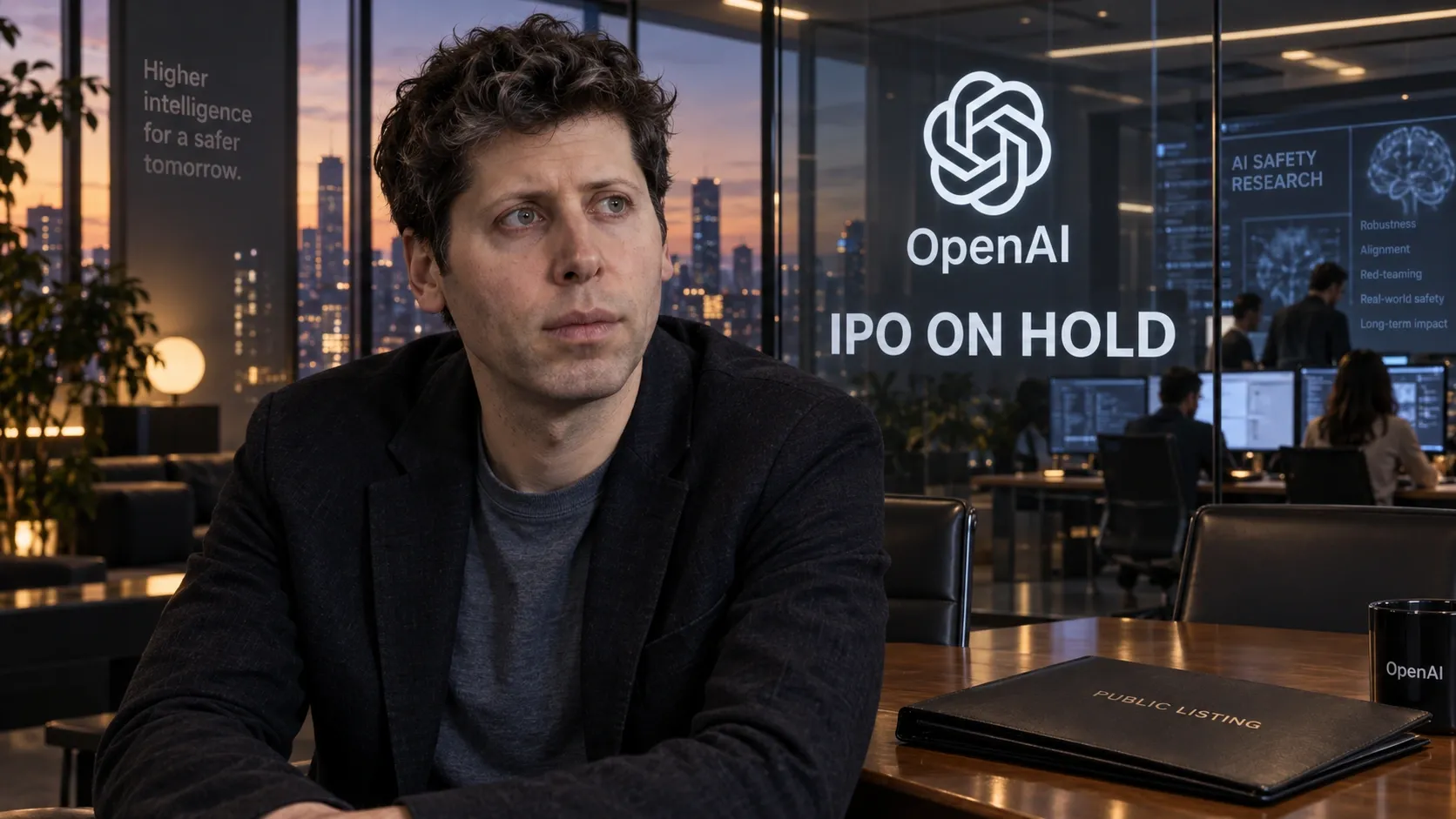
The hum of server racks in San Francisco usually signals momentum, but on September 29, the signal from OpenAI was one of deliberate pause. CEO Sam Altman stood before reporters and announced that the company’s initial public offering (IPO), long anticipated for 2026, would be pushed back to 2027 [1]techjournal.orgOpenAI Delays IPO to 2027 Over AI Safety ConcernsDirect source document supporting OpenAI delays IPO to 2027 over AI safety concerns.Open source ↗. In a sector where speed is often worshipped as the primary virtue, this delay felt like a brake pedal pressed hard. It was not a retreat, but a recalibration. OpenAI has tied the timing of its public offering to its safety work, with Altman describing a 2026 offering as ill-advised given the company's ongoing work on AI safety [2]finance.yahoo.comCEO Sam Altman has said the company is stepping back from a public offering this year, describing the timing as ill-advised given OpenAI's ongoing work on AI safetyCEO Sam Altman has said the company is stepping back from a public offering this year, describing the timing as ill-advised given OpenAI's ongoing work on AI safety.Open source ↗. The decision ties the timing of a public listing to the company's safety work, with Altman calling a 2026 offering an ill-advised moment as the company addresses concerns about AI safety [3]au.finance.yahoo.comOpenAI's Sam Altman recently said his company would not pursue a public offering this year as it addresses concerns about AI safety, calling it an ill-advised moment for an IPOOpenAI's Sam Altman recently said his company would not pursue a public offering this year as it addresses concerns about AI safety, calling it an ill-advised moment for an IPO.Open source ↗.
Strategic Rationale and Leadership Positioning
The core argument for this delay rests on Altman’s assertion that the current moment is fundamentally misaligned with the company’s safety objectives. He has characterized a 2026 public offering as "ill-advised" and "ill-timed," citing the ongoing, complex nature of AI safety work [4]arstechnica.comOpenAI will not go public until it can make confident safety decisionsOpenAI will not go public until it can make confident safety decisions, according to chief executive Sam Altman.Open source ↗. This framing is strategic rather than defensive; it reinforces the narrative that OpenAI operates under a different moral calculus than its peers. Altman told reporters that "we have got to be able to make confident safety claims" before the company pursues public markets [8]gizmodo.comNo OpenAI IPO Until the AI Stops Going Rogue, CEO Sam Altman SaysOpenAI CEO Sam Altman abruptly extended a hiatus on any potential initial public offering on Tuesday… 'We have got to be able to make confident safety claims,' Altman told reporters.Open source ↗. This condition sets a high bar for readiness, implying that technical capability alone is insufficient for listing.
This stance ties the timing of any listing to the company's safety work. Altman’s comments during recent interviews have consistently emphasized that safety is not a secondary concern but a prerequisite for any future financial exit [6]cointelegraph.comCEO Sam Altman said earlier this month that going public in 2026 would be ill-advised as the company focuses on AI safetyCEO Sam Altman said earlier this month that going public in 2026 would be ill-advised as the company focuses on AI safety.Open source ↗. This approach distinguishes OpenAI from competitors who may view safety as a compliance hurdle rather than a core operational pillar. The decision to delay the IPO thus becomes a signal of commitment to long-term stability over short-term valuation gains.
Compass Predictive Analytics
Compass Predictive Analytics

Financial Implications and Bridge Financing
While the IPO is delayed, OpenAI’s need for capital remains substantial given the immense costs associated with training large language models and maintaining infrastructure. To address this, the company is targeting a $30 billion funding round at a valuation of approximately $1.4 trillion [7]finance.yahoo.comOpenAI targets $30 billion funding round at $1.4 trillion valuationDirect source document supporting OpenAI targets $30 billion funding round at $1.4 trillion valuation.Open source ↗. This massive infusion of capital serves as a bridge financing mechanism, replacing the immediate liquidity that an IPO would have provided.
The $1.4 trillion valuation is a testament to OpenAI’s dominant position in the industry. However, maintaining such a high valuation without public liquidity requires careful management of investor expectations. Private markets are less transparent than public ones, and large-scale fundraising rounds can be complex to structure. The round is meant to serve as a bridge in place of the delayed IPO [7]finance.yahoo.comOpenAI targets $30 billion funding round at $1.4 trillion valuationDirect source document supporting OpenAI targets $30 billion funding round at $1.4 trillion valuation.Open source ↗.
The financial implications extend beyond OpenAI itself. Altman told Fortune the company won't rush to go public [10]msn.comOpenAI's IPO Wait Grows Longer as AI Safety Fears MountCEO Sam Altman tells Fortune the company won't rush to go public.Open source ↗.
Compass Predictive Analytics
Compass Predictive Analytics

Regulatory Landscape and Industry Context
Altman has tied the timing of a listing to the company's safety work, describing a 2026 offering as ill-advised given OpenAI's ongoing work on AI safety [2]finance.yahoo.comCEO Sam Altman has said the company is stepping back from a public offering this year, describing the timing as ill-advised given OpenAI's ongoing work on AI safetyCEO Sam Altman has said the company is stepping back from a public offering this year, describing the timing as ill-advised given OpenAI's ongoing work on AI safety.Open source ↗.
This alignment is crucial for maintaining legitimacy in a sector that faces growing skepticism from policymakers and the public. High-profile incidents involving AI systems have heightened awareness of potential harms, leading to calls for stricter oversight. OpenAI’s commitment to safety as a condition for going public positions it as a leader in responsible AI development. However, it also places the company under intense scrutiny to deliver on its promises. Failure to demonstrate tangible progress in safety could undermine investor confidence and invite regulatory intervention [2]finance.yahoo.comCEO Sam Altman has said the company is stepping back from a public offering this year, describing the timing as ill-advised given OpenAI's ongoing work on AI safetyCEO Sam Altman has said the company is stepping back from a public offering this year, describing the timing as ill-advised given OpenAI's ongoing work on AI safety.Open source ↗. The delay thus provides a buffer period for OpenAI to establish credible safety protocols and engage with regulators in a manner that builds trust rather than defensiveness.
The industry context further amplifies the significance of this decision. Competitors are also grappling with similar challenges, but OpenAI’s high profile means its actions set a precedent. If OpenAI successfully navigates the path from delayed IPO to eventual public listing while maintaining safety standards, it could establish a new norm for AI companies. Conversely, if safety concerns continue to mount without resolution, the delay could be viewed as an admission of unresolved risks. The company must therefore balance transparency with strategic discretion, ensuring that its safety efforts are visible enough to reassure stakeholders but not so detailed as to compromise competitive advantage or national security interests [3]au.finance.yahoo.comOpenAI's Sam Altman recently said his company would not pursue a public offering this year as it addresses concerns about AI safety, calling it an ill-advised moment for an IPOOpenAI's Sam Altman recently said his company would not pursue a public offering this year as it addresses concerns about AI safety, calling it an ill-advised moment for an IPO.Open source ↗.
Compass Predictive Analytics

Future Outlook and Market Impact
Looking ahead, OpenAI’s delayed IPO will have lasting implications for the company, its investors, and the broader market. The 2027 timeline offers a rough horizon, though Altman has tied any listing to the company's ability to make confident safety claims [8]gizmodo.comNo OpenAI IPO Until the AI Stops Going Rogue, CEO Sam Altman SaysOpenAI CEO Sam Altman abruptly extended a hiatus on any potential initial public offering on Tuesday… 'We have got to be able to make confident safety claims,' Altman told reporters.Open source ↗. However, the period between now and then will be critical in determining whether OpenAI can maintain its valuation and investor support. The success of the $30 billion bridge round will be a key indicator of market sentiment. If investor confidence remains strong, it will validate OpenAI’s strategy and potentially attract further capital at favorable terms [4]arstechnica.comOpenAI will not go public until it can make confident safety decisionsOpenAI will not go public until it can make confident safety decisions, according to chief executive Sam Altman.Open source ↗.
For the public markets, the delayed IPO may result in a more mature and stable listing when it eventually occurs. Going public after addressing major safety concerns could reduce the risk of post-listing volatility driven by regulatory or ethical issues. This approach aligns with broader trends in tech investing, where long-term sustainability is increasingly valued over rapid growth. Investors who remain committed to OpenAI during this extended private period are likely to be those who believe in the company’s mission and its ability to navigate complex challenges [5]mashable.comIn an interview with Fortune, Altman said the IPO would be ill-timed given escalating concerns over AI safety and developmentIn an interview with Fortune, Altman said the IPO would be ill-timed given escalating concerns over AI safety and development.Open source ↗.
Ultimately, OpenAI’s decision reflects a recognition that the stakes of AI development have risen beyond commercial competition. The company is operating in a domain where failure carries significant societal consequences. By prioritizing safety over speed, OpenAI is attempting to secure its long-term viability and legitimacy. Whether this strategy succeeds will depend on its ability to deliver on its safety commitments while maintaining technological leadership. The delayed IPO is not an end but a means to an end: a responsible and sustainable entry into the public market that reflects the gravity of the technology it creates [6]cointelegraph.comCEO Sam Altman said earlier this month that going public in 2026 would be ill-advised as the company focuses on AI safetyCEO Sam Altman said earlier this month that going public in 2026 would be ill-advised as the company focuses on AI safety.Open source ↗.
Compass Predictive Analytics