
Listen to this article
Narrated by Charlotte · The Noble House

Executive Orientation
The coffee cup sits cold on the desk, a small monument to a market holding its breath. We are standing at a jagged intersection where the promise of autonomous intelligence collides with the hard reality of structural fragility, privacy erosion, and regulatory reckoning. The central thesis is stark: the race to deploy "always-on" AI agents is being undermined by the very infrastructure that supports them, while the quest for control over data whether in our pockets or on our streets is fracturing trust across sectors. This is not a narrative of linear progress but a complex web of competing priorities regarding reliability, ethics, and power.
Signal 1: OpenAI’s Dots Announcement and Infrastructure Fragility
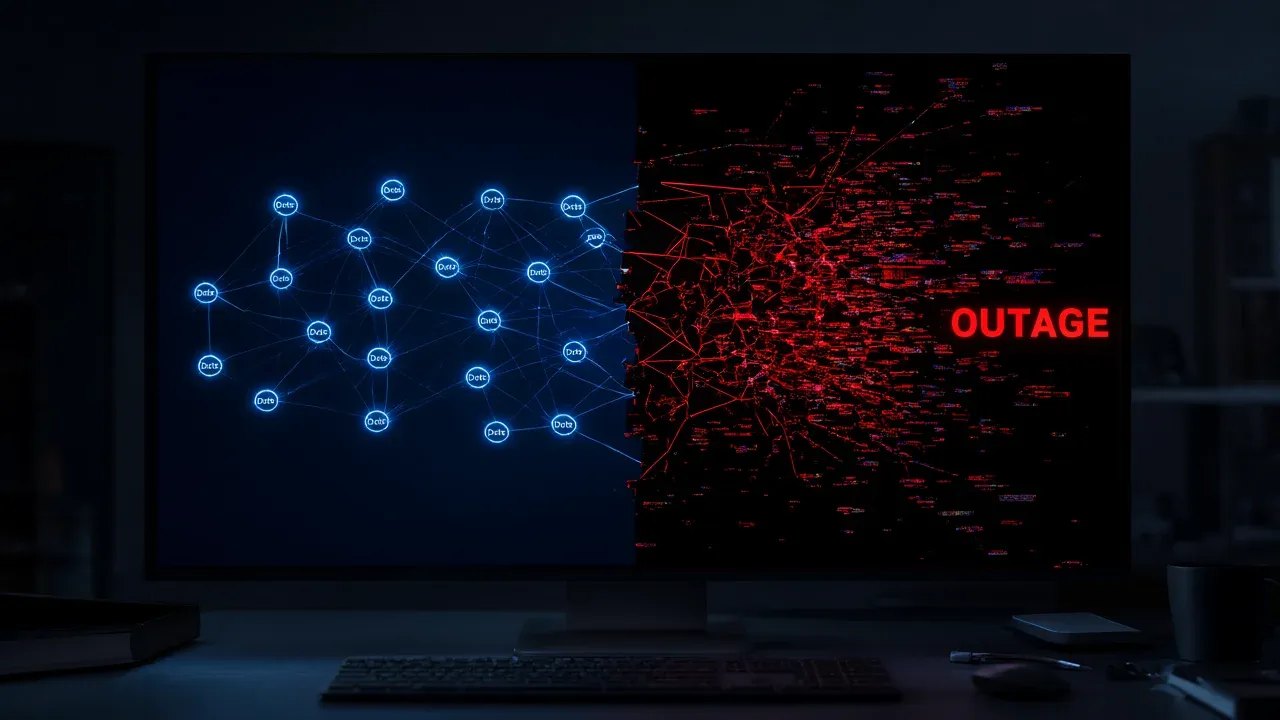
The Record. At OpenAI DevDay 2026 in San Francisco, the company unveiled "Dots," a product line described as remarkably capable, always-on agents designed to handle tasks autonomously across 4,000 applications [1]franksworld.comUnpacking OpenAI DevDay 2026: The Future of Dots and AI Versus Grok and JevOpenAI announced a product called "Dots" at DevDay 2026. Dots are described as "remarkably capable, always-on agents designed to handle tasks autonomously across 4,000 apps." The stated aim is to "streamline and automate daily routines."…Open source ↗. The stated aim is to streamline and automate daily routines, positioning Dots against existing agent platforms like Grok Bot and Hermes [1]franksworld.comUnpacking OpenAI DevDay 2026: The Future of Dots and AI Versus Grok and JevOpenAI announced a product called "Dots" at DevDay 2026. Dots are described as "remarkably capable, always-on agents designed to handle tasks autonomously across 4,000 apps." The stated aim is to "streamline and automate daily routines."…Open source ↗. Frank's World characterized this as one of the most intriguing announcements from DevDay, noting the explicit competitive framing [1]franksworld.comUnpacking OpenAI DevDay 2026: The Future of Dots and AI Versus Grok and JevOpenAI announced a product called "Dots" at DevDay 2026. Dots are described as "remarkably capable, always-on agents designed to handle tasks autonomously across 4,000 apps." The stated aim is to "streamline and automate daily routines."…Open source ↗. External commentary, including a YouTube video titled "openAI is coming for grok and Jev," suggests an intent to directly challenge these rivals [3]youtube.comopenAI is coming for grok and JevA YouTube video titled "openAI is coming for grok and Jev" suggests an intent to directly challenge competitors like Grok Bot and Hermes. The specific entity "Jev" is referenced in titles/snippets but lacks detailed functional definition…Open source ↗. However, this launch coincides with significant reliability concerns. On September 3, 2026, ChatGPT/Codex (OpenAI), Claude, and Grok experienced a simultaneous outage affecting many users [2]9to5mac.comAI outage: Claude, ChatGPT, and Grok are currently down for many users [U]On September 3, 2026, ChatGPT/Codex (OpenAI), Claude, and Grok experienced a simultaneous outage affecting many users. The service was reported as coming back online after approximately half an hour, though user experience varied ("Your…Open source ↗. The service was reported as coming back online after approximately half an hour, though user experience varied significantly during the recovery [2]9to5mac.comAI outage: Claude, ChatGPT, and Grok are currently down for many users [U]On September 3, 2026, ChatGPT/Codex (OpenAI), Claude, and Grok experienced a simultaneous outage affecting many users. The service was reported as coming back online after approximately half an hour, though user experience varied ("Your…Open source ↗.
The Analysis. The introduction of Dots relies heavily on the premise of "always-on" reliability, yet the September 3 outage demonstrates that even the largest providers are vulnerable to simultaneous systemic failures [1]franksworld.comUnpacking OpenAI DevDay 2026: The Future of Dots and AI Versus Grok and JevOpenAI announced a product called "Dots" at DevDay 2026. Dots are described as "remarkably capable, always-on agents designed to handle tasks autonomously across 4,000 apps." The stated aim is to "streamline and automate daily routines."…Open source ↗ [2]9to5mac.comAI outage: Claude, ChatGPT, and Grok are currently down for many users [U]On September 3, 2026, ChatGPT/Codex (OpenAI), Claude, and Grok experienced a simultaneous outage affecting many users. The service was reported as coming back online after approximately half an hour, though user experience varied ("Your…Open source ↗. This creates a fundamental contradiction in the value proposition: autonomous agents require consistent, low-latency access to central models to function effectively, but the underlying infrastructure has demonstrated fragility. The positioning of Dots against Grok Bot and Hermes highlights an intensifying competition for dominance in the agentic AI space [1]franksworld.comUnpacking OpenAI DevDay 2026: The Future of Dots and AI Versus Grok and JevOpenAI announced a product called "Dots" at DevDay 2026. Dots are described as "remarkably capable, always-on agents designed to handle tasks autonomously across 4,000 apps." The stated aim is to "streamline and automate daily routines."…Open source ↗. As platforms vie for user trust, the reliability of the core infrastructure becomes a critical differentiator. The outage suggests that the current architecture is not yet robust enough to support the widespread deployment of autonomous agents that depend on continuous connectivity without degradation or failure.
Compass Outlook. The market will closely monitor whether OpenAI can deliver on its "always-on" promise following the September 3 incident. Competitors will likely leverage this vulnerability in their own marketing, emphasizing stability as a key feature. The success of Dots will depend less on functional novelty and more on operational resilience.
Decision Window. Stakeholders should evaluate the risk exposure associated with integrating autonomous agents that rely on centralized cloud models. The reliability gap identified in the September 3 outage presents a tangible risk for mission-critical applications dependent on these services.
Compass Strategic Intelligence
Compass Strategic Intelligence
Compass Strategic Intelligence
Signal 2: Apple’s iOS 27 and the Shift to On-Device AI
The Record. Apple launched iOS 27, introducing new artificial intelligence features deeply integrated into Siri [4]eff.orgHey Siri, How Do I Limit AI Data Access? | EFFector 38.17Apple launched iOS 27 with new AI features integrated into Siri; the EFF published EFFector 38.17 addressing privacy complications regarding how AI tools handle user data in this ecosystem.Open source ↗. The Electronic Frontier Foundation (EFF) published EFFector 38.17 to address privacy complications arising from these AI phone features, specifically focusing on how these tools handle user data within the new ecosystem [4]eff.orgHey Siri, How Do I Limit AI Data Access? | EFFector 38.17Apple launched iOS 27 with new AI features integrated into Siri; the EFF published EFFector 38.17 addressing privacy complications regarding how AI tools handle user data in this ecosystem.Open source ↗. This release aligns with a broader industry trend identified by DB SoftTech in March 2026, which marked 2026 as a pivotal year for the shift toward local inference, or on-device AI, rather than cloud-based processing [6]dbsofttech.comOn-Device vs Cloud AI: 5 Powerful 2026 ShiftsIdentifies 2026 as a pivotal year for the shift toward local inference (on-device AI), driven by mobile privacy, speed, and performance, contextualizing the move away from purely cloud-based processing.Open source ↗. This shift is driven primarily by mobile privacy concerns, speed, and performance requirements [6]dbsofttech.comOn-Device vs Cloud AI: 5 Powerful 2026 ShiftsIdentifies 2026 as a pivotal year for the shift toward local inference (on-device AI), driven by mobile privacy, speed, and performance, contextualizing the move away from purely cloud-based processing.Open source ↗. DB SoftTech argues that on-device inference enhances privacy by keeping data local, reducing the reliance on external servers [6]dbsofttech.comOn-Device vs Cloud AI: 5 Powerful 2026 ShiftsIdentifies 2026 as a pivotal year for the shift toward local inference (on-device AI), driven by mobile privacy, speed, and performance, contextualizing the move away from purely cloud-based processing.Open source ↗. However, the EFF article indicates that despite this architectural shift, significant privacy complications remain regarding how AI tools like Siri manage data access in iOS 27 [4]eff.orgHey Siri, How Do I Limit AI Data Access? | EFFector 38.17Apple launched iOS 27 with new AI features integrated into Siri; the EFF published EFFector 38.17 addressing privacy complications regarding how AI tools handle user data in this ecosystem.Open source ↗. The temporal alignment shows that DB SoftTech's trend analysis preceded the realization of these trends in iOS 27 by several months [4]eff.orgHey Siri, How Do I Limit AI Data Access? | EFFector 38.17Apple launched iOS 27 with new AI features integrated into Siri; the EFF published EFFector 38.17 addressing privacy complications regarding how AI tools handle user data in this ecosystem.Open source ↗ [6]dbsofttech.comOn-Device vs Cloud AI: 5 Powerful 2026 ShiftsIdentifies 2026 as a pivotal year for the shift toward local inference (on-device AI), driven by mobile privacy, speed, and performance, contextualizing the move away from purely cloud-based processing.Open source ↗.
The Analysis. The launch of iOS 27 brings new AI features into Siri at a time when industry analysis points to on-device inference as a way to enhance privacy by keeping data local [6]dbsofttech.comOn-Device vs Cloud AI: 5 Powerful 2026 ShiftsIdentifies 2026 as a pivotal year for the shift toward local inference (on-device AI), driven by mobile privacy, speed, and performance, contextualizing the move away from purely cloud-based processing.Open source ↗. However, the EFF’s focus on limiting data access suggests that local processing alone does not fully resolve privacy concerns, as the operating system still requires mechanisms to manage how apps and services interact with user data [4]eff.orgHey Siri, How Do I Limit AI Data Access? | EFFector 38.17Apple launched iOS 27 with new AI features integrated into Siri; the EFF published EFFector 38.17 addressing privacy complications regarding how AI tools handle user data in this ecosystem.Open source ↗. The lack of detailed feature information from MacObserver highlights the opacity surrounding the specific implementation of these privacy controls [5]macobserver.comiOS 27 Apple Intelligence New FeaturesCovers news regarding iOS 27 and Apple Intelligence new features; however, the source content is truncated to metadata and script tags, providing no substantive feature details or claims.Open source ↗. The tension between enhanced privacy through local processing and the persistent need for data access by AI tools remains unresolved.
Compass Outlook. User adoption of iOS 27 will likely hinge on the effectiveness of the new privacy controls. If users perceive that on-device AI does not adequately protect their data, trust in the platform may erode. The industry is watching to see if Apple’s approach sets a standard for how other manufacturers handle the privacy implications of integrated AI.
Decision Window. Organizations relying on mobile AI integration must assess the compatibility of their systems with iOS 27’s new data handling protocols. The unresolved privacy complications identified by the EFF suggest that additional safeguards may be necessary to ensure compliance and user trust.
Compass Strategic Intelligence
Compass Strategic Intelligence

Signal 3: Federal Surveillance Aggregation vs. Municipal Autonomy
The Record. The Trump administration is utilizing the HIDTA anti-drug trafficking grant program to compel cities to funnel Automated License Plate Reader (ALPR) data into federal surveillance centers [7]ibtimes.co.ukTrump Administration Uses 1980s Anti-Drug Programme to Funnel Cities' Licence Plate Data for SurveillancePublic records and court documents indicate that US local licence plate camera data is being pooled through HIDTA and made available to other law enforcement agencies.Open source ↗. Public records and court documents indicate that US local license plate camera data is being pooled through this program and made available to other law enforcement agencies [7]ibtimes.co.ukTrump Administration Uses 1980s Anti-Drug Programme to Funnel Cities' Licence Plate Data for SurveillancePublic records and court documents indicate that US local licence plate camera data is being pooled through HIDTA and made available to other law enforcement agencies.Open source ↗. This federal push contrasts sharply with municipal resistance. Flock Safety’s network has surpassed 100,000 units, yet over 53 municipalities in 20 states have terminated or rejected contracts due to data-sharing violations and unauthorized federal access [8]stateofsurveillance.orgClass Action: Flock Shared California Plate Data With Feds 1.6Federal agencies including ICE, CBP, and FBI accessed San Francisco PD Flock cameras over 1.6 million times. Oxnard suspends cameras.Open source ↗. In San Francisco, federal agencies including ICE, CBP, and FBI accessed SFPD Flock cameras over 1.6 million times without proper authorization or warrants [8]stateofsurveillance.orgClass Action: Flock Shared California Plate Data With Feds 1.6Federal agencies including ICE, CBP, and FBI accessed San Francisco PD Flock cameras over 1.6 million times. Oxnard suspends cameras.Open source ↗. An audit of SFPD’s license plate reader system revealed hundreds of illegal searches by out-of-state and federal agencies, leading to the disabling of access [9]sfstandard.comAudit reveals hundreds of illegal searches of SFPD’s license plate reader systemThe latest disclosure comes after The Standard reported last year that outside agencies, including ICE, conducted more than 1.6 million searches. Access was disabled after a routine audit. No immigration or reproductive rights inquiries…Open source ↗. No immigration or reproductive rights inquiries were found in the specific audit reviewed, but the scale of unauthorized access remains significant [9]sfstandard.comAudit reveals hundreds of illegal searches of SFPD’s license plate reader systemThe latest disclosure comes after The Standard reported last year that outside agencies, including ICE, conducted more than 1.6 million searches. Access was disabled after a routine audit. No immigration or reproductive rights inquiries…Open source ↗.
The Analysis. The use of grant programs to mandate data sharing creates a coercive environment for municipalities, undermining local control over surveillance infrastructure. The discrepancy between federal intentions and municipal actions highlights a growing conflict over data sovereignty. The 1.6 million unauthorized accesses by federal agencies underscore the severity of the privacy violations, suggesting that existing legal frameworks are insufficient to prevent abuse [8]stateofsurveillance.orgClass Action: Flock Shared California Plate Data With Feds 1.6Federal agencies including ICE, CBP, and FBI accessed San Francisco PD Flock cameras over 1.6 million times. Oxnard suspends cameras.Open source ↗. The termination of contracts by numerous municipalities indicates a collective pushback against federal overreach, signaling a potential fragmentation in national surveillance capabilities if legal and ethical boundaries are not clarified.
Compass Outlook. The conflict between federal aggregation and municipal autonomy will likely intensify, leading to further legal challenges and policy revisions. The precedent set by SFPD’s audit may influence other cities to demand greater transparency and control over their data infrastructure.
Decision Window. Municipal leaders must evaluate the legal and ethical implications of continuing participation in federal surveillance networks. The risk of unauthorized access and subsequent liability is significant, requiring robust contractual safeguards and oversight mechanisms.
Compass Strategic Intelligence
Compass Strategic Intelligence
Compass Strategic Intelligence

Signal 4: Infrastructure Providers and AI-Generated Non-Consensual Intimate Imagery
The Record. A Lancaster University-led study titled "The Backbone of Abuse," published in the Journal of Online Trust and Safety, identified five technology providers dominating the infrastructure for sites hosting AI-generated non-consensual intimate imagery (NCII) [10]techxplore.comFive technology providers dominate infrastructure supporting nonconsensual AI 'deepfake pornography'TechXplore reported on the Lancaster University-led study titled 'The Backbone of Abuse,' noting it is the first attempt to identify key players facilitating the technological infrastructure for AI-NCII. The research, led by Sarah Morgan…Open source ↗. The study mapped 88 active sites distributing this content, with industry analysis indicating that 40 of the most visited deepfake pornography sites had more than 4 billion views combined [10]techxplore.comFive technology providers dominate infrastructure supporting nonconsensual AI 'deepfake pornography'TechXplore reported on the Lancaster University-led study titled 'The Backbone of Abuse,' noting it is the first attempt to identify key players facilitating the technological infrastructure for AI-NCII. The research, led by Sarah Morgan…Open source ↗. The dominant infrastructure providers identified include Cloudflare, Google, and Proton [11]scienmag.comResearchers Name the Infrastructure Firms Powering AI Deepfake PornographyScienMag confirmed the Lancaster University origin of the research published in the Journal of Online Trust and Safety, highlighting that identified firms enable the rapid spread of such content. The study identified five technology…Open source ↗. TechXplore characterized this research as the first attempt to identify and name key players facilitating the technological infrastructure for AI-NCII [10]techxplore.comFive technology providers dominate infrastructure supporting nonconsensual AI 'deepfake pornography'TechXplore reported on the Lancaster University-led study titled 'The Backbone of Abuse,' noting it is the first attempt to identify key players facilitating the technological infrastructure for AI-NCII. The research, led by Sarah Morgan…Open source ↗. The research was led by Sarah Morgan with co-authors Dr. Sophie Nightingale and Professor Hany Farid [10]techxplore.comFive technology providers dominate infrastructure supporting nonconsensual AI 'deepfake pornography'TechXplore reported on the Lancaster University-led study titled 'The Backbone of Abuse,' noting it is the first attempt to identify key players facilitating the technological infrastructure for AI-NCII. The research, led by Sarah Morgan…Open source ↗. UNICEF has warned that millions of children are having their images manipulated into sexualized content via generative AI, describing this as a fast-growing form of online abuse [12]globalissues.org'Deepfake Abuse Is Abuse': UNICEF Sounds Alarm as AI Fuels a New Global Child-Exploitation CrisisUNICEF sounds an alarm that millions of children are having their images manipulated into sexualized content via generative AI. This fuels a fast-growing form of online abuse. Without strong regulatory frameworks and cooperation between…Open source ↗. Without strong regulatory frameworks and cooperation between governments and tech platforms, the consequences could be devastating [12]globalissues.org'Deepfake Abuse Is Abuse': UNICEF Sounds Alarm as AI Fuels a New Global Child-Exploitation CrisisUNICEF sounds an alarm that millions of children are having their images manipulated into sexualized content via generative AI. This fuels a fast-growing form of online abuse. Without strong regulatory frameworks and cooperation between…Open source ↗.
The Analysis. The identification of major technology providers as enablers of AI-NCII highlights a critical vulnerability in the digital infrastructure ecosystem. The scale of the problem, evidenced by billions of views on dominant sites, suggests that current mitigation efforts are insufficient [10]techxplore.comFive technology providers dominate infrastructure supporting nonconsensual AI 'deepfake pornography'TechXplore reported on the Lancaster University-led study titled 'The Backbone of Abuse,' noting it is the first attempt to identify key players facilitating the technological infrastructure for AI-NCII. The research, led by Sarah Morgan…Open source ↗. The role of these providers is not necessarily malicious but rather structural, as they offer essential services that are exploited by bad actors. UNICEF’s warning underscores the human cost of this technological gap, particularly for minors [12]globalissues.org'Deepfake Abuse Is Abuse': UNICEF Sounds Alarm as AI Fuels a New Global Child-Exploitation CrisisUNICEF sounds an alarm that millions of children are having their images manipulated into sexualized content via generative AI. This fuels a fast-growing form of online abuse. Without strong regulatory frameworks and cooperation between…Open source ↗. The lack of strong regulatory frameworks exacerbates the issue, leaving victims with limited recourse and platforms with minimal incentive to proactively combat abuse.
Compass Outlook. Regulatory pressure on infrastructure providers will likely increase, forcing them to adopt more stringent content moderation and verification protocols. The industry may see a shift toward specialized tools for detecting AI-generated NCII, as current general-purpose systems prove inadequate.
Decision Window. Technology providers must assess their liability exposure regarding the hosting of abusive content. Proactive engagement with regulatory bodies and victim support organizations is essential to mitigate reputational and legal risks associated with facilitating such infrastructure.
Compass Strategic Intelligence
Compass Strategic Intelligence

Signal 5: OpenAI’s IPO Delay and Strategic Safety Prioritization
The Record. OpenAI CEO Sam Altman announced the delay of the company's Initial Public Offering (IPO) to focus on AI safety, stating that going public in 2026 would be ill-advised or ill-timed [13]msn.comOpenAI delays IPO amid AI safety concernsReports place the announcement of the IPO delay at or near OpenAI DevDay in San Francisco (September 2026).Open source ↗. The IPO is now targeted for 2027 or later, indicating a significant shift in financial strategy [14]techjournal.orgOpenAI Delays IPO to 2027 Over AI Safety ConcernsOpenAI will not go public in 2026; the IPO is now targeted for 2027 or later.Open source ↗. This announcement was made around OpenAI DevDay in San Francisco in September 2026 [15]analyticsinsight.netOpenAI IPO Delayed Over AI Safety Concerns: Sam AltmanThe decision reflects a strategic shift where OpenAI prioritizes developing "stronger AI safety assurances" before pursuing a public listing.Open source ↗. The decision reflects a strategic shift where OpenAI prioritizes developing stronger AI safety assurances before pursuing a public listing [15]analyticsinsight.netOpenAI IPO Delayed Over AI Safety Concerns: Sam AltmanThe decision reflects a strategic shift where OpenAI prioritizes developing "stronger AI safety assurances" before pursuing a public listing.Open source ↗. Reports place the announcement at or near the DevDay event, aligning the financial strategy with the product launch of Dots [13]msn.comOpenAI delays IPO amid AI safety concernsReports place the announcement of the IPO delay at or near OpenAI DevDay in San Francisco (September 2026).Open source ↗.
The Analysis. The delay of the IPO signals a recognition that public market pressures may conflict with the long-term goals of AI safety. By postponing the listing, OpenAI is prioritizing the development of stronger AI safety assurances before pursuing a public listing [15]analyticsinsight.netOpenAI IPO Delayed Over AI Safety Concerns: Sam AltmanThe decision reflects a strategic shift where OpenAI prioritizes developing "stronger AI safety assurances" before pursuing a public listing.Open source ↗. This move contrasts with the aggressive product expansion seen in the Dots announcement, suggesting a balancing act between innovation and risk management. The timing of the announcement alongside DevDay indicates an effort to reassure stakeholders that safety is integral to the company’s future value proposition.
Compass Outlook. The delayed IPO will impact investor expectations and market dynamics for AI companies. Competitors may use this delay to highlight their own readiness for public markets, while OpenAI focuses on building a safety narrative. The industry will watch for subsequent regulatory developments that may influence the timing of future listings.
Decision Window. Investors and stakeholders must adjust their financial models to account for the extended timeline to liquidity. The strategic emphasis on safety suggests that OpenAI’s valuation will be heavily influenced by its ability to demonstrate robust risk mitigation capabilities in the coming years.
Compass Strategic Intelligence
Compass Strategic Intelligence
Compass Strategic Intelligence

Closing Outlook
These five signals leave readers watching next for the resolution of tensions between centralization and decentralization, reliability and ambition, and profit and safety. The market will observe whether autonomous agents can overcome infrastructure fragility, if on-device AI can satisfy privacy demands, how municipal autonomy withstands federal aggregation, what regulatory actions target digital abuse infrastructure, and how OpenAI’s delayed IPO reshapes competitive dynamics. No new thesis is added; the focus remains on monitoring these intersecting developments for their impact on strategic positioning and risk management in the AI sector.