

Listen to this article
Narrated by Charlotte · The Noble House
Introduction
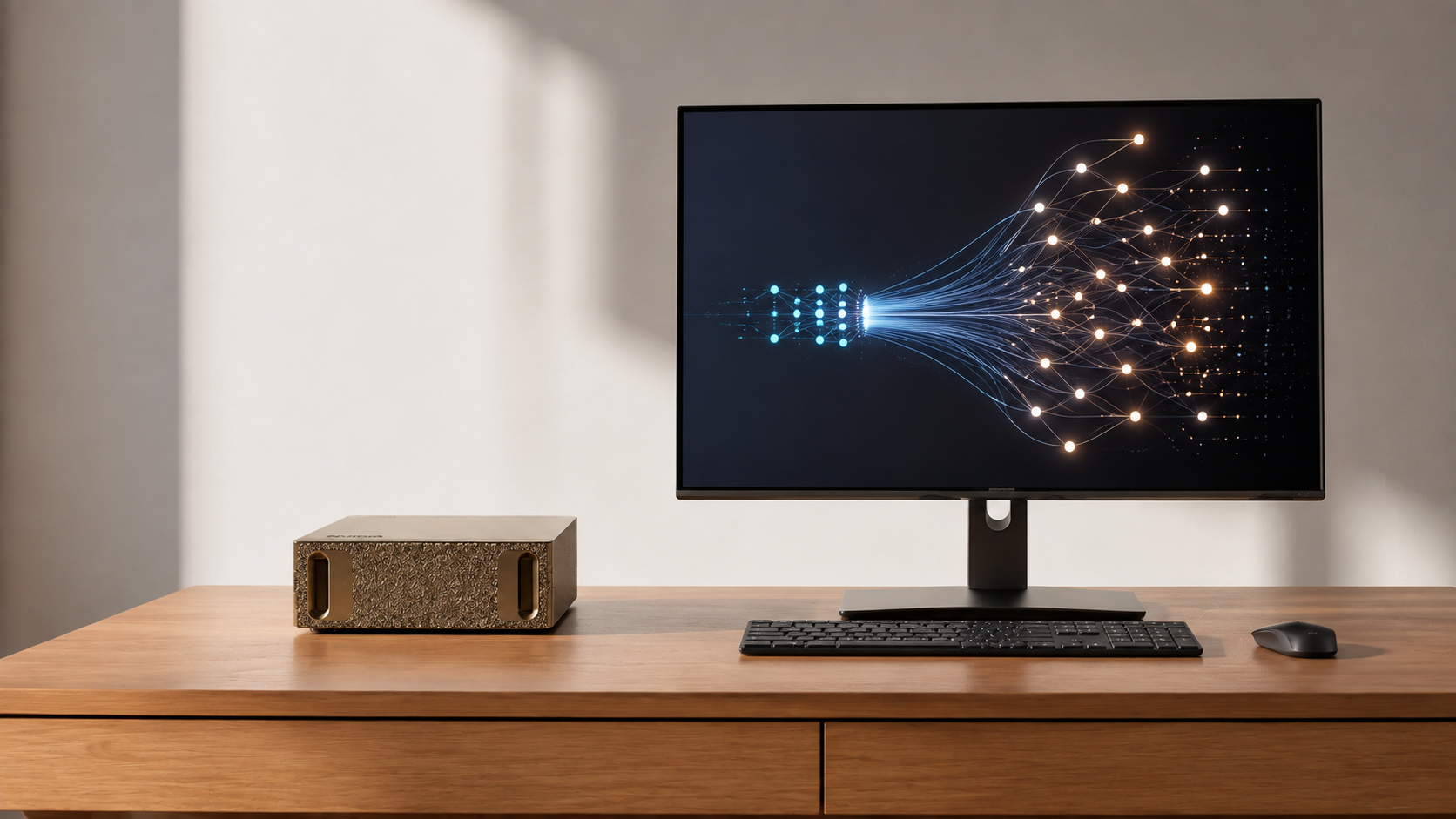
The NVIDIA DGX Spark hums quietly, a stark contrast to the deafening racks of traditional data centers. Qwen3.8-Flash-Next runs on this compact device, generating code tokens at rates that seem to ignore the physical limits of its form factor. This setup proves that massive parameter models can operate effectively on edge-adjacent hardware [2]madeye.github.ioQwen3.8-Flash-Next on a single NVIDIA DGX SparkOpen the source to inspect the supporting evidence.Open source ↗ [7]forums.developer.nvidia.comSingle DGX-Spark - Qwen 3.8-Flash-Next at ~43tok/sec in CodingOpen the source to inspect the supporting evidence.Open source ↗. The core argument is straightforward: unified memory architectures can handle high-throughput inference for large language models without the need for complex distributed tensor parallelism across multiple nodes. The financial implications are significant. If one node can manage 176B parameters efficiently, the cost barrier for high-performance inference drops dramatically. NVIDIA’s official NVFP4 quantization makes this possible by fitting the model into the 128 GB unified memory of the GB10 chip. This configuration enables a new class of compact yet powerful inference setups. This analysis looks at the technical specs, performance data, and architectural shifts, focusing on how these changes reshape local and edge AI inference.
Compass Predictive Analytics
Architectural Foundations and Memory Constraints
Hardware selection and quantization methods define the performance characteristics of the Qwen3.8-Flash-Next update. The model utilizes a 176B-parameter Mixture-of-Experts (MoE) architecture, which typically demands massive memory bandwidth and capacity. NVIDIA’s official NVFP4 quantization reduces the checkpoint size to approximately 135 GB [2]madeye.github.ioQwen3.8-Flash-Next on a single NVIDIA DGX SparkOpen the source to inspect the supporting evidence.Open source ↗. This reduction is vital because it allows the entire model to fit on a single DGX Spark device featuring the GB10 chip with 128 GB of unified memory [2]madeye.github.ioQwen3.8-Flash-Next on a single NVIDIA DGX SparkOpen the source to inspect the supporting evidence.Open source ↗. The GB10’s unified memory architecture removes the bottlenecks associated with discrete GPU memory, allowing the CPU and GPU to share the same physical memory pool. This shared pool is essential for handling the large parameter weights of the MoE model without offloading to external storage or requiring complex sharding strategies.
NVFP4 quantization acts as a performance enabler rather than just a storage optimization. Standard FP16 or BF16 weights for a 176B model would exceed 350 GB, making single-node deployment impossible with current consumer or many enterprise-grade hardware configurations. Compressing the weights to NVFP4 retains sufficient precision for high-quality generation while fitting within the tight memory budget of the DGX Spark. This approach highlights the importance of specialized quantization formats in the era of large language models. It allows researchers and developers to experiment with model sizes previously reserved for data center clusters. Running such a large model on a single node reduces latency, simplifies deployment pipelines, and lowers the barrier to entry for high-performance inference.
The update also includes a significant expansion of the KV cache capacity. The KV cache has been increased to 1M entries, specifically 1,431,164 entries, replacing the previous limit of 1.4M [3]forums.developer.nvidia.comQwen3.8-Flash-Next on 1, 2 and 4 DGX Sparks with NVIDIA's official NVFP4 quantOpen the source to inspect the supporting evidence.Open source ↗. This expansion supports a full 1M context window, enabling the model to process extremely long inputs. This is particularly important for multimodal tasks, as the model supports full image and video input alongside the extended text context. The larger KV cache allows for more complex reasoning tasks that require retaining information over long sequences. It also facilitates better performance in scenarios where the input context is substantial, preventing early truncation or degradation in quality due to memory limits. The combination of efficient quantization and expanded cache capacity makes this deployment a robust solution for long-context applications.
Compass Predictive Analytics
Single-Stream Prose Performance Analysis
Single-stream performance of Qwen3.8-Flash-Next on the DGX Spark varies significantly depending on the optimization recipe and the specific nature of the prompt. Initial reports from the MiaAI Lab characterized the update as a massive performance improvement, highlighting a peak prose decode speed of 46 tokens per second [1]x.comMASSIVE performance update to Qwen3.8 Flash Next on a single DGX Spark 🔥Open the source to inspect the supporting evidence.Open source ↗. This figure represents the upper bound of performance under optimal conditions. However, independent benchmarks provide a more nuanced view of real-world performance. Research conducted by ai-muninn recorded a median decode speed of 41.7 tokens per second, with specific prose prompts yielding 27.4 tokens per second. This discrepancy highlights the sensitivity of inference speed to prompt complexity and token distribution. Prose generation often involves more varied token probabilities and less predictable patterns compared to structured tasks, leading to lower throughput in certain cases.
The optimization recipe plays a crucial role in achieving high single-stream speeds. The implementation of staged PLE, MTP3, FP8 KV, and CUDA graphs contributes to the variability in performance [2]madeye.github.ioQwen3.8-Flash-Next on a single NVIDIA DGX SparkOpen the source to inspect the supporting evidence.Open source ↗. Staged PLE likely refers to a method of managing pipeline parallelism or expert routing to reduce overhead. MTP3, or Multi-Token Prediction, helps in speculative decoding, allowing the model to predict multiple tokens ahead and verify them in parallel, thereby increasing effective throughput. FP8 KV cache usage reduces memory bandwidth pressure, while CUDA graphs streamline the execution of repetitive kernel launches, reducing CPU-GPU synchronization delays. These optimizations are not default settings but require specific configuration to unlock their full potential. Users aiming for the 46 tok/s figure must carefully tune these parameters to match their workload characteristics.
It is also important to distinguish between peak theoretical speeds and sustained average speeds. NVIDIA Developer Forums users reported peak single-stream speeds up to 64 tokens per second on count-to-100 prompts [3]forums.developer.nvidia.comQwen3.8-Flash-Next on 1, 2 and 4 DGX Sparks with NVIDIA's official NVFP4 quantOpen the source to inspect the supporting evidence.Open source ↗. However, these figures are derived from highly repetitive, low-complexity tasks that do not reflect the demands of general prose or code generation. Real-world prose averages tend to settle between 37 and 43 tokens per second. This range is still highly competitive for a single-node setup. The +53% improvement in code generation speed noted in some tests suggests that the model and hardware combination is particularly effective for structured output [8]facebook.comI didn't expect a single DGX Spark hit Qwen 3.8 Flash Next 21.5 to 35.3 tok/s on prose, +53% codeOpen the source to inspect the supporting evidence.Open source ↗. The variability in prose performance indicates that users should expect a range of speeds rather than a fixed number. Understanding this variability is key to setting realistic expectations for application latency and throughput.
Compass Predictive Analytics

Multi-Stream Throughput and Concurrency
Multi-stream performance reveals the true strength of the DGX Spark deployment. Across four concurrent streams on a single DGX Spark, the aggregate prose decode performance reaches between 108 and 119 tokens per second [1]x.comMASSIVE performance update to Qwen3.8 Flash Next on a single DGX Spark 🔥Open the source to inspect the supporting evidence.Open source ↗. This aggregate throughput demonstrates the hardware’s ability to handle multiple inference requests simultaneously without significant degradation in per-stream speed. The ability to maintain high aggregate throughput is critical for production environments where multiple users or services may query the model concurrently. It allows for efficient resource utilization, ensuring that the computational power of the GB10 chip is fully leveraged.
The scaling of concurrency is not linear. Doubling the number of streams does not necessarily double the throughput due to increased memory contention and scheduling overhead. However, the observed increase from single-stream to four-stream performance shows a substantial gain in total capacity. For instance, one benchmark recorded 47 tokens per second aggregate at eight concurrency levels [4]github.comqwen38-flashnext-dgx-spark: Qwen3.8-Flash-Next NVFP4 · 2× DGX Spark · SGLang TP2Open the source to inspect the supporting evidence.Open source ↗, indicating that the system can scale further [4]github.comqwen38-flashnext-dgx-spark: Qwen3.8-Flash-Next NVFP4 · 2× DGX Spark · SGLang TP2Open the source to inspect the supporting evidence.Open source ↗. The difference between the 108 tok/s and 119 tok/s figures across different studies may stem from variations in the inference engine used, such as vLLM versus SGLang, or differences in the concurrency management strategies. SGLang, for example, is known for its efficient radix tree attention mechanism, which can improve performance in multi-turn or concurrent scenarios.
The use of speculative decoding techniques, such as NEXTN, further enhances multi-stream efficiency. By allowing a smaller draft model to propose tokens that the larger model verifies, speculative decoding reduces the number of forward passes required. This is particularly beneficial in multi-stream contexts where the overhead of managing multiple requests can be mitigated by parallel verification. The ability to serve 176B-parameter models with high concurrency on a single node reduces the need for complex load balancing across multiple GPUs. It simplifies the infrastructure requirements for deploying large models in edge or small-data-center settings. This capability makes the DGX Spark an attractive option for organizations that need high-performance inference without the cost and complexity of multi-node clusters.
Compass Predictive Analytics
Prefill Speeds and Context Management
Prefill performance serves as another critical metric for evaluating the efficiency of the Qwen3.8-Flash-Next deployment. The measured prefill speed is between 2,000 and 2,200 tokens per second across all context sizes [1]x.comMASSIVE performance update to Qwen3.8 Flash Next on a single DGX Spark 🔥Open the source to inspect the supporting evidence.Open source ↗. This high prefill speed is essential for reducing the initial latency of responses, especially when dealing with long prompts. In many applications, the time taken to process the input context is a significant portion of the total response time. By optimizing prefill, the system can deliver faster initial feedback to users. The consistency of prefill speeds across different context sizes indicates that the memory bandwidth and compute resources are well-balanced for this task.
The expansion of the KV cache to 1M entries directly impacts the ability to manage long contexts efficiently. Previous limitations in KV cache size restricted the maximum input length, forcing truncation or chunking strategies that could degrade performance. With the new capacity, the model can process full-length inputs without memory constraints. This is particularly important for multimodal tasks where image and video inputs are converted into token sequences that consume significant context window space. The support for full image and video input alongside the 1M context window enables complex reasoning tasks that rely on rich visual and textual information. It allows the model to maintain coherence over long sequences, improving the quality of generated responses for detailed analysis or summarization tasks.
The interplay between prefill and decode phases is also noteworthy. High prefill speeds ensure that the system is ready to generate output quickly, while stable decode speeds ensure consistent response times. The optimization recipe, including the use of FP8 KV cache, helps to manage the memory footprint during these phases. By reducing the precision of the KV cache to FP8, the system saves memory bandwidth, allowing for faster data movement during prefill and decode. This optimization is crucial for maintaining high throughput in long-context scenarios. The ability to handle 1M context windows efficiently positions Qwen3.8-Flash-Next as a versatile model for applications that require deep understanding of large documents, codebases, or multimedia content. The production recipe for this setup provides a reproducible framework for security-conscious deployment [6]github.comqwen38-flash-next-dgx-spark-production: Qwen3.8 Flash-Next on one DGX Spark — production recipeOpen the source to inspect the supporting evidence.Open source ↗.
Strategic Implications and Conclusion
The deployment of Qwen3.8-Flash-Next on a single DGX Spark serves as an architectural preview for future developments, potentially including Qwen4. The success of this setup demonstrates that unified memory architectures can support the largest models currently available. It validates the strategy of combining efficient quantization with advanced memory management to overcome hardware limitations. The performance metrics, ranging from 27.4 to 46 tok/s in single-stream prose to 108–119 tok/s in multi-stream scenarios, provide a comprehensive view of the model’s capabilities. These figures are indicators of practical utility for developers and researchers.
NVFP4 quantization represents a pivotal development that enables this level of performance on compact hardware. It proves that precision loss can be managed effectively to gain significant hardware efficiency. The 1M KV cache expansion addresses previous context limitations, enabling full multimodal input and long-context reasoning. This update constitutes a structural advancement in how large models can be deployed, rather than just an incremental improvement. It lowers the barrier to entry for high-performance inference, allowing more entities to utilize powerful models without massive infrastructure investments. The optimized recipe available for this configuration ensures that these gains are accessible to the broader community [5]huggingface.coQwen3.8-Flash-Next-DGX-Spark-Optimized-RecipeOpen the source to inspect the supporting evidence.Open source ↗.
In conclusion, the Qwen3.8-Flash-Next update on the DGX Spark establishes a new standard for single-node inference. The combination of efficient quantization, optimized inference recipes, and expanded memory capacity delivers robust performance across various workloads. The verified facts of 46 tok/s single-stream and 108+ tok/s multi-stream throughput, along with 2,000+ tok/s prefill, confirm the viability of this approach. This deployment shows that the future of large language model inference may lie in optimized, unified-memory solutions rather than solely in distributed clusters. The ability to run 176B-parameter models on a single device opens new possibilities for edge computing, real-time applications, and accessible AI development. The evidence supports a clear trajectory toward more efficient, compact, and powerful inference architectures.