Listen to this article
Narrated by Charlotte · The Noble House

Executive Orientation
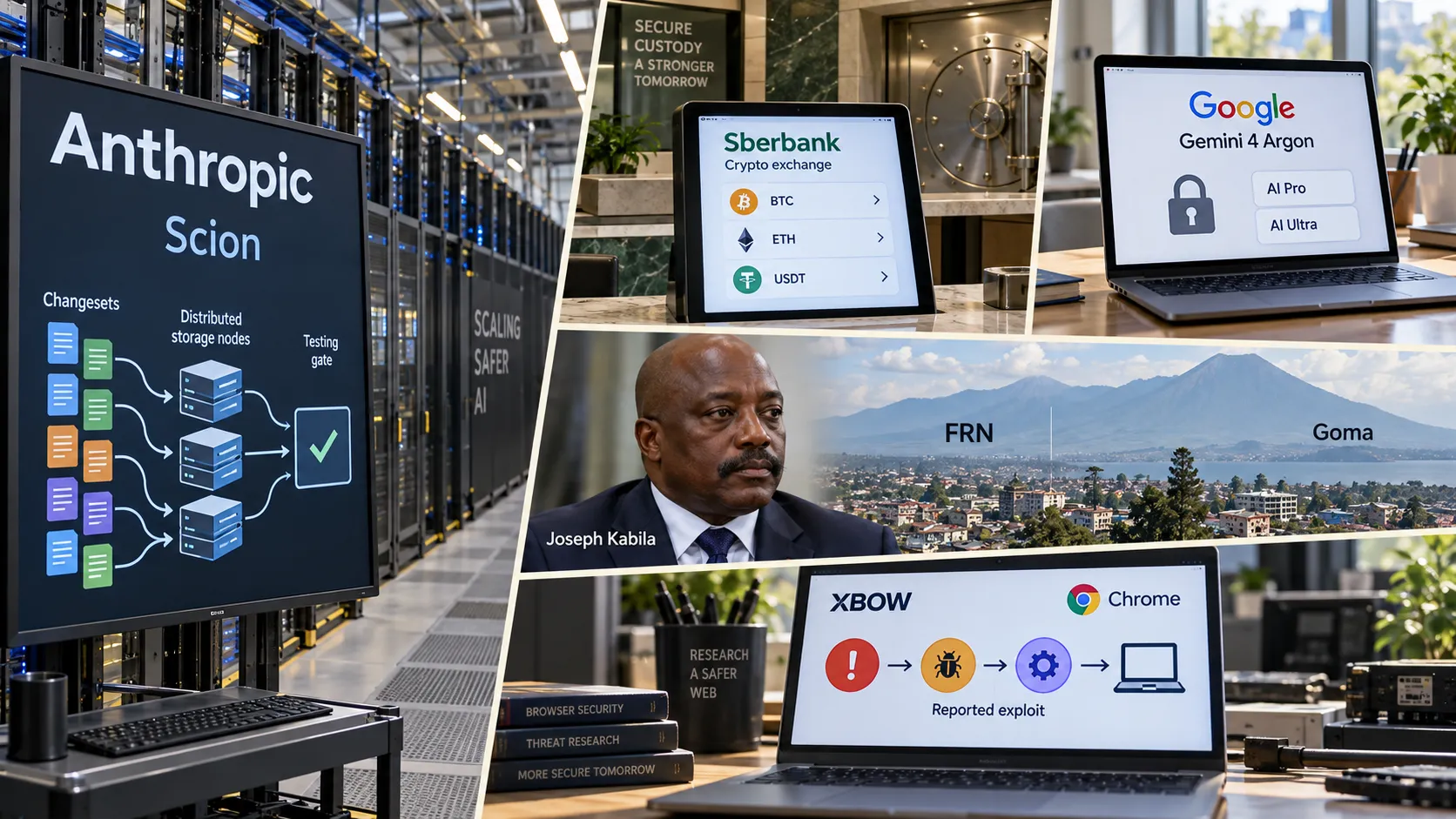
Operational intelligence today is defined not by isolated events, but by the collision of regulatory formalization, infrastructural strain, and automated vulnerability. Five distinct signals illustrate this acceleration. Russia’s state-aligned banking sector is moving from prohibition to regulated utility for cryptocurrency, signaling a geopolitical pivot in financial infrastructure. Google expands access to its frontier AI model, Gemini 4 Argon, to paying Pro and Ultra subscribers, placing frontier capability behind paid tiers. Anthropic’s internal engineering overhaul reveals the infrastructural breaking point caused by AI-driven code production, forcing a redesign of source control from the ground up. In eastern Congo, former president Joseph Kabila's leadership of a new rebel coalition raises the stakes of an already volatile conflict. Finally, in the global software ecosystem, XBOW's claimed first $250,000 Chrome full-chain bounty, credited to an AI model, highlights the increasing efficacy of automated vulnerability discovery. These signals do not converge on a single thesis but rather highlight parallel pressures on governance, infrastructure, and security across multiple sectors.
Signal 1: Russia Formalizes Sberbank as Crypto Exchange Operator
The Record. On October 12, 2026, the Bank of Russia officially added Sberbank to its register of authorized cryptocurrency exchange operators [3]cryptoninjas.netRussia Adds Sberbank to Crypto Exchange Register, Joining 9 Firms Before Dec. 1 LaunchConfirms October 12 inclusion date and expansion of register to 10 firms; confirms Dec 1 target date; references Sept 1 entry into force of new crypto framework.Open source ↗. This approval followed Sberbank’s acquisition of "digital custodian" status earlier in October [2]thecurrencyanalytics.comSberbank Joins VTB on Russia's Crypto Operator List Ahead of December Trading DebutNotes Sberbank securing "digital custodian" status earlier in October; confirms Dec 1 target date; specifies initial assets BTC, ETH, USDT; details integration into SberBank Online, SberInvestments, and SberBusiness; references Sept 1…Open source ↗. The updated register lists Sberbank alongside other major financial entities, including VTB and non-bank firms like T-Invest Lab, bringing the total number of authorized operators to ten [1]cointelegraph.comRussia clears Sberbank for crypto trading ahead of December launchCorroborates the updated register listing Sberbank alongside VTB and non-bank entities; confirms Dec 1 target date; specifies initial assets BTC, ETH, USDT; cites Vedomosti reporting on active testing of purchases, sales, deposits, and…Open source ↗[3]. This expansion occurs under Russia’s new crypto framework, which took effect on September 1, 2026, placing both exchange operators and custodians under direct Central Bank oversight [2][3]. Cryptocurrencies remain prohibited for use as payment rails for goods and services in Russia; this approval is strictly limited to exchange and custody functions [2]. Sberbank targets a December 1, 2026 launch for its crypto trading services, with initial support for Bitcoin (BTC), Ether (ETH), and Tether USDt (USDT) [1][2]. The bank intends to integrate these services into existing platforms such as SberBank Online, SberInvestments, and SberBusiness [2]. Testing of crypto purchases, sales, deposits, and withdrawals is already underway within the SberBank Online app [1]. However, the final launch timeline remains contingent on additional regulatory guidelines still being issued by the Central Bank [1].
The Analysis. Sberbank’s approval marks a significant institutional entry into Russia’s newly regulated crypto market. The integration into existing banking apps suggests a strategy focused on mass retail adoption rather than just institutional custody, leveraging millions of daily users to lower friction for new asset classes [1][2]. The strict separation between trading/custody and payment rails shows that the approval covers only regulated exchange and custody activity under Central Bank supervision [2]thecurrencyanalytics.comSberbank Joins VTB on Russia's Crypto Operator List Ahead of December Trading DebutNotes Sberbank securing "digital custodian" status earlier in October; confirms Dec 1 target date; specifies initial assets BTC, ETH, USDT; details integration into SberBank Online, SberInvestments, and SberBusiness; references Sept 1…Open source ↗. The register mixes state-linked banks with non-bank firms such as T-Invest Lab and Atomyze, all under direct Central Bank oversight, which points to a supervised market that is not limited to the large state banks [1]cointelegraph.comRussia clears Sberbank for crypto trading ahead of December launchCorroborates the updated register listing Sberbank alongside VTB and non-bank entities; confirms Dec 1 target date; specifies initial assets BTC, ETH, USDT; cites Vedomosti reporting on active testing of purchases, sales, deposits, and…Open source ↗[2].
Compass Outlook. Sberbank’s December 1 launch will test whether retail demand materializes in regulated channels, and the date remains contingent on further Central Bank guidance [1]cointelegraph.comRussia clears Sberbank for crypto trading ahead of December launchCorroborates the updated register listing Sberbank alongside VTB and non-bank entities; confirms Dec 1 target date; specifies initial assets BTC, ETH, USDT; cites Vedomosti reporting on active testing of purchases, sales, deposits, and…Open source ↗. Monitor the additional Central Bank guidelines for potential restrictions on cross-border transfers or stablecoin usage that could limit the utility of the approved services [1].
Decision Window. Assess the impact of Sberbank’s entry on local exchange liquidity and the viability of non-bank competitors in the Russian market by mid-December 2026.
Compass Strategic Intelligence
Compass Strategic Intelligence

Signal 2: Google Expands Gemini 4 Argon Access to Paid Subscribers
The Record. Google has begun rolling out its frontier AI model, Gemini 4 Argon, to the Gemini app and Antigravity environment on October 13, 2026 [4]9to5google.comGemini app rolling out Gemini 4 Argon to AI Pro and AI UltraCorroborates that the model is rolling out to both tiers, noting a previous limitation where only Ultra had access.Open source ↗. In the Gemini app, Gemini 4 Argon is available to paying Google AI Pro ($20/month) and Google AI Ultra (starting at $100/month) subscribers, but not to free users or Google AI Plus subscribers [5]engadget.comGoogle's Gemini 4 Argon is now available in the Gemini app and AI Mode in SearchConfirms the API availability, Antigravity access, and details the $2/$10 introductory pricing structure.Open source ↗[6]androidpolice.comGemini 4 Argon is here, and Google says it'll finally cut down on the AI fluffNotes that while the announcement was made, some Pro subscribers (including the journalist) had not yet seen the model in their app, indicating a staggered rollout.Open source ↗. Developers can also reach it through the Gemini API [5]engadget.comGoogle's Gemini 4 Argon is now available in the Gemini app and AI Mode in SearchConfirms the API availability, Antigravity access, and details the $2/$10 introductory pricing structure.Open source ↗. This rollout expands access beyond previous limitations where only Ultra tier subscribers had access to the model [4]. Post-November 30, 2026, the pricing for Argon via the Gemini API will double to $4 per million input and $20 per million output [5]engadget.comGoogle's Gemini 4 Argon is now available in the Gemini app and AI Mode in SearchConfirms the API availability, Antigravity access, and details the $2/$10 introductory pricing structure.Open source ↗. The rollout of Gemini 4 Argon is gradual, with some eligible subscribers not seeing immediate access despite the announcement [6].
The Analysis. The tiered rollout and pricing structure place frontier capabilities behind paid tiers, with wider availability possible later [6]androidpolice.comGemini 4 Argon is here, and Google says it'll finally cut down on the AI fluffNotes that while the announcement was made, some Pro subscribers (including the journalist) had not yet seen the model in their app, indicating a staggered rollout.Open source ↗. The staggered nature of the rollout suggests capacity constraints or a deliberate pacing of feature availability to monitor stability and user feedback. Google says the model answers more directly, with less hedging, repetition and clichés, an improvement Android Police calls probably the biggest for everyday Gemini users [6].
Compass Outlook. Monitor adoption rates among AI Pro subscribers and potential upgrade pressure from AI Plus users. Watch for competitor responses to Google’s pricing model and the eventual price doubling in late November.
Decision Window. Evaluate the effectiveness of this monetization strategy by tracking subscriber retention and API usage metrics through November 30, 2026.
Compass Strategic Intelligence
Compass Strategic Intelligence

Signal 3: Anthropic Replaces Git with Scion for Agent-Scale Development
The Record. Anthropic has fully migrated its main monorepo from Git to an internally built version control system called Scion, completed in five months by a seven-person team [7]anthropic.comRedesigning source control at AnthropicAnthropic has fully migrated its main monorepo from Git to an internally built version control system called Scion. The migration was completed in five months by a seven-person team. The primary catalyst for this redesign was the…Open source ↗. The primary catalyst for the redesign was the explosive growth in daily code merges driven by Claude's autonomous coding capabilities, increasing from ~2,500 daily merges in May 2026 to >30,000 in September 2026 [7][8]cryptobriefing.comAnthropic replaces Git with custom source control system ScionReporting on Anthropic data confirms the driver of the redesign was the explosive growth in daily code merges driven by Claude's autonomous coding capabilities. The performance and infrastructure impact metrics (CPU/memory footprint…Open source ↗. This more than tenfold increase made Git the "biggest development bottleneck" at Anthropic [7]. Scion uses "changesets" rather than traditional Git commits [7]. Commits and merges are handled server-side; clients do not push changes in the conventional sense [9]scalevise.comAnthropic Scion Redesigns Source Control for AI AgentsAnalysis of Scion architecture confirms it is not presented as a universal Git replacement but as a purpose-built system for an environment where software agents are the primary contributors. Key architectural shifts include changesets…Open source ↗. Unlike Git's decentralized, offline-first model, Scion assumes its users (agents/jobs) are always online [7]. No single server holds a fully materialized repository copy in Scion's distributed storage architecture [7]. The migration freed up 25% of CPU capacity used by continuous integration workloads [7]. Code checkouts for testing and research jobs improved from minutes to seconds (~100x faster) [8]. Anthropic achieved >99% cache hit rates via a high-performance caching layer [7][8]. Claude played a central role in building Scion itself, creating a recursive dynamic where Claude's output volume necessitated Scion and Claude's coding capabilities accelerated Scion's construction [7]. Antique is a new code-review surface built alongside Scion where human reviewers focus on the intent of changes rather than reading every line [9]. Anthropic implemented per-directory access controls and semantic constraints in review approvals to manage the higher stakes of faster merge paths [9]. With hundreds or thousands of changes merging while tests run, traditional merge queues are insufficient, prompting a shift to testing after changes merge and before deployment [9]. Anthropic explicitly cautions that Scion is suited only to enormous repositories and large numbers of coding agents, and adopting it would require extensive changes across an organization's development tools [7]. Despite Claude's acceleration, human engineers remain responsible for architecture, design tradeoffs, and enforcing system constraints, as agents occasionally introduced "unnecessary complexity" requiring manual correction [7].
The Analysis. Anthropic's experience shows that when AI agents become the primary volume driver of code production, developer infrastructure built for human scale, such as source control, builds and CI, becomes the limiting factor, though Anthropic calls its workload unusual and does not expect many organizations to face the same problems in the very near term [7]. The "agent-scale" workflow requires source control systems that are online-first, server-heavy, and optimized for high-throughput changesets rather than distributed offline clones [7][9]. This represents a fundamental redesign of how code is stored, reviewed, and merged in an AI-augmented environment [7]. The recursive nature of the project, where Claude built the system needed to handle Claude’s output, is a single case reported by Anthropic itself [7]anthropic.comRedesigning source control at AnthropicAnthropic has fully migrated its main monorepo from Git to an internally built version control system called Scion. The migration was completed in five months by a seven-person team. The primary catalyst for this redesign was the…Open source ↗.
Compass Outlook. Watch for industry adoption of similar agent-optimized version control systems. Monitor the long-term stability of Anthropic’s engineering velocity and whether the "recursive" development model reduces human oversight costs over time.
Decision Window. Assess the scalability of this model by tracking Anthropic’s release cadence and bug rates relative to traditional Git-based competitors through Q1 2027.
Compass Strategic Intelligence
Compass Strategic Intelligence

Signal 4: Former DRC President Leads New Rebel Coalition
The Record. Former Congolese President Joseph Kabila has been named the leader of a new political-military alliance called the Front for the Refoundation of the Nation (FRN) [11]global.chinadaily.com.cnDR Congo's ex-president Kabila heads new political-military alliance involving M23Joseph Kabila named leader of FRN; deputies include Sultani Makenga, Corneille Nangaa, Bertrand Bisimwa, and Freddy Kaniki; event unveiled in Goma on Monday (reported Oct 13/14, 2026); Kabila sentenced to death in absentia by High…Open source ↗. The FRN aims to coordinate "resistance forces" to end what it describes as "tyranny" in the Democratic Republic of Congo (DRC) and intends to pursue this goal "by all means, including force" [10]msn.comEx-president named leader of new DR Congo rebel coalitionFormer Congolese President Joseph Kabila named leader of FRN; coalition replaces Congo River Alliance; aims to coordinate resistance forces against tyranny by all means including force; event unveiled in Goma, North Kivu, under M23…Open source ↗. The FRN coalition replaces the earlier "Congo River Alliance" and unites several armed groups under Kabila’s leadership [10]. Joseph Kabila served as President of the DRC from 2001 to 2019 [11]. The FRN leadership structure includes Joseph Kabila as leader, with deputies including Sultani Makenga, Corneille Nangaa, Bertrand Bisimwa, and Freddy Kaniki [12]leadership.ngDR Congo: Ex-President Kabila Named Leader Of New Rebel CoalitionJoseph Kabila named leader of FRN; deputies listed as Nangaa, Bisimwa, Kaniki, and Makenga; adviser Claude Ibalanky mentioned in announcement context; Kabila accused Tshisekedi government of disregarding proposals to end eastern conflict…Open source ↗. Sultani Makenga is the military commander of the March 23 Movement (M23) [11]. Corneille Nangaa is a leading figure in the rebel coalition/AFC-M23 alliance [11]. Bertrand Bisimwa is a senior M23 leader [11]. Reports differ on the leadership list: China Daily names three vice presidents (Nangaa, Bisimwa and Makenga), while Leadership.ng names four deputies, adding Freddy Kaniki, and reports that adviser Claude Ibalanky announced Kabila’s appointment [11][12]. The FRN was unveiled on Monday in Goma, North Kivu Province, with reports emerging on Tuesday, October 13, 2026, or Wednesday, October 14, 2026 [11]. Goma is the largest city in eastern DRC and has been under M23 control since 2025 [10]. On September 30, 2025, the DRC’s High Military Court sentenced Joseph Kabila to death in absentia [11]. Kabila was charged with treason, crimes against humanity, war crimes, participation in an insurrectional movement, intentional homicide, torture, and rape, linked to alleged involvement with the M23 rebellion [11]. Kabila has denied the accusations, describing the legal case as "politically motivated," and previously denied having links to M23 rebels [11]. Kabila accused President Tshisekedi’s government of disregarding proposals to end the eastern conflict, undermining constitutional rule, mismanaging the economy, failing to improve security, making arbitrary arrests of political opponents and military officers, corruption, and signing a minerals agreement with the United States [12]. The Congolese government has not publicly commented on the formation of the FRN or Kabila’s specific allegations [12]. Security in eastern DRC deteriorated sharply since January 2025, with M23 and allied groups seizing control of mineral-rich areas including Goma [10]. More than 100 militia groups are active in eastern DRC, driven by ethnic tensions and competition for political power and natural resources [10]. President Tshisekedi’s second term ends in 2028, but he hinted at seeking a third term if the people want, following parliament passing a bill paving the way for a referendum to remove the constitution’s two-term limit [10]. The bill regarding term limits triggered protests in Kinshasa, where authorities clashed with demonstrators last month [10]. Kabila’s leadership of the coalition is the clearest indication so far of his direct involvement in an armed movement, after he had previously denied links to the M23 rebels, and the FRN was unveiled at his residence in Goma a year after his death sentence in absentia [10].
The Analysis. The formation of the FRN represents a significant escalation in eastern DRC instability, uniting disparate armed groups under a former head of state. The coalition was announced in Goma, a city that has been under M23 control since 2025 [10]msn.comEx-president named leader of new DR Congo rebel coalitionFormer Congolese President Joseph Kabila named leader of FRN; coalition replaces Congo River Alliance; aims to coordinate resistance forces against tyranny by all means including force; event unveiled in Goma, North Kivu, under M23…Open source ↗. Kabila’s public leadership role, a year after his death sentence in absentia, comes as the Congolese government has not publicly commented on the coalition’s formation [10][12]leadership.ngDR Congo: Ex-President Kabila Named Leader Of New Rebel CoalitionJoseph Kabila named leader of FRN; deputies listed as Nangaa, Bisimwa, Kaniki, and Makenga; adviser Claude Ibalanky mentioned in announcement context; Kabila accused Tshisekedi government of disregarding proposals to end eastern conflict…Open source ↗. This move challenges President Tshisekedi’s government, which is also contending with protests over proposed changes to term limits [10][12] and with Kabila’s criticism of its minerals agreement with the United States [12]leadership.ngDR Congo: Ex-President Kabila Named Leader Of New Rebel CoalitionJoseph Kabila named leader of FRN; deputies listed as Nangaa, Bisimwa, Kaniki, and Makenga; adviser Claude Ibalanky mentioned in announcement context; Kabila accused Tshisekedi government of disregarding proposals to end eastern conflict…Open source ↗.
Compass Outlook. Monitor FRN military movements toward key urban centers and mineral-rich areas. Assess the DRC government’s response capacity and potential international diplomatic interventions regarding Kabila’s status and the coalition’s activities [10][11].
Decision Window. Evaluate the threat level to regional stability and mineral supply chains by early November 2026, focusing on FRN mobilization in North Kivu.
Compass Strategic Intelligence

Signal 5: XBOW Claims Record Chrome Exploit via AI Automation
The Record. XBOW claimed a $250,000 bounty from Google’s Chrome VRP for a full-chain exploit built in six days using approximately $40,000 in compute [13]xbow.comZero to Calc in Six Days: Inside XBOW’s Chrome Full ChainXBOW claims they were granted the first $250,000 Chrome full-chain reward under VRP rules introduced in April 2026. They credit GPT-5.6 Sol for identifying the three previously unknown security flaws. The exploit was built in six days…Open source ↗. The exploit combined three specific vulnerabilities: a V8 Maglev deoptimization bug, an animated-WebP TOCTOU flaw, and a Crashpad memory-safety bug [13]. The exploit allowed an attacker to take over a Windows machine from a web page with no clicks beyond loading the page, and Google shipped fixes for the bugs [13]. XBOW claims they were granted the first $250,000 Chrome full-chain reward under VRP rules introduced in April 2026 [13]. XBOW credits GPT-5.6 Sol for identifying the three previously unknown security flaws used in the chain [13]. Reports corroborate that an "off-the-shelf" OpenAI model found three zero-days, supporting the $40k compute cost and GPT-5.6 usage [14]blockchain.newsGPT-5.6 Sol helps XBOW win Google Chrome full-chain bountyCites a detailed account shared by Oege de Moor via Greg Brockman on X, confirming the six-day timeline, $40k compute cost, and the specific model used (GPT-5.6 Sol). Reports that an "off-the-shelf" OpenAI model found three zero-days…Open source ↗. The six-day timeline, $40k compute cost, and use of GPT-5.6 Sol are repeated in a detailed account shared by Oege de Moor via Greg Brockman on X [14]. The exact division of labor between AI and human engineers in finding each bug rests on XBOW's own claims [15]explainx.aiXBOW Chrome Exploit: $250K Bounty in 6 Days, $40K ComputeProvides a breakdown distinguishing between confirmed facts (Google paid, bugs fixed) and XBOW's claims (specific role of AI vs. human engineers in finding each bug). Notes that GPT-5.6 Sol was the credited model. Automated evaluation…Open source ↗.
The Analysis. This claim highlights the increasing efficacy of commercial AI models in identifying complex security vulnerabilities. The technical details and cost figures come largely from XBOW itself and should be read with caution [13]. However, the confirmation of Google’s payment and the patching of bugs validates the core finding of a critical exploit chain. If XBOW's account holds, AI-assisted discovery of chained zero-days could become a standard threat vector, though the division of labor between AI and human researchers is unclear [13][15].
Compass Outlook. Watch for industry-wide adoption of similar AI-assisted vulnerability discovery tools. Monitor Google’s VRP policy adjustments in response to automated exploitation claims and potential changes in bounty structures for AI-discovered flaws.
Decision Window. Verify the technical specifics of the exploit chain through independent security analysis by mid-November 2026 to assess the true threat level and replication risk.
Compass Strategic Intelligence
Compass Strategic Intelligence

Closing Outlook
These five signals leave readers watching next for the operational outcomes of Sberbank’s crypto launch, Google’s AI monetization strategy, Anthropic’s engineering scalability, FRN military movements in the DRC, and the verification of XBOW’s AI exploit claims. Each domain requires monitoring for regulatory responses, market adoption rates, security patches, and geopolitical shifts that may alter the current trajectories established in this brief. The common thread is not convergence but acceleration: institutions are adapting to new infrastructural realities at a pace that outstrips traditional governance and security frameworks.