

Listen to this article
Narrated by Charlotte · The Noble House

Auction Volume and Yield Trajectories
The United States government sold $728 billion in Treasury securities during the week ending October 10, 2026, spread over eight auctions [1]wolfstreet.comThe US government sold $728 billion of Treasury securities during the week, spread over eight auctionsThe US government sold $728 billion of Treasury securities during the week, spread over eight auctions.Open source ↗[3]bullbear.newsTreasury announced a $728 billion bond sell-off this weekTreasury announced a $728 billion bond sell-off this week, pushing 3-, 10- and 30-year auction yields to their highest levels in two decades and lifting short-term rates sharply.Open source ↗[4]dollarcollapse.comUS Government Sold $728 Billion of Treasuries This WeekUS Government Sold $728 Billion of Treasuries This Week: Yields at the 3-Year, 10-Year, 30-Year Auctions Highest in 20 Years.Open source ↗. The volume comprised $607 billion in Treasury bills with maturities from four to twenty-six weeks and $121 billion in notes and bonds [1]. Four of the six bill auctions exceeded $100 billion, and most of those sales replaced maturing bills [1].
Yields on medium- and long-dated securities moved sharply [3]. Auction yields at the 3-year, 10-year, and 30-year notes reached their highest levels in over two decades [4][7]msn.comTreasury yields rise ahead of closely-watched 10-year auction and FOMC minutesU.S. Treasury yields climbed early Wednesday after retreating in the previous session, as investors awaited a closely watched 10-year note auction.Open source ↗. The 3-year Treasury note auctioned on October 6 cleared at 4.932%. That was the highest auction yield since May 2006 [1]. In the secondary market, the 3-year yield had traded above 5% in late September. Market participants were pricing aggressive monetary tightening before the government’s supply event [1].
The 10-year Treasury note is a critical benchmark for global finance. It auctioned on October 7 at a yield of 5.30%. That was its highest level since November 2000 [1]. The figure represented the minimum yield required to absorb the full $39 billion offering [1]. Prior to the auction, the benchmark yield climbed to 5.361%. It established a 24-year high and reflected intense pressure on long-dated debt [2]stocktwits.comTreasury Yields Hit 24-Year Highs Ahead Of $39B 10-Year Note SaleTreasury Yields Hit 24-Year Highs Ahead Of $39B 10-Year Note Sale — Danske Reportedly Sees Risk Of 6% As Pressure Builds. Persistent inflation, higher energy prices and heavy borrowing by the government and hyperscalers are pressuring…Open source ↗. The 30-year Treasury bond auctioned on October 8 cleared at 5.618%. That was the highest level since August 2000 [1]. Before the sale, overnight trading saw the yield reach as high as 5.72% before buyers piled in and the auction yield came in lower [1]. These yield levels suggest that investors are demanding substantial compensation for holding US debt over extended horizons. Persistent inflation and fiscal uncertainty drive this dynamic [6]msn.comUS bonds fall, lifting yields for 2nd day, as oil weighs, 30-year auction loomsIn late morning trading, the benchmark 10-year yield was up 2.8 basis points at 5.305% after hitting a 24-year high on Wednesday. US 30-year yields, on the other hand, were flat to slightly higher at 5.666%.Open source ↗.
Compass Predictive Analytics
Compass Predictive Analytics

Drivers of Market Pressure
The surge in Treasury yields reflects a confluence of macroeconomic pressures. Persistent inflation remains the primary threat to long-term bondholders. It erodes the real purchasing power of fixed-income returns [1]. The Federal Reserve’s September meeting resulted in a unanimous 25-basis-point rate hike. The federal funds target range moved to 3.75%-4% [2]. This decision marked the first rate increase since 2023 [7]msn.comTreasury yields rise ahead of closely-watched 10-year auction and FOMC minutesU.S. Treasury yields climbed early Wednesday after retreating in the previous session, as investors awaited a closely watched 10-year note auction.Open source ↗.
Energy prices have exacerbated inflationary fears. Rising oil prices, driven by geopolitical tensions and supply constraints in the Middle East, fuel concerns about continued cost-push inflation [6]. Brent crude futures rose to $104.87 per barrel. US crude reached $92.30. These levels threaten to embed higher costs into the broader economy [6]. Bloomberg reporting flagged that the coming US CPI is expected to show overall inflation boosted by higher gasoline prices [4].
Competition for capital has intensified. Heavy borrowing by both the government and hyperscalers is a key factor. The government’s annual deficit approaches $2 trillion. It necessitates continuous new debt issuance to finance existing obligations [1]. Artificial intelligence companies are issuing substantial amounts of corporate debt at yields significantly higher than Treasuries. SpaceX 10-year notes traded at 7.20%. That is nearly 200 basis points above US Treasuries. It illustrates the depth of private sector demand for high-yield instruments [1]. The government has to compete with those AI bonds for buyers [1].
Danske Bank chief analyst Jens Peter Sorensen sees a risk that both the 10-year and 30-year yields reach 6% as investors demand greater compensation for holding longer-maturity debt [2]. Economist Peter Schiff has warned that a 10-year yield above 5.5% could push mortgage rates above 8% and renew stress on government-sponsored enterprises backing $7.8 trillion in mortgages if losses rise [2].
Compass Predictive Analytics

Demand Dynamics and Foreign Participation
Demand for US Treasuries has shown resilience despite high yields. Foreign investors play a significant role. The $39 billion auction of 10-year notes attracted strong foreign participation. Sovereign wealth funds, central banks, and international banks acquired more than 80% of the supply [8]theepochtimes.com10-Year Treasury Bond Yield Slides After Strong Foreign Auction DemandThe UK 30-year government bond yield topped 6 percent. Japanese government bond yields are also elevated, with the 30-year yield at a record high of 4.2 percent.Open source ↗. This figure is substantially higher than the 10-year auction average of approximately 72%. After the auction results, the 10-year yield slid below 5.3 percent [8].
The 30-year bond auction also demonstrated robust foreign interest. Indirect bidders, which include central banks and large institutions, secured 72.3% of the $22 billion sale. That surpassed the 10-auction average of 68% [5]cnbc.comTreasury yields are lower after reaching multiyear highs, traders weigh latest bond auctionThe benchmark 10-year Treasury yield was down more than 4 basis points at 5.229% after reaching its highest level since 2002 this week. The 30-year Treasury bond yield dropped more than 5 basis points to 5.602% after trading around a…Open source ↗. Direct bidders, comprising institutional and non-institutional US investors, took 20.9% of the supply [5]. In the 10-year auction, primary dealers purchased fewer than 3% of the bonds, far below the 9% average [8].
Wolf Street's Wolf Richter argues that the bond market is functioning again after years of Federal Reserve interest rate repression, which created a generation of long-term securities that became toxic when yields began to rise [1]. This process has been painful for existing bondholders. A 30-year Treasury bond sold in November 2020 at a yield of 1.68% has lost more than half its market value. The Treasury Department bought back $2 billion of this specific issue at only 46.8 cents on the dollar [1].
Short-term yields have also reacted sharply to rate hike expectations. The 6-month Treasury yield closed at 4.32%. It sits 44 basis points above the Effective Federal Funds Rate. This indicates that the market expects at least one additional rate hike in the coming months [1].
Compass Predictive Analytics

Global Context and Market Implications
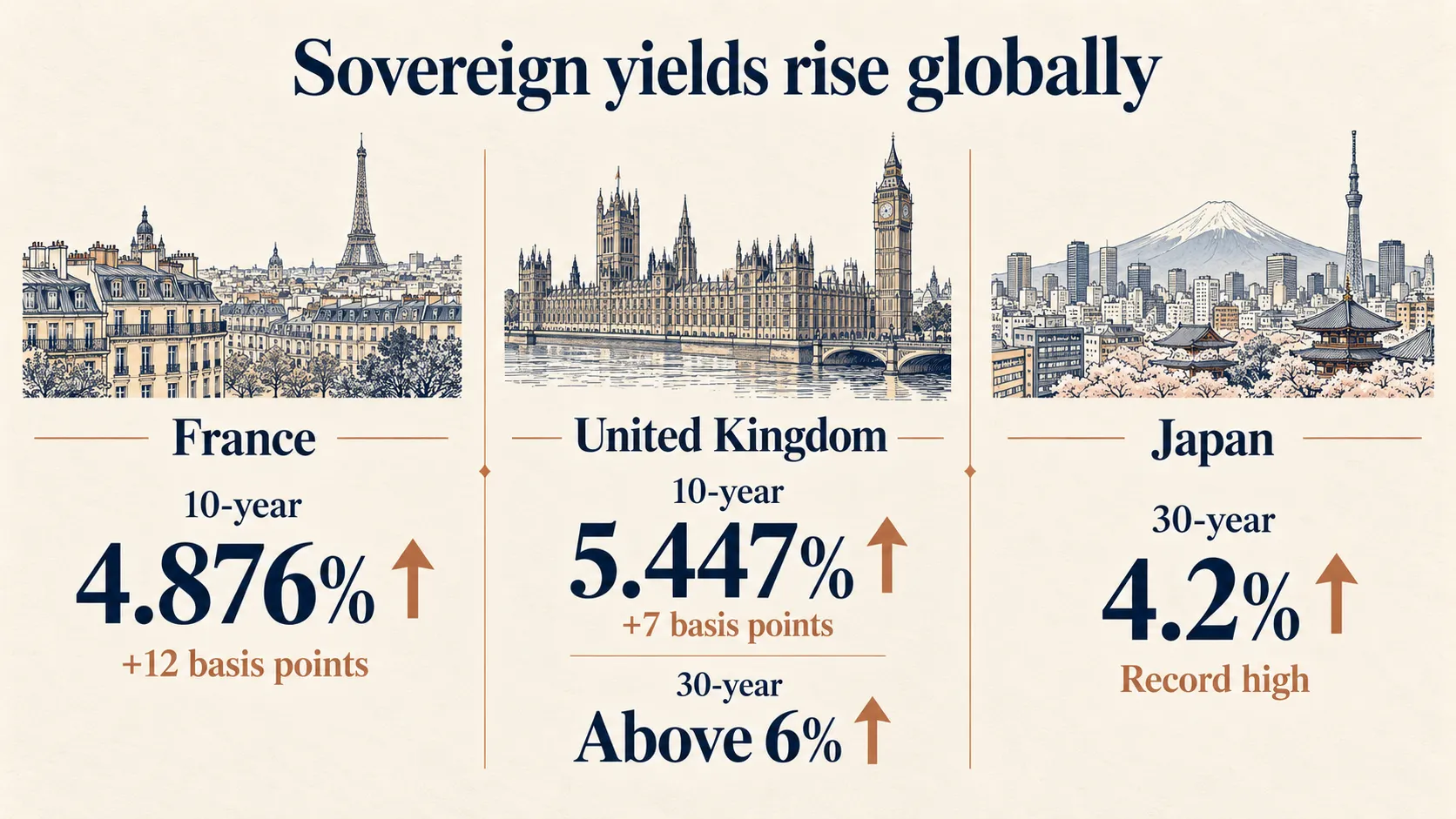
The pressure on US Treasury yields is part of a broader global trend. It affects sovereign debt markets worldwide. French 10-year yields rose 12 basis points to 4.876%. UK 10-year gilt yields gained 7 basis points to 5.447% [2]. The UK 30-year government bond yield topped 6 percent. Japanese government bond yields reached record highs of 4.2 percent for the 30-year maturity [8]. This synchronization suggests that investors worldwide are reassessing the risk profile of sovereign debt. They do so in an environment of sticky inflation and fiscal expansion.
A Deutsche Bank poll reported by Reuters found that 37% of surveyed family offices view rates and yields as the biggest threat to global growth. This surpasses concerns about inflation (23%) and artificial intelligence risks (17%) [2]. The survey was conducted at a Singapore forum attended by about 200 family offices and wealthy individuals [2].
The strength of the US dollar has benefited from the surge in bond yields. The U.S. Dollar Index surged above 102. It reflects its attractiveness as a yield-bearing asset relative to other currencies [8]. This potentially supports the greenback against currencies like the euro and Japanese yen [8].
He stated that the US faces a "real rate issue" due to robust activity [8]. This perspective aligns with the idea that a healthy economy requires higher interest rates to manage demand and inflation. Nevertheless, the speed of the yield increase has rattled investors. Ian Lyngen of BMO noted that while the 3-year auction was relatively well received, the 10-year sale was more critical in setting the tone for US rates [2].
Compass Predictive Analytics
Assessment of Fiscal Sustainability
Deficits are running at about $2 trillion a year and must be financed with new debt sales, which have to draw in new buyers [1].
AI companies are selling large amounts of debt at much higher yields, and the government has to compete with those bonds for buyers [1].
Danske Bank's Jens Peter Sorensen sees a risk that both the 10-year and 30-year yields reach 6% as investors demand greater compensation for holding longer-maturity debt [2].
The auctions cleared, but only at the highest yields in more than two decades, which is what it took to sell all $121 billion of notes and bonds; at those higher yields, additional demand emerged and the bond market settled down [1]wolfstreet.comThe US government sold $728 billion of Treasury securities during the week, spread over eight auctionsThe US government sold $728 billion of Treasury securities during the week, spread over eight auctions.Open source ↗.
Compass Predictive Analytics