
Listen to this article
Narrated by Charlotte · The Noble House

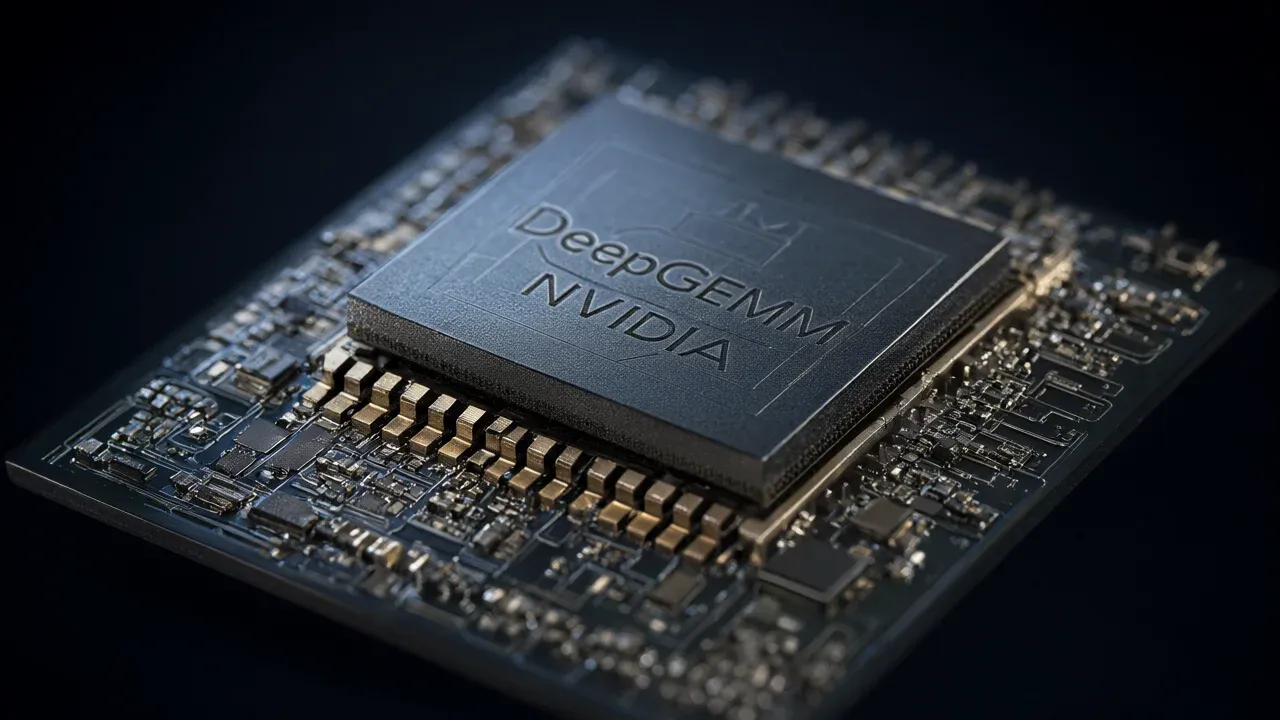
An AI system can produce the same answer, using the same number of tokens, while making those tokens less expensive to compute. That distinction is the starting point for understanding DeepGEMM. DeepSeek’s open-source library works inside the machinery that performs the model’s numerical operations. It gives engineers another way to extract useful computation from supported accelerators. [1]github.comDeepGEMM: Clean and Efficient BLAS Kernel Library on GPUThe primary repository documents supported computation primitives, hardware requirements, development history and the September 30 Ascend announcement.Open source ↗
The reason to pay attention is hardware leverage. When more powerful accelerators are expensive or difficult to obtain, extracting additional useful work from available machines becomes a strategic capability. DeepGEMM belongs to that effort. Its potential value reaches beyond a faster benchmark: a compatible operator could gain capacity, improve responsiveness or change the economics of a service without first buying a larger fleet.
The timely development is DeepSeek’s September 30 release of DeepGEMM-Ascend. The main project was already active in 2025; its history records continuing changes through September 2026. This is an expanding infrastructure effort, rather than a newly discovered shortcut that makes an assistant consume fewer tokens. [1]github.comDeepGEMM: Clean and Efficient BLAS Kernel Library on GPUThe primary repository documents supported computation primitives, hardware requirements, development history and the September 30 Ascend announcement.Open source ↗[5]github.comDeepGEMM-AscendThe primary repository describes an API-compatible Ascend port, developed and validated on Ascend 950 hardware with its own toolchain requirements.Open source ↗
The Work Moves Faster; the Task Still Exists
Tokens represent pieces of the text a model processes or generates. DeepGEMM operates at a different layer: matrix multiplication and related numerical work. Its current repository covers several precisions and other large-language-model primitives, including operations used in mixture-of-experts systems. [1]github.comDeepGEMM: Clean and Efficient BLAS Kernel Library on GPUThe primary repository documents supported computation primitives, hardware requirements, development history and the September 30 Ascend announcement.Open source ↗
Improving that arithmetic does not shorten a prompt, remove a reasoning step or guarantee that an agent needs fewer attempts. The task still determines how much work the system must do. The potential gain lies in performing some of that work more efficiently.
Three measurements therefore deserve separate treatment: tokens used to complete the task, resources spent processing those tokens, and the price a provider charges. A kernel addresses part of the second measurement. The first depends on the model and workflow; the third also reflects operating costs, commercial choices and competition. A result at one layer cannot establish a percentage saving at another.
Hardware Constraints Become an Engineering Agenda
DeepSeek’s V3 technical report makes the underlying pressures explicit. It describes communication bandwidth as a bottleneck and identifies limitations in Hopper’s FP8 accumulation. The team overlaps communication with computation and uses higher-precision accumulation to work around those constraints. These are documented engineering responses, rather than a claim that hardware limits vanished. [4]arxiv.orgDeepSeek-V3 Technical ReportDeepSeek’s technical report explains its mixed-precision training approach, including higher-precision accumulation to address numerical limitations.Open source ↗
I read DeepGEMM as part of that wider systems-engineering approach. Hardware constraints can focus attention on idle arithmetic units, data transfers, numerical precision and coordination across devices. Improving those layers can increase what an existing investment delivers. The significance lies in treating the available machine as something to understand and optimize, rather than assuming progress always requires a more expensive replacement.
If such work spreads through compatible serving stacks, the ripple could reach organizations that did not develop the original kernels. More productive hardware could make some applications viable at a smaller scale, relieve capacity pressure or free resources for higher-quality work. That is a prospective industry effect. Its size depends on adoption, workload fit and whether operators carry the gain through to the service people actually use.
Compass Predictive Analytics
The Engineering Beneath the Promise
Consider a kitchen with fast cooks who repeatedly wait for ingredients. Improving the stove alone leaves much of that delay intact. GPU programmers face an analogous scheduling problem: numerical units need data at the right time, in a usable layout, while other work continues.
NVIDIA’s Hopper architecture provides a Tensor Memory Accelerator that moves data asynchronously between memory spaces. A thread can initiate a transfer while other threads continue computation, reducing the instructions and registers devoted to moving data. Coordinating those activities helps turn hardware capability into usable throughput. [2]docs.nvidia.comNVIDIA Hopper Tuning GuideNVIDIA explains how the Tensor Memory Accelerator overlaps data movement and computation on Hopper GPUs.Open source ↗
Low precision introduces another challenge. Smaller numerical representations can improve efficiency, but the accumulated result still has to remain reliable. DeepSeek’s V3 report describes higher-precision accumulation as part of its FP8 training approach. The important principle is to accelerate suitable operations while protecting the numerical behavior the model needs. Precision is an engineering decision, with consequences for correctness. [4]arxiv.orgDeepSeek-V3 Technical ReportDeepSeek’s technical report explains its mixed-precision training approach, including higher-precision accumulation to address numerical limitations.Open source ↗
DeepGEMM packages optimized numerical routines for developers who can integrate them into a compatible system. The current NVIDIA requirements specify SM90 or SM100 GPUs and CUDA 12.9 or later. An open-source license makes the code available; it does not make every computer a supported accelerator. [1]github.comDeepGEMM: Clean and Efficient BLAS Kernel Library on GPUThe primary repository documents supported computation primitives, hardware requirements, development history and the September 30 Ascend announcement.Open source ↗
Compass Predictive Analytics
A Faster Kernel Must Earn Its Place in the Whole System
The strongest reason to resist a universal savings claim comes from measured inference research. A 2025 study by Kim and colleagues compared FP8 and BF16 behavior on NVIDIA H100 and Intel Gaudi 2. In its stated Llama 3.1 8B Instruct decode test at batch size 64, the H100’s FP8 gain was below 25%, despite the attraction of much higher theoretical arithmetic throughput. That is a result from that study, not a DeepGEMM benchmark. [3]arxiv.orgAn Inquiry into Datacenter TCO for LLM Inference with FP8The study distinguishes hardware capability from measured inference performance and examines prefill, decode and total ownership costs.Open source ↗
The distinction matters because serving a model includes more than one multiplication. The study separates prefill, which processes the prompt, from decode, which produces subsequent tokens, and examines how different matrix shapes and hardware constraints affect performance. It also treats power and facility costs as part of ownership economics. [3]arxiv.orgAn Inquiry into Datacenter TCO for LLM Inference with FP8The study distinguishes hardware capability from measured inference performance and examines prefill, decode and total ownership costs.Open source ↗
For an operator, the practical question is where the application spends its time. Faster arithmetic has greater value when arithmetic is the bottleneck. If data movement, communication or another stage dominates, the benefit can shrink. The evidence worth buying is an improvement in the whole workload, with output quality and operating conditions held accountable.
There is a concrete integration path: vLLM’s documentation exposes DeepGEMM as a backend option for compatible computation, including FP8 block-quantized mixture-of-experts operations. That establishes availability in a serving framework. It does not establish which company deployed it, the performance of an undisclosed service, or a discount on someone else’s API. [6]docs.vllm.aivLLM Engine Arguments: Kernel BackendsThe serving framework exposes DeepGEMM options for compatible linear-layer and mixture-of-experts computation.Open source ↗

Compass Predictive Analytics
Ascend Opens a Second Engineering Front
DeepGEMM-Ascend extends the project to Huawei’s accelerator platform. DeepSeek describes the port as API-compatible and says its initial release was developed and validated on Ascend 950 devices. It requires the Ascend software stack, including CANN and Torch NPU. Hardware-specific implementation work remains beneath the shared interface. [5]github.comDeepGEMM-AscendThe primary repository describes an API-compatible Ascend port, developed and validated on Ascend 950 hardware with its own toolchain requirements.Open source ↗
That is the strategic opening I find most interesting. A common interface can make it easier for developers to carry familiar operations across supported hardware families. The implementation may still require substantial platform expertise, and compatibility does not mean equal performance. But an additional working route can expand the choices available to an infrastructure team.
My reading is that DeepSeek is competing at a layer that receives less attention than model rankings: the machinery needed to operate intelligence. A team that can improve its numerical routines and extend their reach may gain flexibility over how it deploys. Demonstrating that advantage will require real workloads on each platform, rather than treating the existence of a port as proof of independence from every hardware constraint.
There is already a research example of this kind of reuse. The July 2026 X-Stage paper treats DeepGEMM MegaMoE as a testbed for improved communication-computation scheduling. Its authors report a 1.18-fold geometric-mean kernel speedup over their Expert-Wave baseline across 84 configurations. That measures their scheduling work in that experiment; it is not a DeepGEMM-wide inference saving. The important signal is that other researchers can build on an accessible engineering foundation. [7]arxiv.orgX-Stage: An Overlooked Pipeline Stage for Communication-Computation Overlap in DiT InferenceA separate research paper uses DeepGEMM MegaMoE as a testbed for improving communication-computation scheduling; the reported gains concern specific kernel experiments.Open source ↗

Compass Predictive Analytics
Where an Efficiency Gain Becomes a Business Advantage
Imagine an organization serving a recurring document-analysis workload on hardware it already owns. If its engineers improve a genuine compute bottleneck, one possible result is more documents processed in the same operating window. Another is additional capacity for a more demanding analysis. Those are prospective use cases, not measured DeepGEMM deployments.
For a smaller infrastructure provider, that capacity could change which services are economical to offer. For a larger provider, it could affect fleet utilization or the margin available for new features. Customers benefit when those gains reach them as better responsiveness, stronger service or lower cost. Passing the benefit through is a business decision, rather than an automatic property of the library.
Agents make this question more urgent because a useful task may require several model calls, tool executions and corrections. Lowering the resource cost of an individual call can help. Repeatedly pursuing the wrong task still wastes capacity. Efficient numerical execution and competent orchestration have to reinforce one another.
I would judge the result by cost per successfully completed task under a stated quality standard. Count retries, failed outputs, tool costs and human correction. Then compare the same workload before and after the change. A cheap answer that creates more work for its user has not earned the title of efficiency.
Compass Predictive Analytics
The Real Contest Is Useful Work
The strongest evidence of progress will be published, reproducible results that connect these kernels to complete serving workloads: named hardware, comparable software settings, prompt and output lengths, latency, throughput and quality. Those measurements can show where the gains survive integration and where they disappear. They can also make the Ascend port’s practical value assessable.
I expect infrastructure efficiency to remain a meaningful arena of AI competition. That is an analytical judgment about the incentive to make expensive hardware more productive, not a prediction of a particular provider’s next price cut. DeepGEMM gives that contest a concrete, inspectable engineering surface.
A headline can promise that intelligence has suddenly become almost free. The more durable achievement would be a system that produces more useful work with the resources already available to it. That is the opportunity worth watching: engineers extending the reach of intelligence, and operators proving that the additional reach becomes value for the people who depend on it.

Compass Predictive Analytics