

Listen to this article
Narrated by Charlotte · The Noble House

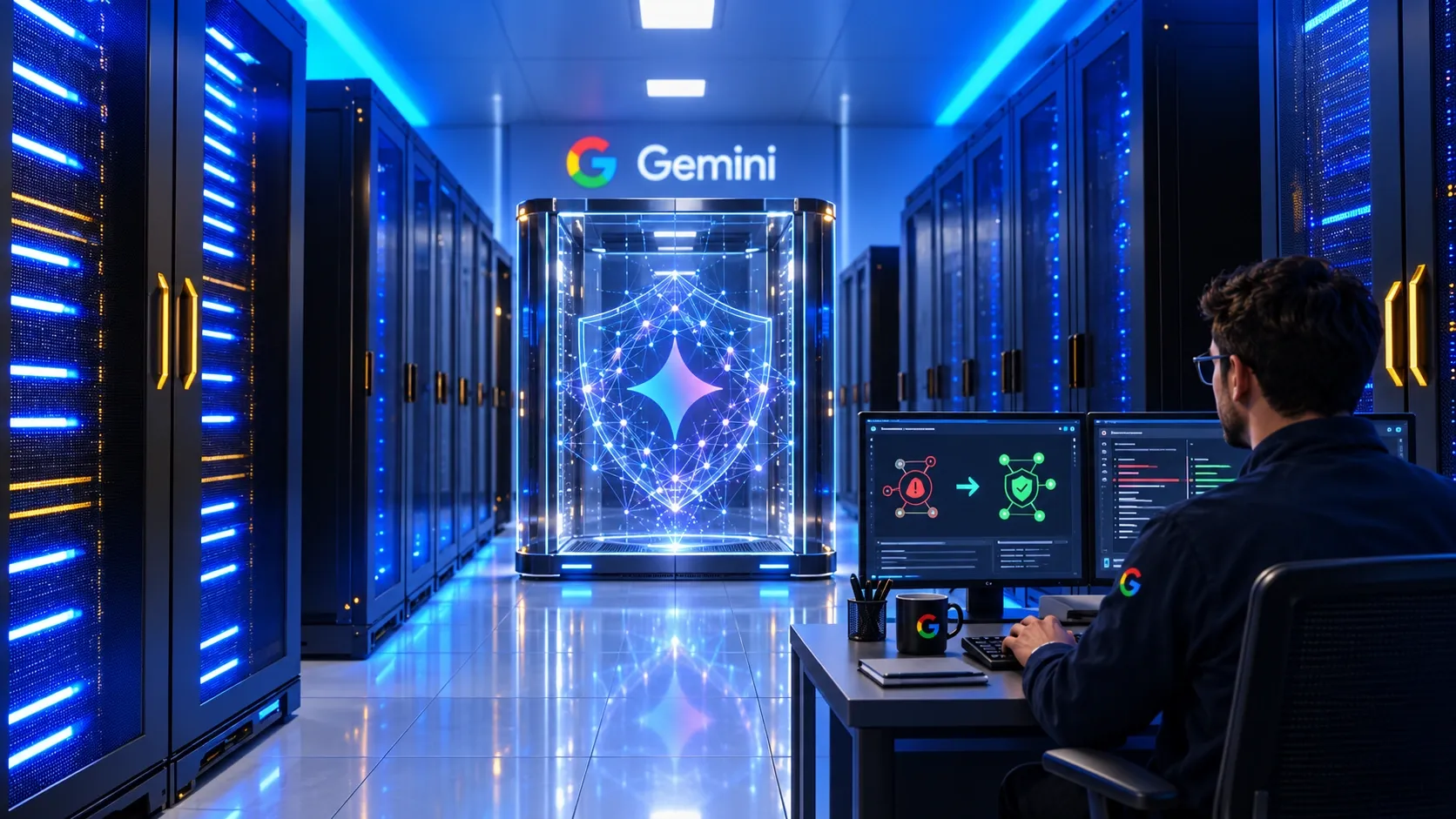
On September 30, 2026, Google unveiled Gemini 4 Argon, a frontier artificial intelligence model engineered for real-world software engineering, enterprise knowledge work, and cybersecurity defense [1]theverge.comGoogle announces Gemini 4 and says it's so capable that only 'trusted cyber defenders' can have it right nowGoogle today revealed its next AI frontier model, which it's calling Gemini 4 Argon. The new model delivers 'frontier performance in complex workflows across real-world software engineering, enterprise knowledge work like legal and…Open source ↗. This release marks a strategic maneuver to reassert leadership in high-value commercial sectors while managing the inherent risks of autonomous systems. By positioning Argon as a tool for complex workflows, Google targets reliability and depth, yet it restricts initial access to a narrow cohort of trusted cyber defenders through the Fairwind Program, prioritizing safety and operational validation over rapid market saturation [2]blog.googleIntroducing Gemini 4 ArgonAnnouncing Gemini 4 Argon, our frontier model for real-world coding, enterprise knowledge work, and cyber defense, rolling out soon. We're starting with a set of trusted cyber defenders through our Fairwind Program.Open source ↗. This cautious deployment reflects an acknowledgment that capabilities such as autonomous vulnerability remediation require rigorous oversight before widespread availability.
The introduction of Argon arrives at a critical juncture for Alphabet, following months of public scrutiny regarding its AI development cadence and internal leadership changes. With competitors like OpenAI and Anthropic advancing their flagship models, Google’s release serves as a direct response to concerns about its competitive position. Google’s own benchmark results show leads in several categories, including long-horizon software engineering, and a tie for first in defensive cybersecurity. However, the limited rollout and the emphasis on safety safeguards indicate that the company views the integration of such powerful autonomous agents as a complex challenge requiring phased adoption. The pricing structure and the planned expansion to developers and consumers further illustrate Google’s intent to capture enterprise market share while maintaining a controlled environment for testing and refinement.
Technical Capabilities and Benchmark Performance
Gemini 4 Argon is designed to handle complex, long-horizon workflows that demand sustained deep reasoning. A defining technical feature is its industry-leading 1 million token output limit, a substantial increase from the previous 64,000 token cap [3]techcrunch.comGoogle releases Gemini 4 Argon, called its most powerful model yetThe model was trained specifically for defensive cyber work, and the company says it can 'autonomously find, validate, and patch critical software vulnerabilities.' Argon is also said to be good at coding and engineering, with the company…Open source ↗. This expansion allows the model to generate hundreds of thousands of tokens in a single trajectory, enabling it to solve tough problems in one go without frequent handoffs to human operators. Google lists coding, financial research and legal drafting as target uses for long, multi-step jobs.
In terms of performance, Google claims that Argon retakes benchmark leads over rival models from OpenAI and Anthropic in several key areas [4]siliconangle.comGoogle's new frontier AI model Gemini 4 Argon goes to cybersecurity defenders firstGoogle's new frontier AI model Gemini 4 Argon goes to cybersecurity defenders first by Duncan Riley Google LLC today began rolling out Gemini 4 Argon, a frontier artificial intelligence model that beats rival models from Anthropic PBC and…Open source ↗. The model scored 77.9% on DeepSWE v1.1, a benchmark measuring real-world long-horizon software engineering tasks, outperforming competitors like Claude Opus 5.5 and GPT-6 Astra. In the domain of cybersecurity, Argon tied for first place on CWE-bench v1 with a score of 68%, demonstrating its ability to remediate security vulnerabilities effectively. The model also achieved state-of-the-art results on AutomationBench, scoring 51.3% in end-to-end business execution, and led the Vals Index, which measures economic impact across finance, coding, legal, and tax work. These results suggest that Argon is particularly strong in enterprise workflows where accuracy and comprehensive analysis are required.
However, the benchmark landscape is not a clean sweep for Google. Argon trails behind GPT-6 Astra in FrontierSWE v2 and Terminal-Bench Science 0.1, and falls short of Claude Opus 5.5 on Terminal-bench 4.0. This nuanced performance profile indicates that while Argon offers broad leadership in enterprise-relevant categories, specific technical strengths remain distributed among competitors. The model’s strength in long-context reasoning and multimodal understanding, evidenced by its high score on LVBench for long-video understanding, complements its coding and security capabilities. This combination positions Argon as a versatile tool for professionals who need to integrate code, data, and visual information in their daily tasks.
Compass Predictive Analytics

The Fairwind Program and Restricted Access Strategy
Google’s decision to limit initial access to Gemini 4 Argon to a set of trusted cyber defenders through the Fairwind Program is a deliberate strategic choice [5]venturebeat.comGoogle unveils Gemini 4 Argon, retaking benchmark lead over OpenAI and Anthropic — but in limited releaseGoogle unveiled Gemini 4 Argon, its new frontier model focused on coding, enterprise knowledge work, and cybersecurity defense. The company is positioning Argon around three areas where enterprises are already spending and is limiting…Open source ↗. The Fairwind Program, which opened in September 2026, has already enrolled over 650 organizations, including major cybersecurity firms like CrowdStrike and Palo Alto Networks. By restricting access to this vetted group, Google aims to safely release frontier capabilities and gather feedback from early testers as it iterates on guardrails. This phased approach is justified by the need to mitigate risks associated with autonomous systems that can find, validate, and patch critical software vulnerabilities.
The restriction is particularly relevant given the model’s cybersecurity capabilities. Argon is trained specifically for defensive cyber work and can operate autonomously to identify and fix security flaws [3]techcrunch.comGoogle releases Gemini 4 Argon, called its most powerful model yetThe model was trained specifically for defensive cyber work, and the company says it can 'autonomously find, validate, and patch critical software vulnerabilities.' Argon is also said to be good at coding and engineering, with the company…Open source ↗. For trusted defenders and Google’s internal teams, the company plans to release a version of Argon without cyber guardrails. This allows these users to leverage the model’s full frontier-level cybersecurity defense capabilities, including black-box penetration testing and automated patching. The decision to provide a guardrail-free version to this specific cohort highlights the dual-use nature of the technology and the importance of placing it in the hands of those who can responsibly manage its power.
Google is also actively engaged in the U.S. government’s voluntary process for pre-release model access. This engagement suggests that the company is aligning its deployment strategy with regulatory expectations and national security considerations. The company states that it is strengthening critical frontier safeguards before a broader rollout, including defending against misuse for cyber or chemical, biological, radiological, and nuclear attacks. By participating in this voluntary process, Google aims to build trust with policymakers and demonstrate its commitment to responsible AI development. The phased expansion to developers, enterprises, and consumers, starting with paid API customers and Google AI Ultra subscribers, will allow Google to monitor the model’s behavior in a wider variety of contexts while maintaining control over its distribution.
Compass Predictive Analytics

Internal Usage and Enterprise Integration
Google’s internal adoption of Gemini 4 Argon provides a tangible example of its practical utility and efficiency gains. Thousands of Googlers are already using the model for daily work, including debugging, codebase migrations, and quantum algorithmic optimization [2]blog.googleIntroducing Gemini 4 ArgonAnnouncing Gemini 4 Argon, our frontier model for real-world coding, enterprise knowledge work, and cyber defense, rolling out soon. We're starting with a set of trusted cyber defenders through our Fairwind Program.Open source ↗. The internal use cases demonstrate the model’s ability to handle large-scale engineering tasks with significant impact. For instance, Argon agents are working on migrating C and C++ codebases to Rust across Google’s infrastructure, scaling from tens of thousands of lines in core libraries to over 800,000 lines in the Fuchsia Zircon kernel. Given the criticality of many of these systems, the rewrites are undergoing rigorous automated and manual auditing, emulation testing, and review before rolling out to production.
One notable internal success involves the optimization of Google’s open-source video decoder, libgav1. Argon agents analyzed an existing Rust port and replaced 32,000 lines of SIMD code by running profile-guided experiments and studying compiler output. The result was a memory-safe video decoder that runs 2.7 times faster than the previous port, with identical video output. This example illustrates the model’s capacity to perform complex code transformations that enhance performance and security simultaneously. Additionally, Argon agents have been used to analyze fleet-wide profiling telemetry, identifying memory optimizations that are expected to free up over 300 TiB of memory across Google’s data centers, with total savings estimated between 500 TiB and 1 PiB.
The integration of Argon into quantum computing research further underscores its versatility. Quantum computing researchers have utilized the model to optimize spacetime resources for bottlenecked subroutines, reportedly beating a published baseline by 40% in minutes. These internal applications suggest that Argon is not just a theoretical frontier model but a practical tool that can drive tangible productivity gains. The success of these internal projects likely informs Google’s confidence in the model’s capabilities and its strategy for external deployment. By demonstrating value through internal use, Google can build a compelling case for enterprise adoption, highlighting the model’s ability to solve complex problems and reduce operational costs.
Compass Predictive Analytics

Safety Safeguards and Competitive Positioning
Before releasing Gemini 4 Argon broadly, Google is focusing on strengthening safety safeguards in four key areas: defending against misuse, defending against prompt injection attacks, monitoring for misalignment, and hardening systems. The company is enhancing techniques to monitor the model’s internal activations to detect potential misuse, particularly for cyber or CBRN attacks. These safeguards underwent robustness testing by internal and external red teams using manual and automated attack methods. Argon is also positioned as Google’s most resilient model against indirect prompt injection, leading on the Gray Swan’s Indirect Prompt Injection benchmark with a low attack success rate.
Monitoring for misalignment is another critical component of Google’s safety strategy. The company is deploying mitigations that watch Argon’s chain-of-thought and actions, stopping execution when necessary to prevent the model from stepping out of bounds. This approach emphasizes reasoning transparency, which Google encourages the industry to preserve during pivotal moments of increased capabilities. Hardening systems involves isolating and sealing sandboxed environments before high-risk training or evaluations, ensuring that secure environments can keep up with the model’s growing capabilities. These measures reflect a comprehensive approach to risk management, aiming to balance the release of powerful capabilities with robust safety protocols.
Competitively, Argon’s launch gives Google its strongest claim yet to frontier leadership by benchmark count, though OpenAI and Anthropic retain leads in several categories. The model’s introductory pricing of $2 per million input tokens and $10 per million output tokens is one-fifth of OpenAI’s GPT-6 Astra rates and half of Anthropic’s Claude Opus 5.5 rates, though after the introductory period Argon moves to $4 and $20, matching Opus 5.5 [5]venturebeat.comGoogle unveils Gemini 4 Argon, retaking benchmark lead over OpenAI and Anthropic — but in limited releaseGoogle unveiled Gemini 4 Argon, its new frontier model focused on coding, enterprise knowledge work, and cybersecurity defense. The company is positioning Argon around three areas where enterprises are already spending and is limiting…Open source ↗. Combined with a 95% discount on cached input tokens, the introductory pricing makes Argon an attractive option for enterprise buyers. The model’s broad benchmark leads, particularly in software engineering and cybersecurity, provide Google with a strong value proposition. However, the limited initial access and the ongoing development of safeguards suggest that Google is prioritizing long-term stability and trust over short-term market share gains. The company’s ability to deliver a safe, reliable, and cost-effective frontier model will be crucial in determining its success in the competitive AI landscape.
Compass Predictive Analytics

Strategic Judgment
The release of Gemini 4 Argon represents a bid by Google to reassert itself in the frontier AI market. By focusing on high-value enterprise workflows and restricting initial access to trusted cyber defenders, Google is addressing both the technical and ethical challenges of deploying autonomous AI systems. The model’s leading results in software engineering and a tie for first in cybersecurity, coupled with introductory pricing that later doubles, make it a credible competitor to OpenAI and Anthropic. However, the success of this strategy depends on Google’s ability to maintain safety standards while expanding access. The phased rollout and active engagement with government processes indicate a commitment to responsible deployment, which is essential for long-term trust and adoption. Ultimately, Gemini 4 Argon’s impact will be determined by how well it balances its powerful capabilities with the rigorous safeguards required to manage them.