


Listen to this podcast · 9:37
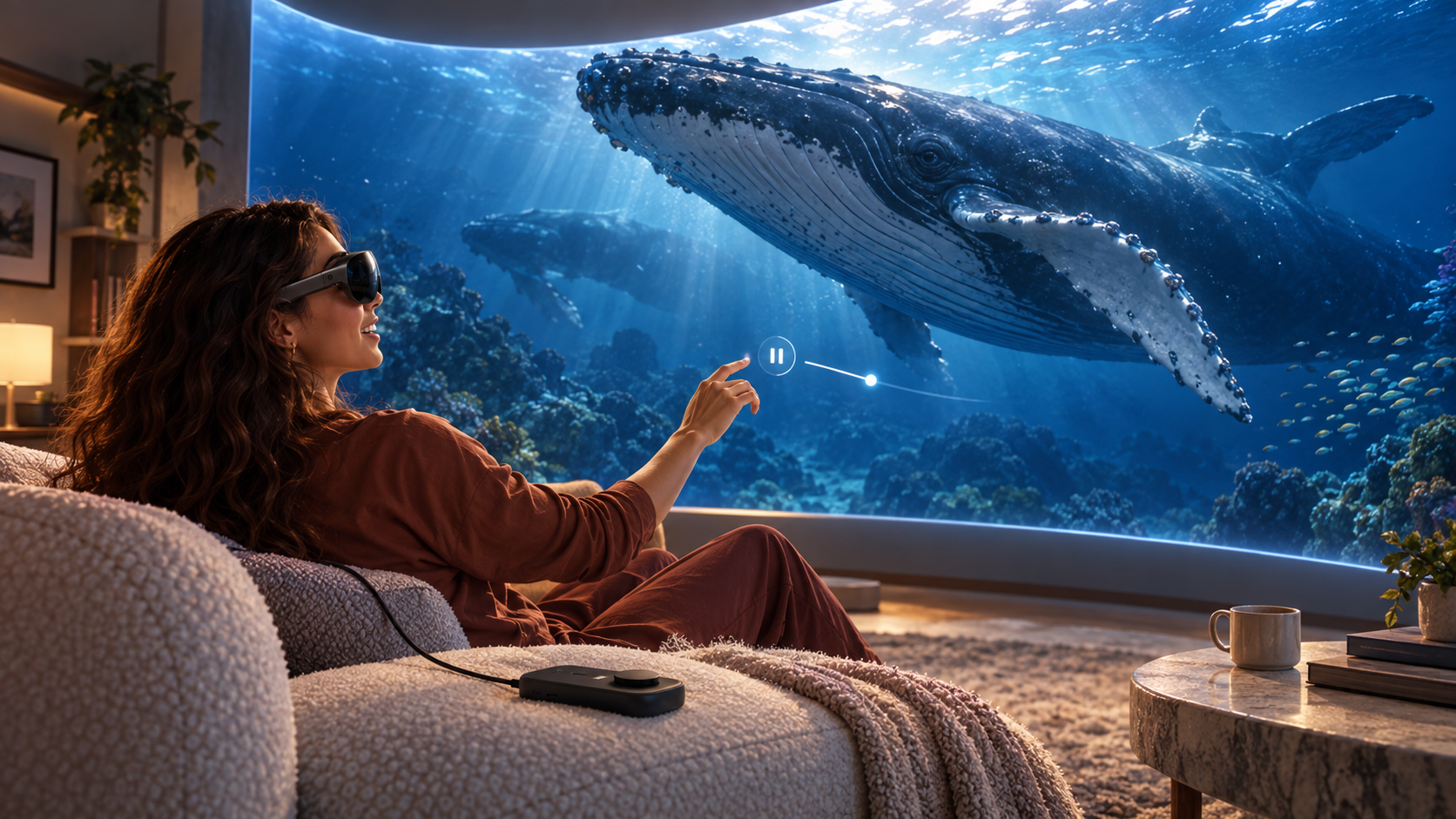
When Mark Zuckerberg presented a private cinema, a computer and a game console inside one pair of glasses, I heard an invitation as much as a product announcement. The rhythm recalled Steve Jobs introducing the iPhone: familiar experiences would converge, and their combination would change what people expected from a device. That parallel is my reading of the presentation. The question reaches beyond the specification sheet. What could people do together if spatial computing became comfortable and attainable enough to enter ordinary life? [1]stockanalysis.comMeta Connect 2026: Opening KeynoteThe speakers demonstrate Agrippa and Cooper, discuss the handheld project, and describe a future transaction-fee business model. Demonstrations and company claims remain attributed.Open source ↗
Apple gave that possibility a persuasive visual language with Vision Pro. Meta now proposes a different bargain: accept some optical and computing compromises in exchange for much less weight on the face and a substantially lower price. Muse adds a further ambition. The computer could help carry an idea from a conversation into work completed.
I see the significance in that combination. A useful capability changes society when people can reach it, afford it and find a recurring reason to use it. Meta has not demonstrated that entire outcome. It has made the proposition concrete enough to demand serious attention.
Judge the computer by what it makes possible
Start in an operating room, where a headset's value depends on the information it puts within a surgeon's view. In September, Stryker reported the first hip arthroscopy using its FDA-authorized SportSuite Vision application on Apple Vision Pro at Duke Health. The application brings surgical video and imaging into a configurable visual workspace. Its authorized use still includes traditional monitors for other operating-room staff. This is a specific clinical application, with specific requirements—not a claim that wearing a headset improves every procedure. [2]stryker.comSportSuite Vision on Apple Vision Pro: first hip arthroscopyStryker reports the Duke Health procedure, FDA authorization and the defined surgical visualization use.Open source ↗
That example changes the comparison. A substantial headset can justify its burden when it helps a professional perform valuable work. Apple also describes filmmakers scouting locations through spatial media and designers developing work in three dimensions. Resolution, tracking, software and reliable interaction matter because the task demands them. [3]apple.comApple Vision Pro upgraded with the M5 chip and Dual Knit BandApple describes spatial-media location scouting and creative applications.Open source ↗
Calling Vision Pro merely an expensive entertainment device misses that foundation. Calling a lighter competitor its replacement misses it too. The useful question is which experiences require Apple's capabilities, and which could reach many more people through Meta's different engineering choices.
Compass Predictive Analytics
September 27 assessment: evidence metrics describe the verified factual source corpus, not probabilities for these editorial scenarios.
Two architectures make different bargains
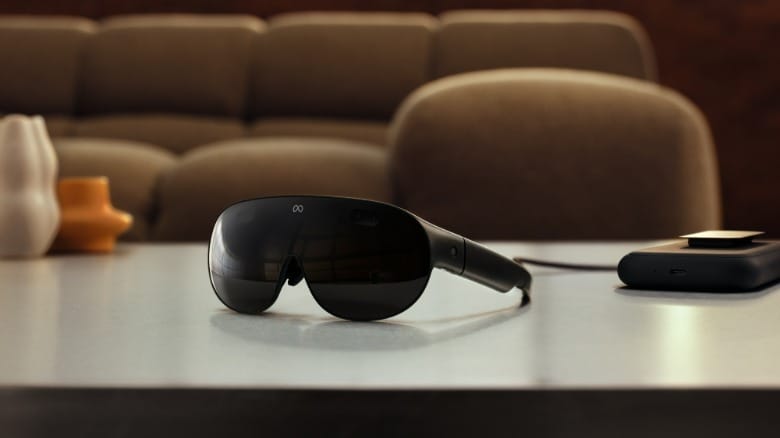
The current Vision Pro combines Apple's M5 processor with the R1 sensor-processing chip. Meta specifies a Snapdragon Reality Elite processor in a separate computing puck. Apple keeps its main computing hardware on the head and tethers a battery; Meta moves compute, battery and storage away from the face. [4]apple.comApple Vision Pro — Technical Specificationsmanufacturer specifications; configuration and workload qualifiers retainedOpen source ↗[5]about.fb.comIntroducing Meta VR Glasses: A Cinema, Courtside Seat, and Workspace in Just 100 Gramsmanufacturer announcement; not independent performance proofOpen source ↗
| Practical distinction | Meta VR Glasses | Current Apple Vision Pro |
|---|---|---|
| Price and timing | Announced at $1,299.99; spring 2027 | Currently sold; reported US starting price $3,699 |
| Head-worn burden | About 100 grams, with a separate compute puck | 750–800 grams including Light Seal and Dual Knit Band, plus a separate battery |
| Local computing | Snapdragon Reality Elite in the puck | M5 plus R1; 16GB unified memory |
| Display | Micro-OLED, marketed as 5K; 37 pixels per degree | Micro-OLED; 23 million pixels across both displays |
| Surroundings | Color camera passthrough and open sides | Camera passthrough with spatial tracking |
| Battery claim | Up to three hours of high-resolution media playback | Up to 2.5 hours general use or three hours video playback |
These figures describe different configurations and manufacturer test conditions. Display marketing labels are especially easy to misread: “5K” does not establish higher per-eye detail than Apple's total pixel count. Nor does a processor family name establish how quickly a particular application will finish. A useful performance comparison needs the same workload and comparable image quality. [4]apple.comApple Vision Pro — Technical Specificationsmanufacturer specifications; configuration and workload qualifiers retainedOpen source ↗[5]about.fb.comIntroducing Meta VR Glasses: A Cinema, Courtside Seat, and Workspace in Just 100 Gramsmanufacturer announcement; not independent performance proofOpen source ↗[6]macrumors.comApple Vision Pro Just Got Even More ExpensiveReported June 2026 US starting price increase from $3,499 to $3,699.Open source ↗
Engadget reports a 70-degree horizontal field of view for Meta VR Glasses. A narrower view can constrain an expansive workspace or an immersive scene. That compromise could matter less to someone watching a large virtual screen than to someone whose work depends on a broad, continuous visual environment. [7]engadget.comMeta VR Glasses and Apple Vision Pro comparisonReports a 70-degree horizontal field of view for Meta VR Glasses.Open source ↗
The name “VR Glasses” also needs care. Meta explicitly offers color passthrough, so the product can combine a view of the room with digital content. Neither this system nor Vision Pro provides transparent optical AR simply by showing camera images. The competitive questions concern clarity, delay, tracking and interaction—not whether one company chose “VR” and another chose “spatial computing” for its description. [4]apple.comApple Vision Pro — Technical Specificationsmanufacturer specifications; configuration and workload qualifiers retainedOpen source ↗[5]about.fb.comIntroducing Meta VR Glasses: A Cinema, Courtside Seat, and Workspace in Just 100 Gramsmanufacturer announcement; not independent performance proofOpen source ↗
Compass Predictive Analytics
A lower price can change who gets to participate
At roughly a third of Vision Pro's reported starting price, Meta's device enters a different purchasing conversation. It remains expensive. But a buyer already considering a premium phone or computer could plausibly consider it as an additional tool or entertainment system. The price creates an opening; worthwhile repeated use must close the sale.
For a small design practice, the decision could turn on a single recurring activity. Imagine reviewing a proposed interior at scale with a client before anyone orders materials. A prevented misunderstanding could matter more than the headset's benchmark ranking. For a student sharing a crowded home, a private workspace could offer room that the physical desk cannot.
These are prospective uses, not established savings. Their importance lies in how the economics change: a capability previously reserved for a specialist room or an occasional consultation could become available whenever the work calls for it.
Comfort then becomes an economic variable. A device people willingly put on gets more opportunities to prove useful. Moving computing off the face may help, although the cable, puck, prescription fit and charging still belong to the experience. A three-hour playback claim supports a session; it does not promise an uninterrupted working day.
Compass Predictive Analytics
Presence could make distance feel less absolute
The most arresting possibility may involve another person. Meta's Hologram calling announcement describes photorealistic representations with live expressions and spatial audio, compatible with calling services including WhatsApp and Zoom. These are rendered people viewed through a display, not free-standing projections that everyone in the room can see. [5]about.fb.comIntroducing Meta VR Glasses: A Cinema, Courtside Seat, and Workspace in Just 100 Gramsmanufacturer announcement; not independent performance proofOpen source ↗
I care less about the science-fiction label than about the quality of the encounter. A convincing glance or gesture could help a teacher recognize confusion, a colleague explain a shape, or a distant parent feel included in an ordinary evening. Familiar communication services reduce the effort of arranging that encounter; the rendering must make it worth having.
Apple's Personas already pursue lifelike remote presence and have improved over time. Meta's challenge is to make its version comfortable, expressive and easy enough that people return. The product will need to earn that confidence through real conversations. [8]apple.comvisionOS 26 introduces powerful new spatial experiences for Apple Vision ProApple describes improvements to the appearance and expression of Personas.Open source ↗
If it succeeds, Zuckerberg's spatial ambition could find a more practical beginning. People would enter because someone they care about is there, or because sharing a space helps them understand something. Useful relationships could give the virtual environment its purpose.
Compass Predictive Analytics
Muse could turn shared understanding into progress
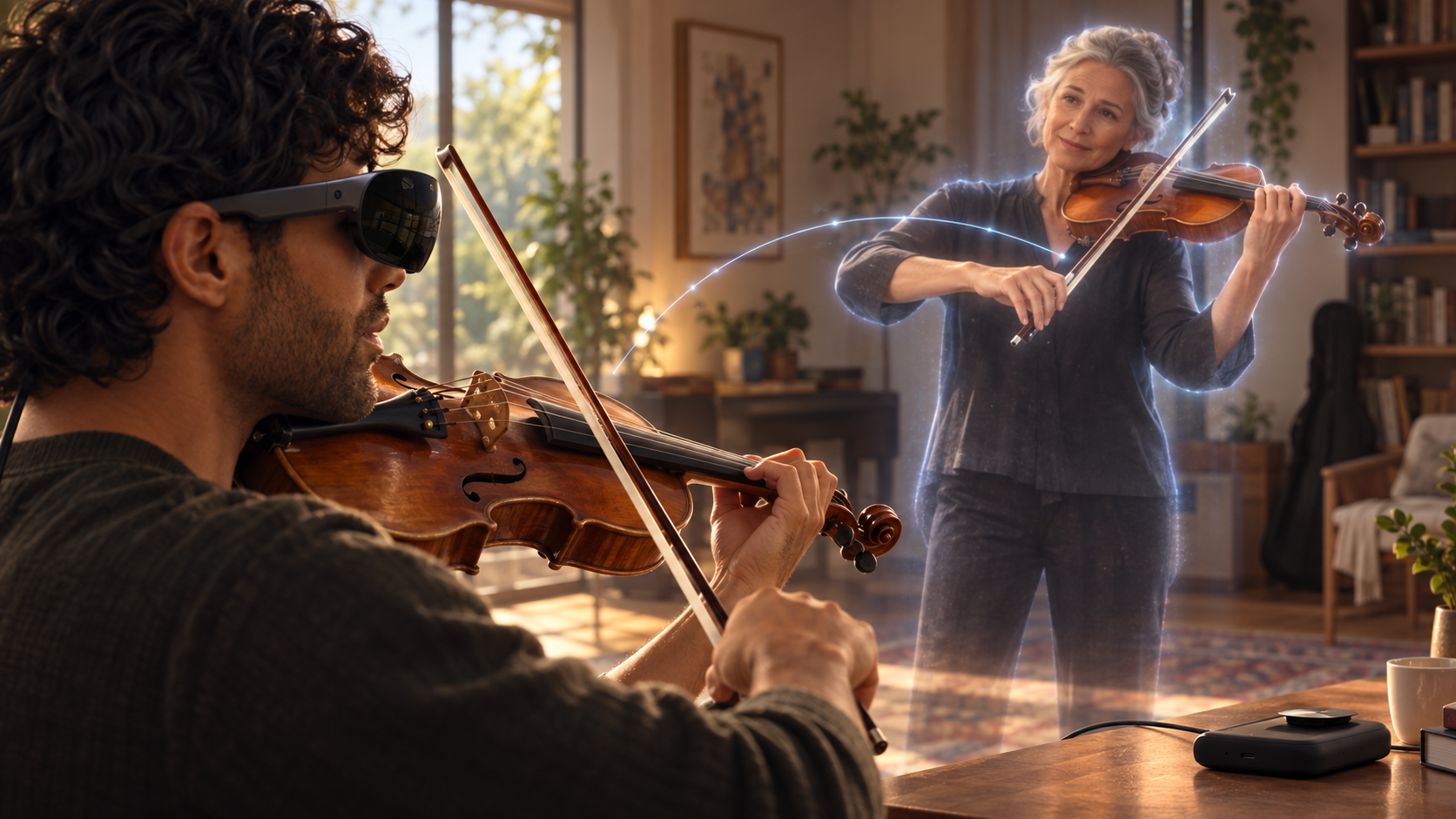
Now add an agent to that encounter. Imagine a young designer reviewing a community library with an architect in another country. They move a proposed wall, compare the afternoon light and resolve a disagreement that a flat drawing had concealed. Muse records the decision, prepares material options and carries the work forward after the call.
Each capability contributes something different: spatial computing makes the proposal legible, presence makes collaboration more natural, and the agent reduces the work between agreement and execution. That future depends on the components working together. Their combined value is the reason to follow this development.
My near-term expectation is a market built around repeatable sessions: entertainment, collaboration, learning and selected professional tasks. Broader adoption would follow evidence that people keep returning after the novelty fades. If software remains awkward or the compromises obstruct the work, the market will stay narrower.
Apple can answer through its applications, computing capability and experience across devices. But it must make the value accessible enough to defend the relationship it introduced. Meta need not outperform Vision Pro at every task to win a much larger place in people's lives.
The designer in that imagined library leaves with more than an impressive view. She understands something, has reached someone and can take a next step that was previously difficult. That is the opportunity worth pursuing. The most consequential thing we may see through these glasses is something we finally have the means to create.
About the evidence assessment
September 27, 2026. 5 qualified sources; 3 independent owners. The native instruments cover validated factual assertions from the linked sources. Forward-looking scenarios and authorial judgments are excluded. Sources outside this metric corpus remain identified in the bibliography.