

Listen to this article
Narrated by Charlotte · The Noble House

MrBeast's half-billion-subscriber milestone records popularity, but its strategic value lies elsewhere. It is evidence that a creator can turn attention into an industrial capability. Behind the spectacle sits a disciplined loop of idea selection, packaging, retention analysis, reinvestment, localization, and organizational scale. The useful lesson is not how to imitate MrBeast. It is how to build a system that learns.
Half a billion is the outcome, not the operating system
On June 12, 2026, MrBeast became the first individual creator to reach 500 million YouTube subscribers. The official YouTube milestone announcement placed the number in a longer sequence: Jimmy Donaldson became the platform's most-subscribed individual creator in November 2022, then its most-subscribed channel in June 2024. His recreation of Squid Game was approaching one billion views.
Five hundred million subscribers do not equal five hundred million active viewers. They are not a corporate valuation, and they do not guarantee the performance of the next upload. The milestone still establishes something strategically important. One creator-led organization accumulated direct distribution on a scale historically reserved for global media networks, then repeatedly activated parts of that audience around expensive productions, consumer products, philanthropy, and partnerships.
The spectacle is easy to see. The machinery is not.
MrBeast's real achievement is the conversion of creative judgment into a learning system. The organization selects a promise that can be understood instantly, designs packaging and story around the same promise, proves the promise quickly, measures where attention strengthens or fails, repairs what the evidence exposes, reinvests the return into the next increase in capability, and redistributes successful work across languages and products.
That loop is the asset. The videos are its visible output.
For a smaller creator, publisher, or intelligence company, this distinction changes the question. The goal is not to reproduce the money, pacing, facial expression, or scale of a MrBeast video. The goal is to identify which parts of the operating system remain powerful when the budget is small.
Packaging is product design before production begins
A thumbnail is often treated as promotional material applied after the work is finished. MrBeast treats packaging as part of the product specification.
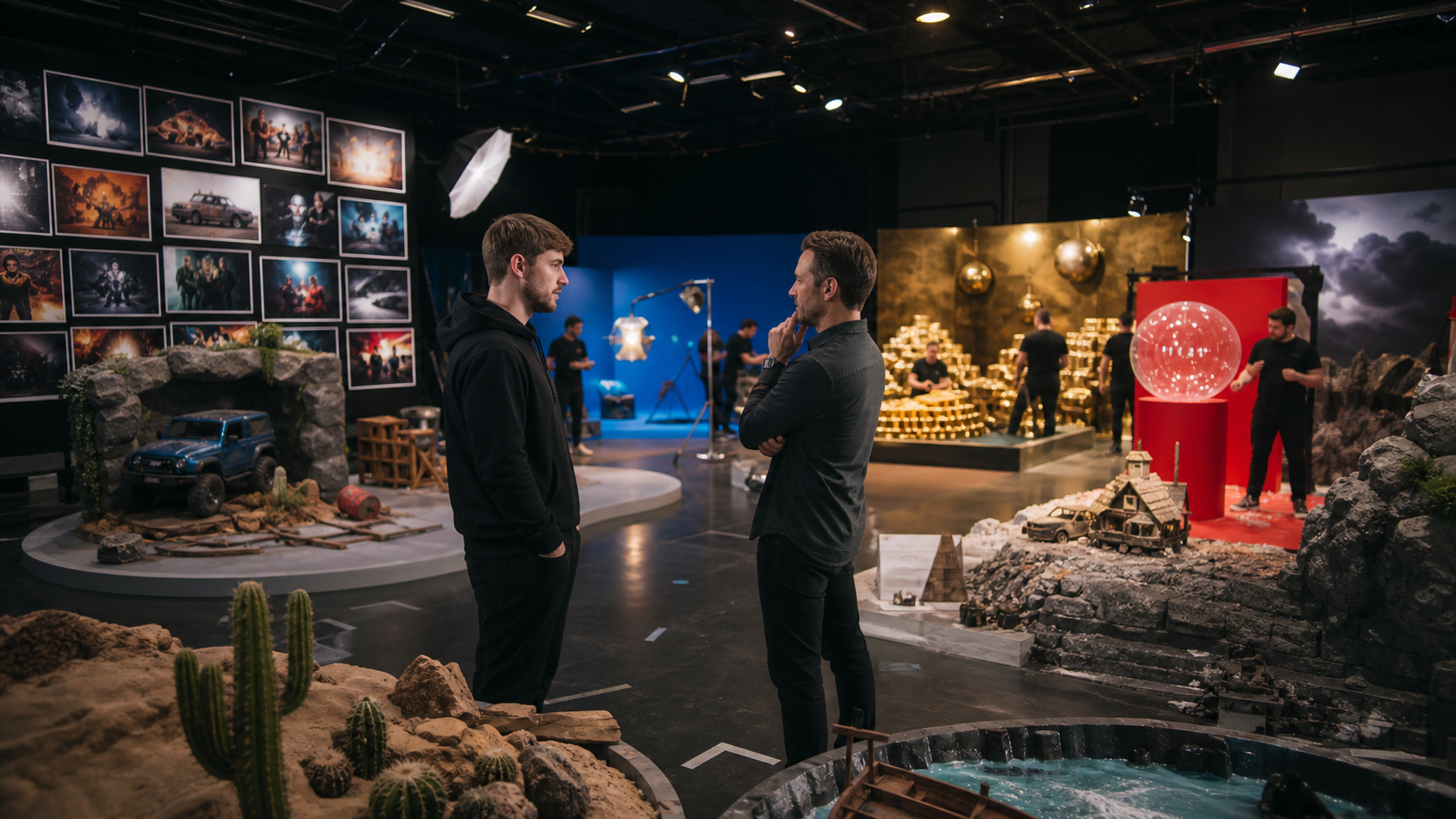
In a direct interview recorded inside his thumbnail studio, the process included storyboards, stand-ins, alternative compositions, and review of older images. A Jon Youshaei interview focused on the creative process documented how deliberately the team constructs and evaluates those options. In a separate WIRED interview, Donaldson described considering many thumbnail framings and changing them after release.
The logic is deeper than clickbait. The title and thumbnail define a contract: this is the event, conflict, transformation, or reward the audience will receive. Production must then fulfill that contract. If the image promises one story and the video delivers another, an initial click can become early abandonment.
YouTube's own testing system formalizes the connection. Its Test and Compare tool runs as many as three thumbnails concurrently and selects winners by watch-time share, not click-through rate alone. A thumbnail that attracts curiosity but sends the wrong audience into a disappointing opening may lose to a less sensational image that produces more valuable viewing.
This means packaging should be resolved early enough to influence production. Before an expensive shoot, a team should be able to state the promise in one sentence and express it in one frame. If that cannot be done, the problem may be the idea, not the graphic design.
For Compass, the equivalent is a decision promise. A report, short, or podcast should answer one question before production begins: what will the audience understand, detect, or decide after consuming this? The title, hero, first spoken line, and analysis must settle the same promise.
The first 30 seconds settle the trust debt created by the click
The click creates a debt. The opening must prove that the promised experience is real.
YouTube's audience-retention documentation defines introductory performance around the first 30 seconds. A strong intro percentage indicates that the opening matched the expectation established by the title and thumbnail and kept the audience interested. The same interface exposes spikes, dips, and top moments across the video.
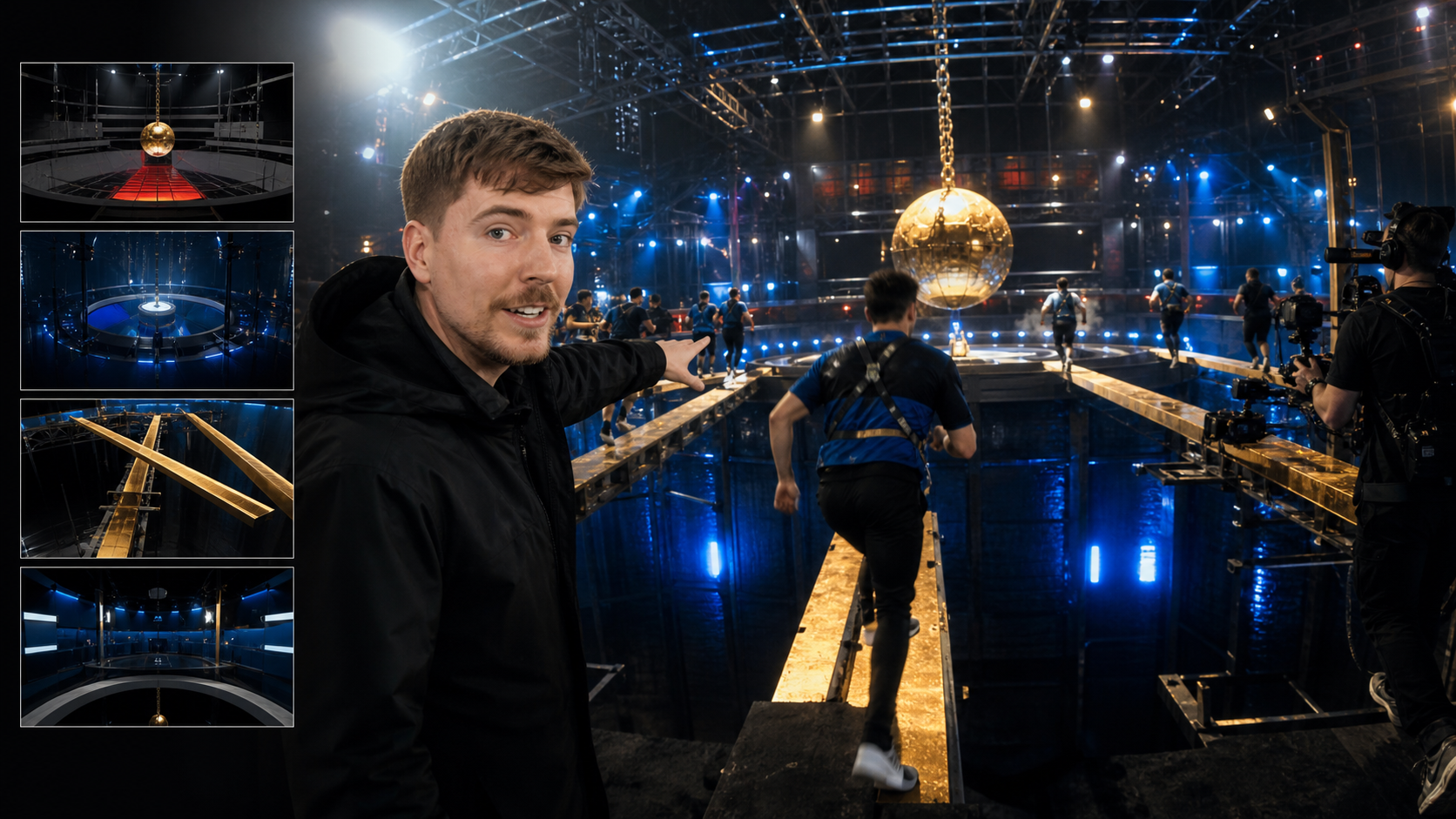
MrBeast's openings often collapse orientation time. The premise is stated immediately. The physical evidence is already visible. Stakes arrive before the viewer has time to wonder whether the title was exaggerated. This does not mean every serious creator should adopt frantic editing. It means the opening should pay off the decision to click before asking for patience.
An intelligence product has a different rhythm but the same obligation. It should not spend its first minute announcing that the world is changing. It should establish the change, its evidence, and why the reader's prior model may now be incomplete. Depth can follow once relevance is earned.
The transferable sequence is simple:
- State the promise.
- Show proof that the promise is real.
- Introduce the constraint or unresolved question.
- Make the next development necessary rather than merely available.
This is not compression for its own sake. It is narrative causality. Each segment should change what the audience knows and create a reason to stay for the consequence.
Retention turns audience behavior into an editorial instrument
Most creative teams evaluate work through taste, internal politics, or comments from the loudest viewers. Retention adds another form of evidence: what people actually did.
YouTube's analytics connect thumbnail impressions to views and watch time. Its retention graph identifies where viewers leave, replay, or remain unusually engaged. The platform also explains that aggregate engagement signals, including watch time, inform relevance in its discovery systems through its account of how YouTube works for users.
These measures create a diagnostic chain:
- Impressions test distribution.
- Click-through tests the clarity and attraction of the package.
- The first 30 seconds test whether the opening honors the package.
- Midpoint retention tests whether escalation and structure sustain interest.
- Completion tests whether the payoff justifies the time.
- The next action tests whether attention becomes a relationship.
The important discipline is to diagnose the right layer. Weak impressions do not prove a bad video. A strong click followed by an immediate drop suggests a broken promise. A stable opening followed by a sharp midpoint decline suggests structural drag. A replay spike may reveal the most valuable idea or the least clear explanation.
This is where the operating system becomes iterative rather than inspirational. The team does not need to guess why every asset failed. It forms a narrow hypothesis, changes one surface, and observes the result. YouTube's concurrent thumbnail testing is especially useful because sequential tests can be distorted by changes in audience composition and timing.
Data does not replace editorial judgment. It shows where judgment should look again.
Reinvestment converts one successful video into the capacity for the next
Donaldson has repeatedly described reinvesting most of the channel's earnings into content. The WIRED interview also contains an important qualification: story matters more than expenditure. A more expensive video is not automatically better.
That qualification explains why reinvestment works when simple spending does not. The return is not poured indiscriminately into spectacle. It funds the removal of constraints: more ambitious concepts, longer preparation, specialized talent, custom environments, additional attempts, better localization, and the organizational capacity to coordinate them.
This creates a flywheel:
better concept and execution → more useful attention → greater revenue and leverage → stronger production capability → a larger feasible concept space.
The loop is powerful because the next project benefits from infrastructure created for the previous one. A studio, a production method, a trained team, an analytics practice, or a localization pipeline remains after one video ends.
Smaller operations should copy the capital discipline, not the spend. Early revenue should first improve reliability and learning speed. For The Noble House, that may mean stronger inference capacity, better editing, dependable scheduling, audience telemetry, reusable visual systems, and distribution automation. A decorative upgrade that does not improve comprehension, production speed, reach, or conversion belongs later.
The correct question is not “How much did this video cost?” It is “Which new capability will still exist after this release?”

Localization transformed a channel into global distribution
A successful video is an asset whose marginal distribution can extend far beyond its original language.
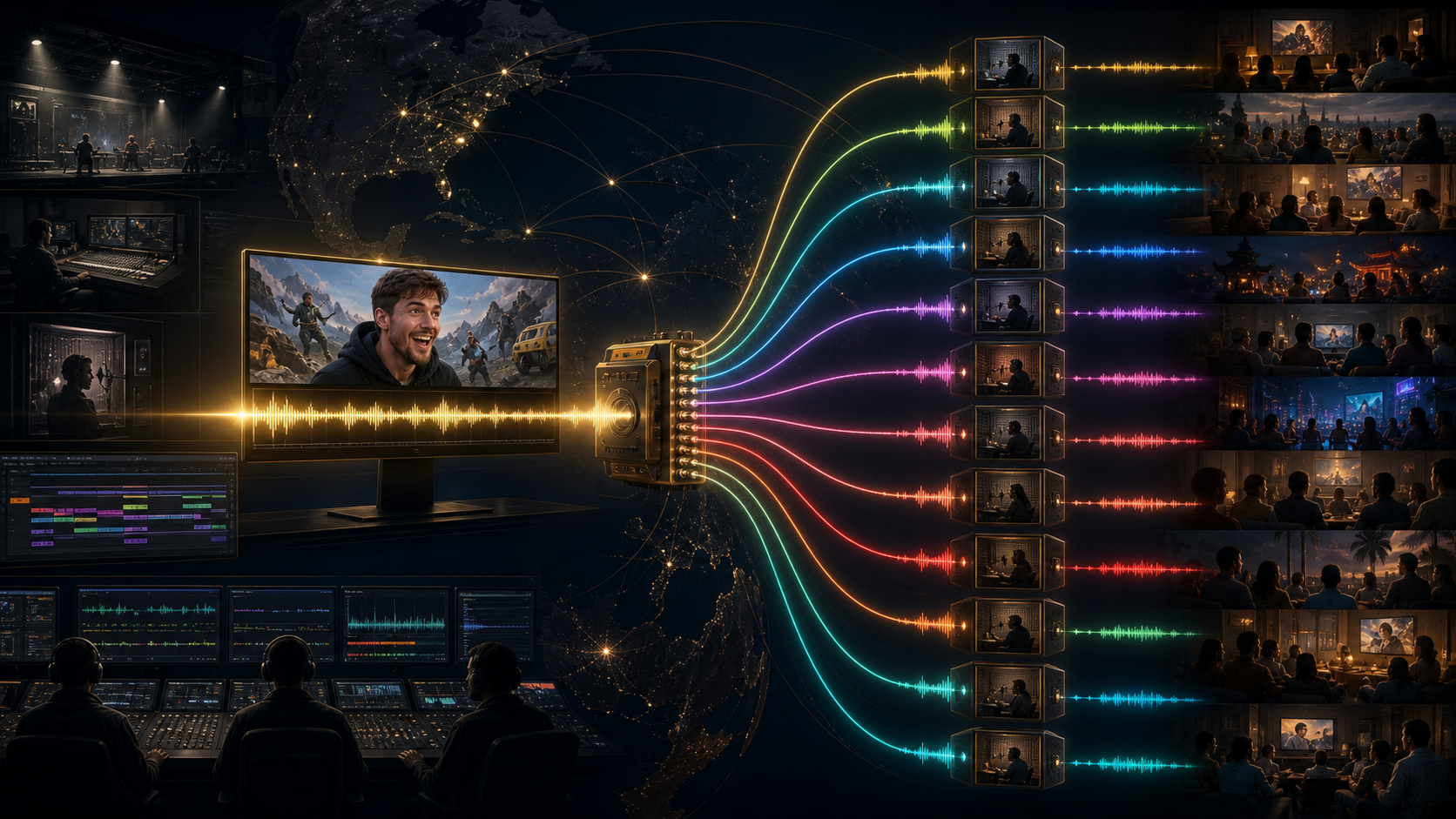
In 2023, YouTube reported that MrBeast had dubbed popular videos into 11 languages. The platform's multi-language audio interview said pilot creators received more than 15 percent of watch time from viewers using a non-primary language. By 2025, YouTube said creators using multi-language audio averaged more than 25 percent of watch time from non-primary-language viewing.
Localization works because the expensive creative event has already occurred. The concept, footage, edit, and proof of demand exist. Dubbing and translated metadata expand the addressable audience at a fraction of the original production cost.
The sequence matters. Localization multiplies validated work. It does not repair a weak premise.
For Compass, multilingual distribution should begin with proven high-value assets: the day's strongest short, a Nexus narration, or a Special Report with broad strategic relevance. The visual master, script, citations, narration timing, and translated metadata should remain linked so that adaptation does not fracture the evidence or brand.
This is a genuine advantage of an AI-native production engine. Research can support multiple forms, while voice and language systems can extend the finished asset. The danger is to treat automated translation as completion. Political, legal, and culturally specific language still requires review because the words carrying the analysis are part of the product.
The channel became a company when the learning loop became organizational
A creator cannot personally operate every camera, negotiate every partnership, inspect every edit, localize every asset, ship every product, and manage every experiment at global scale. Industrialization begins when the operating method can coordinate other people.
A 36-page guide titled How to Succeed in MrBeast Production circulated among staff. It should be treated as leaked internal evidence, not as an official public policy or a safe template for every workplace. Its existence still matters. It shows an effort to translate tacit creator judgment into organizational doctrine: how teams prioritize the final video, communicate production context, and connect specialized work to one outcome.
The scale is now unmistakably corporate. Associated Press reported in 2026 that Beast Industries employed about 700 people and was recruiting executives with experience at large media and technology companies. The same report covered contested workplace allegations, a reminder that creative intensity does not excuse weak governance. Rapid scale can compound culture and key-person risk as quickly as it compounds output.
Capital markets have also begun treating the organization as more than a channel. A January 2026 SEC filing records Bitmine's announced $200 million equity investment in Beast Industries. The accompanying investment announcement described more than 450 million subscribers and more than five billion monthly views across channels at that time. Those are investor-supplied audience figures, not an audited valuation. The transaction nevertheless marks institutional recognition of creator-led distribution as investable infrastructure.
The strategic transition is clear: attention supports products, products finance production, production deepens attention, and organizational capability lets the cycle operate at a scale no individual could sustain.
The system has four vulnerabilities that imitation usually hides
The first vulnerability is platform concentration. Recommendation policy, monetization rules, account enforcement, or audience migration can alter reach faster than a production company can alter its cost structure.
The second is production economics. Reinvestment increases feasible ambition, but it can also make each release dependent on extraordinary performance. A system optimized for escalation may struggle to become less expensive without appearing to retreat.
The third is key-person dependence. MrBeast's identity remains inseparable from the brand's distribution. Executives and systems can reduce operational dependence, but they do not automatically transfer audience trust.
The fourth is governance. The same intensity that produces exceptional work can damage an organization when urgency overrides clear authority, employment safeguards, or sustainable process. Documented allegations remain contested, but the general risk is real for any founder-led production system growing faster than its management discipline.
These are not reasons to dismiss the model. They identify the controls a serious adopter must add: own the audience relationship, constrain production risk, develop formats that survive beyond one personality, and treat governance as part of production quality.
A 90-day playbook can adapt the machine without copying the spectacle
Days 1 to 30: establish the promise and measurement chain. Define one audience and one decision promise for each format. Create title and hero candidates before production. Lock the opening 30 seconds as a separate acceptance surface. Record impressions, click-through, 30-second retention, midpoint retention, completion, and membership or site action. Preserve the research and media masters outside any social platform.
Days 31 to 60: turn releases into controlled learning. Test up to three materially different packages concurrently where the platform permits it. Review one retention graph per release and write one diagnosis, not ten. Recut only the broken layer. Build the first repeatable transformation from Compass research into a short and from the Nexus into an analytical audio segment.
Days 61 to 90: compound the winners. Localize the strongest validated assets. Reinvest revenue or saved labor into the bottleneck that most limits reliability, comprehension, or distribution. Create one recurring format whose value does not depend on novelty alone. Use the email list, member tiers, and owned site to convert platform attention into a direct relationship.
The playbook should be governed by four questions:
- Did the package make one honest promise?
- Did the opening prove it?
- Where did audience behavior contradict the team's belief?
- What capability will remain after the release?
Those questions keep the operating system useful at any budget.
The winning lesson is to copy the learning loop, not the surface style
MrBeast's surface is already everywhere: wide eyes, giant numbers, accelerated edits, escalating prizes, and imitations of imitations. Copying that grammar now makes a creator easier to classify and easier to ignore.
The deeper system remains harder to reproduce. It requires the humility to package before producing, the discipline to settle the click immediately, the patience to read retention as evidence, the restraint to change one layer at a time, the appetite to reinvest, and the organizational maturity to turn personal instinct into repeatable capability.
That system explains why 500 million matters. The number describes a very large audience, but it also records millions of repeated decisions about what people choose, when they leave, what they share, and why they return.
For Compass and The Noble House, the opportunity is not to become MrBeast. It is to apply the same seriousness to a different promise: turning a vast field of signals into intelligence that earns attention because it improves the reader's view of reality. The research engine already creates depth. The next advantage comes from making the promise legible, proving it early, measuring the audience's response, and compounding what works.
The spectacle belongs to MrBeast. The operating principle belongs to anyone disciplined enough to build a learning organization.