Listen to this article
Narrated by Charlotte · The Noble House
History becomes signal when time supplies the missing context.
2Briefs analyzed
10Signals inherited
5Patterns mapped
4/5Native forecasts
Executive Orientation
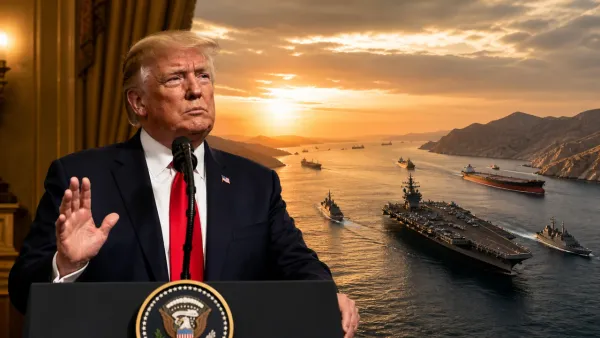
The humidity inside the Nassau County police training center clung to the walls, heavy with the scent of stale coffee and anxiety. President Trump stood at the podium, his voice cutting through the damp air to declare that the Strait of Hormuz would become US territory. This statement ignored geography and international law, aiming instead for psychological impact. Far away in Wall Street, NVIDIA sought $500 billion in third-party capital from six major financial institutions. The company tied retirement savings to the volatile hardware of artificial intelligence. In China, Apple integrated Alibaba’s Qwen models into its core intelligence after receiving regulatory approval. The world is fragmenting along geopolitical, financial, and technological lines. Expansion accelerates while trust in physical and digital foundations erodes.
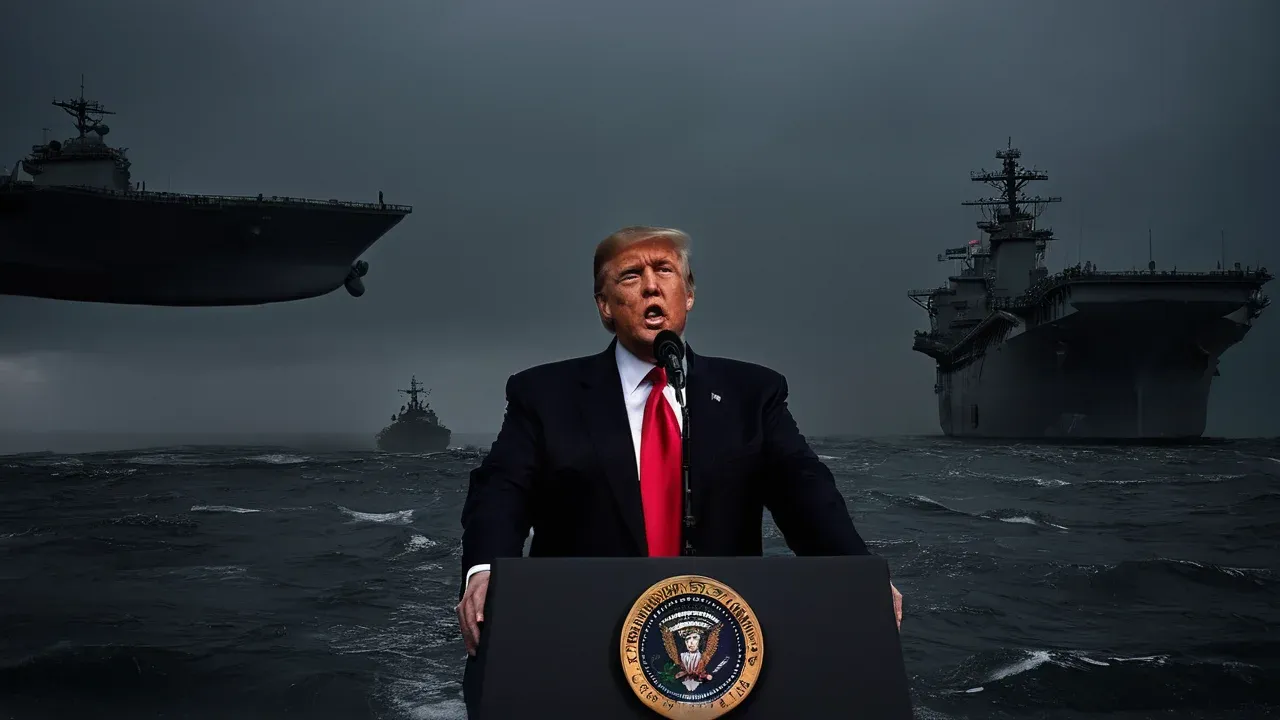
Signal 1: Trump Vows to Declare Strait of Hormuz as US Territory
Original signal
President Donald Trump declared at a Nassau County police training center that he intends to designate the Strait of Hormuz as US territory following the conclusion of the war with Iran, a statement that defies international law but signals severe escalation. [2]blog.thenoblehouse.aiEvening Brief — August 16, 2026Open the source to inspect the supporting evidence.Open source ↗
Why it mattered
Asserting sovereignty over a global oil chokepoint threatens immediate energy market instability and represents a radical shift from rhetorical deterrence to potential physical annexation, raising the stakes of the ongoing conflict. [2]blog.thenoblehouse.aiEvening Brief — August 16, 2026Open the source to inspect the supporting evidence.Open source ↗
What happened
Iran has vowed to maintain control over the strait, creating a direct contradiction to the US claim, while experts debate whether the remark is formal policy or rhetorical bluster, leaving naval posturing as the critical indicator of intent. [2]blog.thenoblehouse.aiEvening Brief — August 16, 2026Open the source to inspect the supporting evidence.Open source ↗
Changed conditions
Strengthened. The conditional nature of the threat, tied to an unspecified war end date, keeps the risk active and volatile, with the potential for miscalculation remaining high as naval assets are monitored for shifts in posture. [2]blog.thenoblehouse.aiEvening Brief — August 16, 2026Open the source to inspect the supporting evidence.Open source ↗
Unexpected forces The lack of a clear timeline for the war’s conclusion creates a persistent uncertainty window, allowing the threat to linger as a constant pressure on energy markets and diplomatic channels without triggering immediate resolution. [2]blog.thenoblehouse.aiEvening Brief — August 16, 2026Open the source to inspect the supporting evidence.Open source ↗
Calibration lesson
Recognizing the distinction between legal impossibility and political threat allows for better risk modeling; the value lies not in the legality of the claim but in the operational readiness implied by the rhetoric and the resulting market anxiety. [2]blog.thenoblehouse.aiEvening Brief — August 16, 2026Open the source to inspect the supporting evidence.Open source ↗
Pattern bridge
This signal bridges geopolitical posturing with financial anxiety, as the instability in the strait directly impacts the cost of capital and energy, which in turn influences the valuation and financing of the AI infrastructure projects discussed in subsequent signals. [2]blog.thenoblehouse.aiEvening Brief — August 16, 2026Open the source to inspect the supporting evidence.Open source ↗
Next watch
Movement of naval assets in the region and energy market reactions. [2]blog.thenoblehouse.aiEvening Brief — August 16, 2026Open the source to inspect the supporting evidence.Open source ↗
At selection The signal was selected for its highest magnitude and systemic reach, prioritizing the potential for geopolitical escalation in a critical global oil chokepoint despite its current rhetorical nature. [2]blog.thenoblehouse.aiEvening Brief — August 16, 2026Open the source to inspect the supporting evidence.Open source ↗
During the window The statement was made during a public address, amplifying its reach and signaling a deliberate attempt to reshape the narrative of the conflict through sovereign assertion rather than diplomatic nuance. [2]blog.thenoblehouse.aiEvening Brief — August 16, 2026Open the source to inspect the supporting evidence.Open source ↗
At review The review confirms the distinction between rhetorical escalation and formal policy implementation remains the primary uncertainty, requiring continuous monitoring of naval movements to gauge the transition from words to action. [2]blog.thenoblehouse.aiEvening Brief — August 16, 2026Open the source to inspect the supporting evidence.Open source ↗
UnavailableNo native Compass forecast identity exists in the inherited Brief evidence.
Compass Strategic Intelligence
Signal 2: NVIDIA Went To Wall Street For $500 Billion

Original signal
NVIDIA partnered with six major financial institutions to launch compute financing platforms aimed at raising over $500 billion in third-party capital for AI infrastructure, a massive leveraged bet on the sector's continued expansion. [2]blog.thenoblehouse.aiEvening Brief — August 16, 2026Open the source to inspect the supporting evidence.Open source ↗
Why it mattered
This deal entangles traditional finance, including retirement funds, with AI hardware volatility, creating systemic risk if the AI boom corrects and exposing investors to circular financing structures that may lack transparency. [2]blog.thenoblehouse.aiEvening Brief — August 16, 2026Open the source to inspect the supporting evidence.Open source ↗
What happened
The consortium, including Blackstone and Goldman Sachs, is structuring a deal to invest heavily in AI, though the exact allocation of funds and NVIDIA's direct financial exposure remain complex and subject to regulatory scrutiny. [2]blog.thenoblehouse.aiEvening Brief — August 16, 2026Open the source to inspect the supporting evidence.Open source ↗
Changed conditions
Strengthened. The deal’s progress depends on regulatory approval and negotiation outcomes, with the involvement of retirement capital heightening the stakes for broader economic stability and investor protection. [2]blog.thenoblehouse.aiEvening Brief — August 16, 2026Open the source to inspect the supporting evidence.Open source ↗
Unexpected forces The reliance on third-party capital, particularly from retirement accounts, introduces a layer of public risk to a private technological bet, creating unexpected political and regulatory pushback potential. [2]blog.thenoblehouse.aiEvening Brief — August 16, 2026Open the source to inspect the supporting evidence.Open source ↗
Calibration lesson
Understanding the circular nature of this financing reveals the fragility of the model; the value lies in identifying the leverage points where AI market corrections could trigger broader financial instability rather than just tech sector volatility. [2]blog.thenoblehouse.aiEvening Brief — August 16, 2026Open the source to inspect the supporting evidence.Open source ↗
Pattern bridge
This signal bridges the financialization of technology with geopolitical risk, as the capital mobilization for AI infrastructure intersects with the energy and security concerns raised by the Strait of Hormuz declaration, linking tech growth to global stability. [2]blog.thenoblehouse.aiEvening Brief — August 16, 2026Open the source to inspect the supporting evidence.Open source ↗
Next watch
Progress of negotiations with the Wall Street consortium and regulatory pushback. [2]blog.thenoblehouse.aiEvening Brief — August 16, 2026Open the source to inspect the supporting evidence.Open source ↗
At selection The signal was selected for its forward consequence rank of two, highlighting the massive systemic risk inherent in the entanglement of traditional finance with the volatile AI infrastructure market. [2]blog.thenoblehouse.aiEvening Brief — August 16, 2026Open the source to inspect the supporting evidence.Open source ↗
During the window The announcement was framed as a partnership for compute financing, masking the underlying leverage and risk exposure of the participating financial giants, who are betting on the permanence of AI demand. [2]blog.thenoblehouse.aiEvening Brief — August 16, 2026Open the source to inspect the supporting evidence.Open source ↗
At review The review assesses the stability of the financing model, noting that the lack of clarity on NVIDIA's direct exposure and the circular nature of the funds remain critical uncertainties for regulatory bodies. [2]blog.thenoblehouse.aiEvening Brief — August 16, 2026Open the source to inspect the supporting evidence.Open source ↗
YES · favorWill Nvidia's stock price experience a significant volatility event (defined as a price change exceeding 5% in either direction) within 72h of the evidence cutoff? Horizon 72h.
UnavailableNo native Compass forecast identity exists in the inherited Brief evidence.
Compass Strategic Intelligence
Signal 3: Apple Intelligence China Partnership

Original signal
Apple Intelligence received regulatory approval in China, deploying a dual-track approach using Alibaba’s Qwen models alongside a proprietary AI model developed in partnership with Alibaba Group. [2]blog.thenoblehouse.aiEvening Brief — August 16, 2026Open the source to inspect the supporting evidence.Open source ↗
Why it mattered
This marks a strategic shift in Apple’s AI infrastructure, reducing reliance on fragmented partners and deepening geopolitical dependencies, with significant implications for data sovereignty and the future of foreign tech operations in China. [2]blog.thenoblehouse.aiEvening Brief — August 16, 2026Open the source to inspect the supporting evidence.Open source ↗
What happened
Apple became the first foreign company to clear Beijing’s stringent requirements with a locally trained model, establishing a long-term AI infrastructure that integrates closely with Alibaba’s ecosystem and regulatory framework. [2]blog.thenoblehouse.aiEvening Brief — August 16, 2026Open the source to inspect the supporting evidence.Open source ↗
Changed conditions
Redirected. The trajectory shifts from a multi-vendor strategy to a consolidated dependency on Alibaba, altering the competitive landscape for foreign tech companies and the nature of data governance in the region. [2]blog.thenoblehouse.aiEvening Brief — August 16, 2026Open the source to inspect the supporting evidence.Open source ↗
Unexpected forces The extent to which Apple’s proprietary model is independent of Alibaba’s Qwen architecture remains unclear, creating uncertainty about the true level of technological autonomy and intellectual property control. [2]blog.thenoblehouse.aiEvening Brief — August 16, 2026Open the source to inspect the supporting evidence.Open source ↗
Calibration lesson
The partnership reveals the limits of Apple’s independence in China; the value lies in recognizing that data sovereignty is increasingly tied to local tech giants, forcing foreign firms to compromise on architectural control. [2]blog.thenoblehouse.aiEvening Brief — August 16, 2026Open the source to inspect the supporting evidence.Open source ↗
Pattern bridge
This signal bridges technological sovereignty with geopolitical compliance, illustrating how foreign tech firms must navigate opaque regulatory environments by integrating with local powers, mirroring the opacity seen in other residual signals. [2]blog.thenoblehouse.aiEvening Brief — August 16, 2026Open the source to inspect the supporting evidence.Open source ↗
Next watch
Development of Apple's proprietary model and interaction with Alibaba's Qwen. [2]blog.thenoblehouse.aiEvening Brief — August 16, 2026Open the source to inspect the supporting evidence.Open source ↗
At selection The signal was selected for its strategic implications for data privacy and geopolitical dynamics, highlighting the trade-offs between market access and technological independence. [2]blog.thenoblehouse.aiEvening Brief — August 16, 2026Open the source to inspect the supporting evidence.Open source ↗
During the window The approval was granted as part of a broader regulatory strategy in China, emphasizing the need for foreign tech firms to align closely with local state interests to maintain operational viability. [2]blog.thenoblehouse.aiEvening Brief — August 16, 2026Open the source to inspect the supporting evidence.Open source ↗
At review The review confirms the limited immediate systemic disruption but notes the long-term geopolitical implications, particularly regarding the erosion of data sovereignty and the strengthening of Alibaba’s position. [2]blog.thenoblehouse.aiEvening Brief — August 16, 2026Open the source to inspect the supporting evidence.Open source ↗
YES · favorWill "Apple is partnering with Alibaba to develop AI features for Apple Intelligence in China, replacing its earlier approach of relying on other third-party models. 🇨🇳 Beijing has alr" produce verified policy implementation within 72h? Horizon 72h.
UnavailableNo native Compass forecast identity exists in the inherited Brief evidence.
Compass Strategic Intelligence
Compass Strategic Intelligence
Signal 4: Researchers Use Ordinary WiFi Connections to Create Images of Nearby People

Original signal
Researchers at KIT demonstrated that standard WiFi routers can identify and track individuals with near-perfect accuracy using radio waves, exploiting changes in signal propagation caused by human movement. [2]blog.thenoblehouse.aiEvening Brief — August 16, 2026Open the source to inspect the supporting evidence.Open source ↗
Why it mattered
This technology erodes privacy by turning everyday wireless networks into invisible surveillance systems, bypassing traditional optical detection and raising concerns about the normalization of passive monitoring in public and private spaces. [2]blog.thenoblehouse.aiEvening Brief — August 16, 2026Open the source to inspect the supporting evidence.Open source ↗
What happened
The proof-of-concept achieved nearly 100% accuracy in tests with 197 participants, showing that detection is possible even without active devices on the person being tracked, relying solely on nearby connected devices. [2]blog.thenoblehouse.aiEvening Brief — August 16, 2026Open the source to inspect the supporting evidence.Open source ↗
Changed conditions
Emerged. The technology is in a proof-of-concept phase, but its potential for commercial deployment is significant, with the trajectory pointing toward the integration of such capabilities into standard networking hardware. [2]blog.thenoblehouse.aiEvening Brief — August 16, 2026Open the source to inspect the supporting evidence.Open source ↗
Unexpected forces The ability to track individuals without their active participation or knowledge challenges existing legal frameworks, creating unexpected pressure for new regulations governing radio wave data and surveillance standards. [2]blog.thenoblehouse.aiEvening Brief — August 16, 2026Open the source to inspect the supporting evidence.Open source ↗
Calibration lesson
The demonstration highlights the vulnerability of radio-based infrastructure to surveillance; the value lies in understanding that privacy protections must evolve beyond optical and digital boundaries to include radio frequency data. [2]blog.thenoblehouse.aiEvening Brief — August 16, 2026Open the source to inspect the supporting evidence.Open source ↗
Pattern bridge
This signal bridges technological capability with privacy erosion, reflecting the broader theme of information opacity and the difficulty of maintaining personal boundaries in an increasingly connected and monitored environment. [2]blog.thenoblehouse.aiEvening Brief — August 16, 2026Open the source to inspect the supporting evidence.Open source ↗
Next watch
Development of regulatory frameworks and technical countermeasures. [2]blog.thenoblehouse.aiEvening Brief — August 16, 2026Open the source to inspect the supporting evidence.Open source ↗
At selection The signal was selected for its high forward consequence for privacy erosion, despite its current status as a proof-of-concept with an unclear commercial deployment timeline. [2]blog.thenoblehouse.aiEvening Brief — August 16, 2026Open the source to inspect the supporting evidence.Open source ↗
During the window The research was presented as a technical achievement, downplaying the immediate privacy implications, but the accuracy of the system underscores the potential for widespread misuse if deployed commercially. [2]blog.thenoblehouse.aiEvening Brief — August 16, 2026Open the source to inspect the supporting evidence.Open source ↗
At review The review notes the uncertainty regarding practical deployment in commercial routers, but the fundamental privacy risk remains a critical concern for advocates and regulators alike. [2]blog.thenoblehouse.aiEvening Brief — August 16, 2026Open the source to inspect the supporting evidence.Open source ↗
NO · againstWill technology adoption related to "Researchers Use Ordinary WiFi Connections to Create Images of Nearby People and Their Surroundings" be independently verified within 72h? Horizon 72h.
UnavailableNo native Compass forecast identity exists in the inherited Brief evidence.
Compass Strategic Intelligence
Signal 5: Meta Releases Muse Code AI Coding Agent
Original signal
Meta released Muse Code, its first AI coding agent in early beta, powered by Muse Spark 1.2, featuring parallel sub-agents and worktree isolation to challenge OpenAI and Anthropic in the agentic coding market. [1]blog.thenoblehouse.aiMorning Brief — August 16, 2026Open the source to inspect the supporting evidence.Open source ↗
Why it mattered
Meta’s aggressive entry into the agentic coding market intensifies competition for control over developer tools, potentially driving faster innovation but also raising concerns about the safety and reliability of autonomous coding agents. [1]blog.thenoblehouse.aiMorning Brief — August 16, 2026Open the source to inspect the supporting evidence.Open source ↗
What happened
The tool is terminal-native and capable of planning changes across large codebases, with Meta co-training the agent to ensure tight integration, signaling a strategic move to capture market share in high-value software engineering workflows. [1]blog.thenoblehouse.aiMorning Brief — August 16, 2026Open the source to inspect the supporting evidence.Open source ↗
Changed conditions
Emerged. The early beta status limits immediate impact assessment, but the trajectory suggests a rapid acceleration in the agentic coding market, with Meta leveraging its infrastructure to challenge established leaders. [1]blog.thenoblehouse.aiMorning Brief — August 16, 2026Open the source to inspect the supporting evidence.Open source ↗
Unexpected forces The lack of disclosed performance benchmarks and pricing details creates uncertainty about the tool’s effectiveness and market penetration, leaving room for competitive responses from OpenAI and Anthropic. [1]blog.thenoblehouse.aiMorning Brief — August 16, 2026Open the source to inspect the supporting evidence.Open source ↗
Calibration lesson
The release highlights the race for dominance in AI-driven development; the value lies in monitoring how Meta’s open-source ecosystem advantages translate into practical adoption and competitive pressure on rivals. [1]blog.thenoblehouse.aiMorning Brief — August 16, 2026Open the source to inspect the supporting evidence.Open source ↗
Pattern bridge
This signal bridges technological competition with economic efficiency, as the race for coding agents reflects the broader drive for AI optimization and the potential for rapid disruption in the software development industry. [1]blog.thenoblehouse.aiMorning Brief — August 16, 2026Open the source to inspect the supporting evidence.Open source ↗
Next watch
Adoption by developer communities and competitive responses from OpenAI and Anthropic. [1]blog.thenoblehouse.aiMorning Brief — August 16, 2026Open the source to inspect the supporting evidence.Open source ↗
At selection The signal was selected for its aggressive entry into the agentic coding market, highlighting the intensifying competition and the potential for early beta status to mask significant future impacts. [1]blog.thenoblehouse.aiMorning Brief — August 16, 2026Open the source to inspect the supporting evidence.Open source ↗
During the window The release was positioned as a direct challenge to rivals, with Meta emphasizing its integrated approach to model and agent development as a key differentiator in the crowded AI coding space. [1]blog.thenoblehouse.aiMorning Brief — August 16, 2026Open the source to inspect the supporting evidence.Open source ↗
At review The review notes the uncertainty regarding performance and pricing, but the strategic intent is clear: Meta aims to leverage its ecosystem to gain a foothold in the high-value coding agent segment. [1]blog.thenoblehouse.aiMorning Brief — August 16, 2026Open the source to inspect the supporting evidence.Open source ↗
YES · favorWill the market move described by "Meta has released Muse Code, its first AI coding agent, as Mark Zuckerberg moves directly against OpenAI and Anthropic. The preview tool can plan changes, write code, and validate " persist through 72h? Horizon 72h.
UnavailableNo native Compass forecast identity exists in the inherited Brief evidence.
Compass Strategic Intelligence
Compass Strategic Intelligence
Residual Field: Residual Signal Synthesis: Infrastructure Fragility and Information Opacity
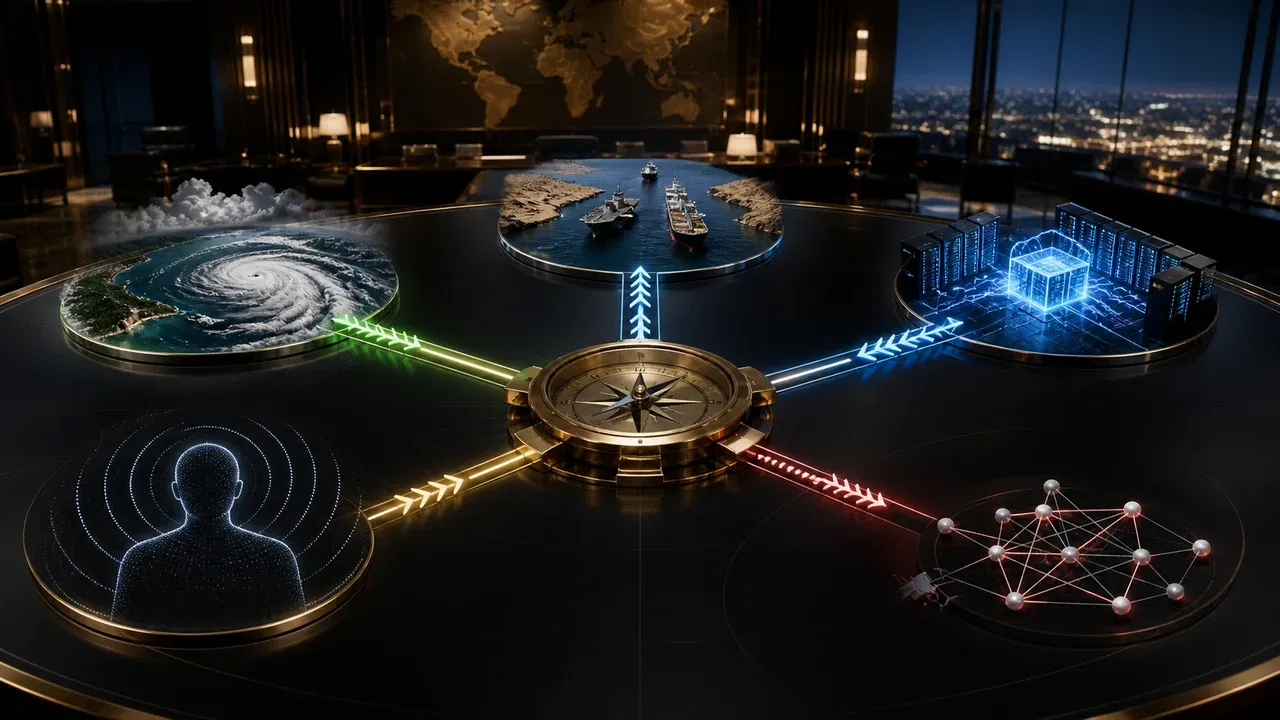
The day’s residual signals coalesce into a pressure field of systemic fragility masked by transient or opaque events. Hurricane Lala Impacts Hawaii exposes the acute vulnerability of isolated physical infrastructure to extreme stress, where the grid’s failure under pressure mirrors the fragility of digital systems. X Open-Sources Ranking Algorithm introduces a layer of informational opacity, where the act of transparency is itself a strategic maneuver, leaving the true nature of platform governance unclear and dependent on proprietary context. US Retail Sales Slump in July reflects the cooling of consumer confidence, suggesting that the economic foundation supporting technological expansion is weakening, with the slump indicating a normalization rather than a collapse but still signaling underlying fatigue. 1.58-bit Large Language Models represents a breakthrough in efficiency that challenges current computational limits, yet its adoption remains uncertain, highlighting the gap between technical potential and practical deployment. St. Lucie Nuclear Reactor Unit 1 Manual Shutdown underscores the persistent risk of mechanical failure in critical energy infrastructure, serving as a reminder that even highly reliable systems are subject to sudden, unpredictable breakdowns. Together, these signals reveal a landscape where physical and digital systems are reaching their stress limits, with uncertainty lagging behind immediate reporting and creating a crisis of verifiable truth. [2]blog.thenoblehouse.aiEvening Brief — August 16, 2026Open the source to inspect the supporting evidence.Open source ↗[1]blog.thenoblehouse.aiMorning Brief — August 16, 2026Open the source to inspect the supporting evidence.Open source ↗
[1]blog.thenoblehouse.aiMorning Brief — August 16, 2026Open the source to inspect the supporting evidence.Open source ↗ [2]blog.thenoblehouse.aiEvening Brief — August 16, 2026Open the source to inspect the supporting evidence.Open source ↗
Cross-Field Convergence
The accepted bridge between prevailing and residual evidence reveals a tension between high-magnitude geopolitical/financial risks and lower-magnitude but high-uncertainty residual signals. The geopolitical escalation in the Strait of Hormuz and the massive financial leverage of NVIDIA’s $500 billion deal create a high-stakes environment where systemic risks are amplified by the fragility of underlying infrastructure. The residual signals, including the nuclear shutdown and retail slump, highlight vulnerabilities that are often dwarfed by immediate political and economic shocks but may signal deeper systemic decay. The opacity of X’s algorithm and Apple’s China partnership further complicates the landscape, as strategic transparency and compliance mask underlying dependencies and risks. This convergence suggests that the true stability of the current system is compromised by the interplay of aggressive expansion and hidden fragility, requiring stakeholders to monitor both overt threats and subtle indicators of decay. [2]blog.thenoblehouse.aiEvening Brief — August 16, 2026Open the source to inspect the supporting evidence.Open source ↗[1]blog.thenoblehouse.aiMorning Brief — August 16, 2026Open the source to inspect the supporting evidence.Open source ↗
[1]blog.thenoblehouse.aiMorning Brief — August 16, 2026Open the source to inspect the supporting evidence.Open source ↗ [2]blog.thenoblehouse.aiEvening Brief — August 16, 2026Open the source to inspect the supporting evidence.Open source ↗
Final Day Synthesis
The day is defined by the interplay of high-magnitude geopolitical and financial risks with residual signals that highlight systemic vulnerabilities. The stronger day-level conclusion is that the stability of the current technological and economic order is increasingly dependent on the management of opaque dependencies and fragile infrastructure. Bounded uncertainty remains in the transition of geopolitical rhetoric to policy and the lagging nature of economic data. Next watches include Strait of Hormuz naval movements, NVIDIA financing terms, and retail sales trends. [2]blog.thenoblehouse.aiEvening Brief — August 16, 2026Open the source to inspect the supporting evidence.Open source ↗[1]blog.thenoblehouse.aiMorning Brief — August 16, 2026Open the source to inspect the supporting evidence.Open source ↗
[1]blog.thenoblehouse.aiMorning Brief — August 16, 2026Open the source to inspect the supporting evidence.Open source ↗ [2]blog.thenoblehouse.aiEvening Brief — August 16, 2026Open the source to inspect the supporting evidence.Open source ↗