
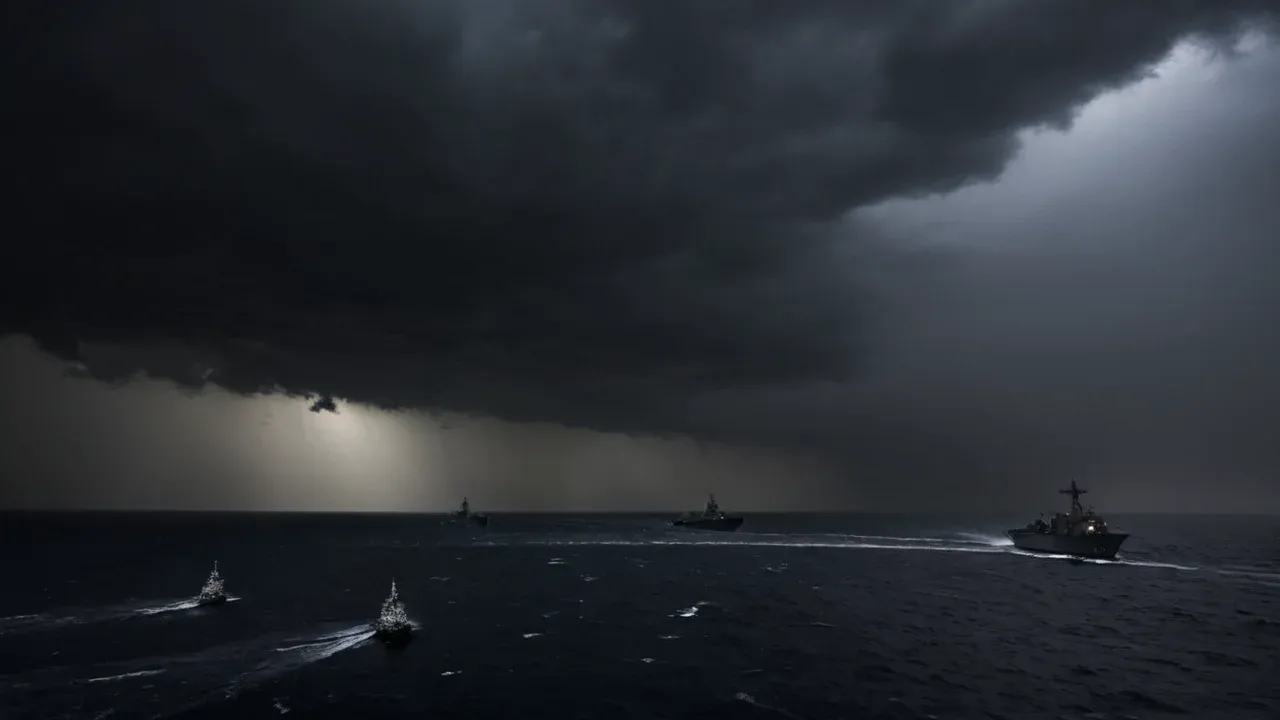
Listen to this article
Narrated by Charlotte · The Noble House
History becomes signal when time supplies the missing context.
2Briefs analyzed
10Signals inherited
5Patterns mapped
2/5Native forecasts
Executive Orientation
The Strait of Hormuz stands as a theater of rhetorical escalation, where legal baselines are challenged by unilateral claims of territorial control. At the same time, the global AI economy undergoes a structural repricing as DeepSeek ends its subsidy-driven price war. Domestic stability is tested by the termination of Temporary Protected Status for a million individuals, while technological sovereignty is redefined by Apple’s proprietary localization in China. These prevailing signals intersect with a residual field of institutional fragility: recurring biological threats to nuclear infrastructure, divergence in AI moral alignment, symbolic vandalism, and shifting enterprise AI economics. The day reveals systemic overextension, where external dominance claims mask internal technical and social erosion.
Signal 1: Geopolitical Escalation Over the Strait of Hormuz

Original signal
President Donald Trump announced plans to declare the Strait of Hormuz a territory of the United States during an address in New York on August 14, 2026. [1]blog.thenoblehouse.aiMorning Brief — August 15, 2026Open the source to inspect the supporting evidence.Open source ↗ Brief evidence
Why it mattered
The claim to declare an international waterway as US territory represents the highest magnitude breach of international law and geopolitical stability. It directly threatens global energy supply chains (systemic reach) and carries immediate forward consequences for inflation and conflict. The momentum is high due to active rhetorical escalation, and the persistence is critical as it redefines the rules of engagement in a multipolar world.
What happened
Iran has strongly rejected the claim, dismissing Trump's remarks as delusions and asserting that the opening and closure of the Strait is not within US authority. [1]blog.thenoblehouse.aiMorning Brief — August 15, 2026Open the source to inspect the supporting evidence.Open source ↗ The Strait of Hormuz is a critical global waterway through which a significant portion of the world's oil passes. [1]blog.thenoblehouse.aiMorning Brief — August 15, 2026Open the source to inspect the supporting evidence.Open source ↗ The claim that the US can declare a foreign international waterway a territory lacks legal basis under international law and is rejected by Iran. [1]blog.thenoblehouse.aiMorning Brief — August 15, 2026Open the source to inspect the supporting evidence.Open source ↗
Changed conditions
Strengthened.
Unexpected forces No additional supported observation was available within the review window.
Calibration lesson
Uncertainty remains: Legal basis for the claim is nonexistent, making the reaction unpredictable.
Pattern bridge
No additional supported observation was available within the review window.
Next watch
Naval movements in the Strait and formal Iranian military responses.
At selection Selected at high confidence. The claim to declare an international waterway as US territory represents the highest magnitude breach of international law and geopolitical stability. It directly threatens global energy supply chains (systemic reach) and carries immediate forward consequences for inflation and conflict. The momentum is high due to active rhetorical escalation, and the persistence is critical as it redefines the rules of engagement in a multipolar world.
During the window The review-window evidence recorded: President Donald Trump announced plans to declare the Strait of Hormuz a territory of the United States during an address in New York on August 14, 2026. [1]blog.thenoblehouse.aiMorning Brief — August 15, 2026Open the source to inspect the supporting evidence.Open source ↗ Iran has strongly rejected the claim, dismissing Trump's remarks as delusions and asserting that the opening and closure of the Strait is not within US authority. [1]blog.thenoblehouse.aiMorning Brief — August 15, 2026Open the source to inspect the supporting evidence.Open source ↗ The Strait of Hormuz is a critical global waterway through which a significant portion of the world's oil passes. [1]blog.thenoblehouse.aiMorning Brief — August 15, 2026Open the source to inspect the supporting evidence.Open source ↗ The claim that the US can declare a foreign international waterway a territory lacks legal basis under international law and is rejected by Iran. [1]blog.thenoblehouse.aiMorning Brief — August 15, 2026Open the source to inspect the supporting evidence.Open source ↗
At review The trajectory remains strengthened. The remaining uncertainty is Legal basis for the claim is nonexistent, making the reaction unpredictable. The analytical focus is to Monitor for kinetic escalation or formal diplomatic rejection that alters the legal baseline.
YES · favorWill any major geopolitical entity issue a formal diplomatic protest or military mobilization in response to the claim within 72h? Horizon 72h.
UnavailableNo native Compass forecast identity exists in the inherited Brief evidence.
Compass Strategic Intelligence
Signal 2: Geopolitical Rhetoric and Energy Security

Original signal
Iran military dismissed US claim that Washington has total control over the Strait of Hormuz as lies and fabrications. [2]blog.thenoblehouse.aiEvening Brief — August 15, 2026Open the source to inspect the supporting evidence.Open source ↗ Brief evidence
Why it mattered
This signal reinforces the Strait of Hormuz narrative with specific claims of 'total control.' It maintains the high systemic reach regarding global energy markets. The forward consequence is severe if rhetoric translates to action. Momentum is sustained by the 'war of words' dynamic, and persistence is high as it challenges existing sovereignty norms.
What happened
Donald Trump warns Iran against closing Strait of Hormuz; tensions escalated after Trump reportedly warned Iranian officials about the consequences of shutting down the Strait of Hormuz again. [2]blog.thenoblehouse.aiEvening Brief — August 15, 2026Open the source to inspect the supporting evidence.Open source ↗ Fox News correspondent Alex Hogan reports on President Donald Trumps latest maneuvering on Iran. [2]blog.thenoblehouse.aiEvening Brief — August 15, 2026Open the source to inspect the supporting evidence.Open source ↗ The dispute over the Strait of Hormuz is characterized as a war of words, with Tehran asserting complete management and control while dismissing US claims of total control as fabrications. [2]blog.thenoblehouse.aiEvening Brief — August 15, 2026Open the source to inspect the supporting evidence.Open source ↗
Changed conditions
Strengthened.
Unexpected forces No additional supported observation was available within the review window.
Calibration lesson
Uncertainty remains: Whether the rhetoric is binding policy or negotiation posturing.
Pattern bridge
No additional supported observation was available within the review window.
Next watch
Shift from 'war of words' to physical naval posturing.
At selection Selected at high confidence. This signal reinforces the Strait of Hormuz narrative with specific claims of 'total control.' It maintains the high systemic reach regarding global energy markets. The forward consequence is severe if rhetoric translates to action. Momentum is sustained by the 'war of words' dynamic, and persistence is high as it challenges existing sovereignty norms.
During the window The review-window evidence recorded: Iran military dismissed US claim that Washington has total control over the Strait of Hormuz as lies and fabrications. [2]blog.thenoblehouse.aiEvening Brief — August 15, 2026Open the source to inspect the supporting evidence.Open source ↗ Donald Trump warns Iran against closing Strait of Hormuz; tensions escalated after Trump reportedly warned Iranian officials about the consequences of shutting down the Strait of Hormuz again. [2]blog.thenoblehouse.aiEvening Brief — August 15, 2026Open the source to inspect the supporting evidence.Open source ↗ Fox News correspondent Alex Hogan reports on President Donald Trumps latest maneuvering on Iran. [2]blog.thenoblehouse.aiEvening Brief — August 15, 2026Open the source to inspect the supporting evidence.Open source ↗ The dispute over the Strait of Hormuz is characterized as a war of words, with Tehran asserting complete management and control while dismissing US claims of total control as fabrications. [2]blog.thenoblehouse.aiEvening Brief — August 15, 2026Open the source to inspect the supporting evidence.Open source ↗
At review The trajectory remains strengthened. The remaining uncertainty is Whether the rhetoric is binding policy or negotiation posturing. The analytical focus is to Assess the gap between rhetorical threats and actual military capability or intent.
UnavailableNo native Compass forecast identity exists in the inherited Brief evidence.
Compass Strategic Intelligence
Signal 3: End of the AI Price War and Market Repricing

Original signal
DeepSeek has warned developers of a significant API price increase in the near term without disclosing specific effective dates or magnitudes. [1]blog.thenoblehouse.aiMorning Brief — August 15, 2026Open the source to inspect the supporting evidence.Open source ↗ Brief evidence
Why it mattered
DeepSeek's price hike signals a structural shift in the AI economy from subsidized growth to cost recovery. It has significant forward consequences for startup viability and market consolidation. Systemic reach is broad across the tech ecosystem. Momentum is strong as competitors adjust, and persistence is high as it defines the new economic baseline for AI infrastructure.
What happened
The community is reacting negatively to the price hike, viewing the reversal of DeepSeek's low-cost strategy as a betrayal of its open ethos. [1]blog.thenoblehouse.aiMorning Brief — August 15, 2026Open the source to inspect the supporting evidence.Open source ↗ Three main factors for the price increase are runaway demand, capacity constraints, and a strategic shift to revenue generation. [1]blog.thenoblehouse.aiMorning Brief — August 15, 2026Open the source to inspect the supporting evidence.Open source ↗ DeepSeek founder Jun Song has attempted to reassure users by claiming that the new prices will still be lower than those of major competitors like Anthropic and Moonshot. [1]blog.thenoblehouse.aiMorning Brief — August 15, 2026Open the source to inspect the supporting evidence.Open source ↗ It is unclear how this price hike will affect the broader open-source AI ecosystem, specifically regarding self-hosting and alternative model adoption. [1]blog.thenoblehouse.aiMorning Brief — August 15, 2026Open the source to inspect the supporting evidence.Open source ↗
Changed conditions
Emerged.
Unexpected forces No additional supported observation was available within the review window.
Calibration lesson
Uncertainty remains: Magnitude and timing of the price increases are not fully disclosed.
Pattern bridge
No additional supported observation was available within the review window.
Next watch
Competitor pricing announcements and enterprise budget shifts.
At selection Selected at high confidence. DeepSeek's price hike signals a structural shift in the AI economy from subsidized growth to cost recovery. It has significant forward consequences for startup viability and market consolidation. Systemic reach is broad across the tech ecosystem. Momentum is strong as competitors adjust, and persistence is high as it defines the new economic baseline for AI infrastructure.
During the window The review-window evidence recorded: DeepSeek has warned developers of a significant API price increase in the near term without disclosing specific effective dates or magnitudes. [1]blog.thenoblehouse.aiMorning Brief — August 15, 2026Open the source to inspect the supporting evidence.Open source ↗ The community is reacting negatively to the price hike, viewing the reversal of DeepSeek's low-cost strategy as a betrayal of its open ethos. [1]blog.thenoblehouse.aiMorning Brief — August 15, 2026Open the source to inspect the supporting evidence.Open source ↗ Three main factors for the price increase are runaway demand, capacity constraints, and a strategic shift to revenue generation. [1]blog.thenoblehouse.aiMorning Brief — August 15, 2026Open the source to inspect the supporting evidence.Open source ↗ DeepSeek founder Jun Song has attempted to reassure users by claiming that the new prices will still be lower than those of major competitors like Anthropic and Moonshot. [1]blog.thenoblehouse.aiMorning Brief — August 15, 2026Open the source to inspect the supporting evidence.Open source ↗ It is unclear how this price hike will affect the broader open-source AI ecosystem, specifically regarding self-hosting and alternative model adoption. [1]blog.thenoblehouse.aiMorning Brief — August 15, 2026Open the source to inspect the supporting evidence.Open source ↗
At review The trajectory remains emerged. The remaining uncertainty is Magnitude and timing of the price increases are not fully disclosed. The analytical focus is to Track the ripple effects on competitor pricing and developer adoption rates.
YES · favorWill technology adoption related to "DeepSeek Is Raising Prices, and the Community Is Not Happy" be independently verified within 72h? Horizon 72h.
UnavailableNo native Compass forecast identity exists in the inherited Brief evidence.
Compass Strategic Intelligence
Compass Strategic Intelligence
Compass Strategic Intelligence
Signal 4: Termination of Temporary Protected Status

Original signal
DHS confirmed the termination of TPS protections, described by supporters as restoring integrity to the system. [1]blog.thenoblehouse.aiMorning Brief — August 15, 2026Open the source to inspect the supporting evidence.Open source ↗ Brief evidence
Why it mattered
The termination of TPS affects ~1 million individuals, representing a high magnitude humanitarian and legal event. While systemic reach is primarily domestic US social stability, the forward consequence involves legal challenges and humanitarian crises. Momentum is high due to judicial clearance. Persistence is high as it alters the legal status of a large population.
What happened
Federal judges have removed legal stays that previously blocked the administration from ending TPS for specific nationalities including Somalia and Haiti. [1]blog.thenoblehouse.aiMorning Brief — August 15, 2026Open the source to inspect the supporting evidence.Open source ↗ The terminations affect approximately 1 million individuals globally, with significant impacts on Haitian and Somali communities in the US. [1]blog.thenoblehouse.aiMorning Brief — August 15, 2026Open the source to inspect the supporting evidence.Open source ↗
Changed conditions
Reversed.
Unexpected forces No additional supported observation was available within the review window.
Calibration lesson
Uncertainty remains: Potential for further judicial stays or policy modifications.
Pattern bridge
No additional supported observation was available within the review window.
Next watch
Legal challenges to the termination and deportation logistics.
At selection Selected at high confidence. The termination of TPS affects ~1 million individuals, representing a high magnitude humanitarian and legal event. While systemic reach is primarily domestic US social stability, the forward consequence involves legal challenges and humanitarian crises. Momentum is high due to judicial clearance. Persistence is high as it alters the legal status of a large population.
During the window The review-window evidence recorded: DHS confirmed the termination of TPS protections, described by supporters as restoring integrity to the system. [1]blog.thenoblehouse.aiMorning Brief — August 15, 2026Open the source to inspect the supporting evidence.Open source ↗ Federal judges have removed legal stays that previously blocked the administration from ending TPS for specific nationalities including Somalia and Haiti. [1]blog.thenoblehouse.aiMorning Brief — August 15, 2026Open the source to inspect the supporting evidence.Open source ↗ The terminations affect approximately 1 million individuals globally, with significant impacts on Haitian and Somali communities in the US. [1]blog.thenoblehouse.aiMorning Brief — August 15, 2026Open the source to inspect the supporting evidence.Open source ↗
At review The trajectory remains reversed. The remaining uncertainty is Potential for further judicial stays or policy modifications. The analytical focus is to Monitor legal appeals and humanitarian impact metrics.
UnavailableNo native Compass forecast identity exists in the inherited Brief evidence.
Compass Strategic Intelligence
Compass Strategic Intelligence
Compass Strategic Intelligence
Signal 5: Apple's Proprietary AI Localization in China

Original signal
Apple has trained its own proprietary LLM specifically for the Chinese market. [1]blog.thenoblehouse.aiMorning Brief — August 15, 2026Open the source to inspect the supporting evidence.Open source ↗ Brief evidence
Why it mattered
Apple's move to a proprietary model in China sets a precedent for technological fragmentation and sovereignty. It has forward consequences for global AI governance and market access. Systemic reach is significant for tech supply chains. Momentum is moderate as it is a strategic shift rather than an acute crisis. Persistence is high as it establishes a new regulatory compliance model.
What happened
The model was developed in partnership with Alibaba Group. [1]blog.thenoblehouse.aiMorning Brief — August 15, 2026Open the source to inspect the supporting evidence.Open source ↗ Apple is reportedly the first foreign company approved to offer its own proprietary AI model within China. [1]blog.thenoblehouse.aiMorning Brief — August 15, 2026Open the source to inspect the supporting evidence.Open source ↗ Apple Intelligence features in China were previously limited or unavailable due to regulatory hurdles. [1]blog.thenoblehouse.aiMorning Brief — August 15, 2026Open the source to inspect the supporting evidence.Open source ↗ Software localization has evolved from translating interfaces to adapting formats and layouts for cultural norms. [1]blog.thenoblehouse.aiMorning Brief — August 15, 2026Open the source to inspect the supporting evidence.Open source ↗ AI localization involves customizing LLM outputs to meet diverse language and cultural needs. [1]blog.thenoblehouse.aiMorning Brief — August 15, 2026Open the source to inspect the supporting evidence.Open source ↗ The partnership with Alibaba is a strategic necessity to comply with China's data sovereignty and AI governance laws. [1]blog.thenoblehouse.aiMorning Brief — August 15, 2026Open the source to inspect the supporting evidence.Open source ↗ Apple's move signifies deep localization by retraining the intelligence itself rather than just translating its output. [1]blog.thenoblehouse.aiMorning Brief — August 15, 2026Open the source to inspect the supporting evidence.Open source ↗
Changed conditions
Emerged.
Unexpected forces No additional supported observation was available within the review window.
Calibration lesson
Uncertainty remains: Scope of the proprietary model and future regulatory changes.
Pattern bridge
No additional supported observation was available within the review window.
Next watch
Implementation details of the Apple-Alibaba partnership.
At selection Selected at medium confidence. Apple's move to a proprietary model in China sets a precedent for technological fragmentation and sovereignty. It has forward consequences for global AI governance and market access. Systemic reach is significant for tech supply chains. Momentum is moderate as it is a strategic shift rather than an acute crisis. Persistence is high as it establishes a new regulatory compliance model.
During the window The review-window evidence recorded: Apple has trained its own proprietary LLM specifically for the Chinese market. [1]blog.thenoblehouse.aiMorning Brief — August 15, 2026Open the source to inspect the supporting evidence.Open source ↗ The model was developed in partnership with Alibaba Group. [1]blog.thenoblehouse.aiMorning Brief — August 15, 2026Open the source to inspect the supporting evidence.Open source ↗ Apple is reportedly the first foreign company approved to offer its own proprietary AI model within China. [1]blog.thenoblehouse.aiMorning Brief — August 15, 2026Open the source to inspect the supporting evidence.Open source ↗ Apple Intelligence features in China were previously limited or unavailable due to regulatory hurdles. [1]blog.thenoblehouse.aiMorning Brief — August 15, 2026Open the source to inspect the supporting evidence.Open source ↗ Software localization has evolved from translating interfaces to adapting formats and layouts for cultural norms. [1]blog.thenoblehouse.aiMorning Brief — August 15, 2026Open the source to inspect the supporting evidence.Open source ↗ AI localization involves customizing LLM outputs to meet diverse language and cultural needs. [1]blog.thenoblehouse.aiMorning Brief — August 15, 2026Open the source to inspect the supporting evidence.Open source ↗ The partnership with Alibaba is a strategic necessity to comply with China's data sovereignty and AI governance laws. [1]blog.thenoblehouse.aiMorning Brief — August 15, 2026Open the source to inspect the supporting evidence.Open source ↗ Apple's move signifies deep localization by retraining the intelligence itself rather than just translating its output. [1]blog.thenoblehouse.aiMorning Brief — August 15, 2026Open the source to inspect the supporting evidence.Open source ↗
At review The trajectory remains emerged. The remaining uncertainty is Scope of the proprietary model and future regulatory changes. The analytical focus is to Monitor regulatory precedents and the independence of the proprietary model.
UnavailableNo native Compass forecast identity exists in the inherited Brief evidence.
Compass Strategic Intelligence
Compass Strategic Intelligence
Compass Strategic Intelligence
Residual Field: The Signal of Institutional and Technical Fragility
The residual field reveals a systemic erosion of reliability across physical, digital, and social infrastructures. Recurring Biological Threats to Nuclear Infrastructure expose the vulnerability of critical energy assets to environmental anomalies, as seen in the jellyfish-induced shutdowns at Gravelines. Simultaneously, Divergence in AI Vulnerability Capabilities highlights a shift in the technological baseline where security and cost are becoming primary constraints, with models like GLM-5.3 leading in detection but lagging in exploitation. Domestic Civil Order and Symbolic Vandalism serves as a symbolic indicator of fracturing social cohesion, exemplified by the vandalism of the WWII Memorial. Economic Shifts in Enterprise AI Infrastructure indicate a pivot toward cost-efficient, open-source models, driven by the need to mitigate rising costs of proprietary systems. Finally, Divergence in Moral Alignment Metrics underscores a fundamental gap in the trust architecture of AI systems, where surface-level agreement masks underlying misalignment. Together, these signals depict a world where foundational stability is being replaced by managed fragility. Morning Brief Evening Brief
Cross-Field Convergence
The convergence of prevailing and residual evidence points to a state of systemic overextension. Aggressive geopolitical posturing over the Strait of Hormuz masks internal technical vulnerabilities, such as the fragility of nuclear infrastructure and the divergence in AI moral alignment. The acceleration of "deep localization" in Apple’s China strategy mirrors the economic restructuring in AI pricing, as both domains move away from open, globalized norms toward controlled, proprietary frameworks. The termination of TPS and the vandalism of the WWII Memorial reflect a breakdown in predictable enforcement and social cohesion, paralleling the legal instability in geopolitical claims. The opportunity for cost-efficient, agentic AI solutions like Palmyra X6 offers a strategic opening to mitigate rising costs, but it also introduces geopolitical risks through reliance on foreign open-source foundations. This convergence suggests that stable frameworks are being replaced by fragmented, high-volatility dynamics, where legal and economic norms are actively contested. Morning Brief Evening Brief
Final Day Synthesis
August 15, 2026, is defined by the intersection of geopolitical rupture, economic restructuring, and institutional fragility. The stronger day-level conclusion is that stable, predictable global systems have ended, replaced by fragmented authority where power asserts itself through rhetorical shocks, market manipulation, and regulatory fragmentation. Bounded uncertainty remains in the potential for kinetic escalation in the Strait of Hormuz and the legal challenges to the TPS termination. Next watches include naval movements in the Strait, competitor pricing announcements, implementation details of the Apple-Alibaba partnership, and legal challenges to the TPS termination. The courage to admit that old frameworks are broken is required to build new ones. Morning Brief Evening Brief