

🎧 Listen to this article
Narrated by Talon · The Noble House
In January 2026, Meta shipped a 50-kilobyte runtime that turns your phone into an AI inference engine.
No cloud. No server. No round trip. Just your phone, running a language model against its own silicon. ExecuTorch 1.0 wasn't a proof of concept. Apple, Qualcomm, Google, and Meta have all converged on the same conclusion: the next battlefield in AI is not the data center. It's the rectangle in your pocket.
Every major smartphone chip since 2023 includes a dedicated neural processing unit
Apple's A18 Pro, powering the iPhone 16 Pro, delivers 35 TOPS (trillions of operations per second) through its Neural Engine. Qualcomm's Snapdragon 8 Elite, announced October 2025, pushes 75 TOPS through its Hexagon NPU. Google's Tensor G4 and Samsung's Exynos 2500 both include dedicated AI accelerators.
But raw TOPS numbers are misleading. Vikas Chandra and Raghuraman Krishnamoorthi, in their January 2026 survey "On-Device LLMs: State of the Union, 2026" published through the Edge AI and Vision Alliance, identified the real bottleneck: memory bandwidth. Mobile devices have 50 to 90 gigabytes per second. Data center GPUs have 2 to 3 terabytes per second. That 30x gap is what actually determines how fast a model generates text on your phone.
This constraint reshaped the entire approach to on-device AI. Instead of scaling models up and hoping hardware catches up, the industry learned to build smaller, sharper models designed for mobile from the start.
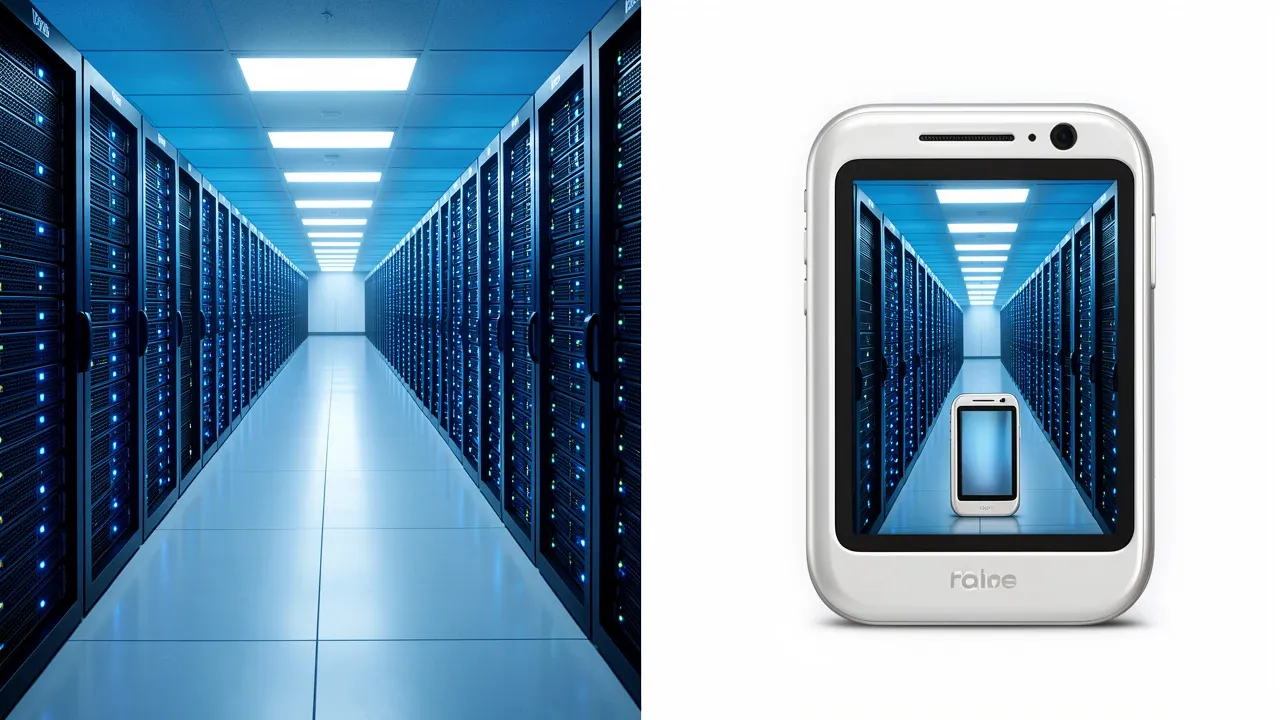
Two years ago, useful AI required 7 billion parameters. Today, sub-billion models do real work.
Meta's Llama 3.2 ships in 1-billion and 3-billion parameter variants explicitly designed for phones. Google's Gemma 3, released early 2025, scales down to 270 million parameters. Microsoft's Phi-4 Mini sits at 3.8 billion. Alibaba's Qwen 2.5 starts at 500 million.
The key technique is quantization: compressing a model from 16-bit precision to 4-bit, which cuts both storage and memory traffic by 4x per token generated. Methods like GPTQ, AWQ, and SmoothQuant have matured to the point where a 4-bit quantized model retains most of its full-precision quality. Researchers at MIT, in their ParetoQ paper presented at a 2025 machine learning conference, found that at 2 bits and below, models learn fundamentally different representations, optimized for extreme efficiency rather than just compressed.
Speculative decoding adds another 2 to 3x speedup: a tiny draft model proposes multiple tokens and a larger model verifies them in parallel. The one-token-at-a-time bottleneck is cracking open.
Apple's bet is the most aggressive: keep computation local, data on-device
Apple Intelligence, announced at WWDC 2024 and expanded at WWDC 2025, is built on a layered architecture. Tasks that can run locally, including text rewriting, photo editing, notification summarization, and real-time translation, stay on the device entirely. Only when a task exceeds the phone's capacity does it reach Apple's Private Cloud Compute, which runs on dedicated Apple Silicon servers designed so that Apple itself cannot access user data in transit.
The Foundation Models framework, opened to third-party developers in June 2025 per Apple's newsroom, gives app developers access to on-device intelligence that works offline (Apple Newsroom, Jun 2025). When your weather app summarizes the forecast, when your email client drafts a reply, when your camera identifies a plant, none of that phones home. The computation happens locally against the Neural Engine, and the data never leaves the device.
This is not altruism. It's strategy. Apple's business model depends on selling hardware at premium prices. If AI requires a cloud subscription, the hardware premium becomes harder to justify. By making the phone itself the AI engine, Apple turns every Neural Engine upgrade into a reason to buy the next iPhone.
Data that never leaves the device cannot be breached, subpoenaed, or sold
In a world where the FTC has fined data brokers hundreds of millions of dollars, where the EU's AI Act imposes strict data processing requirements, and where consumers increasingly distrust cloud services, the phone-as-data-center model offers something no server farm can: zero-transmission privacy.
When a language model runs on your phone to compose a text message, the message's context, including who you're talking to, what you're saying, and what you said before, never exists on a remote server. There is no breach vector because there is no transmission. The attack surface shrinks to the physical device in your hand. For healthcare, finance, legal work, and journalism, on-device AI changes the risk calculus entirely.

The economics of on-device AI are too compelling to ignore
Running large language models in data centers costs between $0.01 and $0.10 per query depending on model size and complexity. At scale, millions of users making dozens of queries per day, the serving costs become staggering. Morgan Stanley estimated in November 2025 that AI inference costs for major cloud providers would exceed $50 billion annually by 2027.
Shifting inference to user hardware transfers that cost to the consumer, who has already paid for the silicon. The phone's NPU sits idle most of the time, waiting for a photo to process, a notification to summarize, a voice command to parse. Using that idle capacity for AI inference costs the cloud provider exactly nothing. Meta's ExecuTorch, with its 50-kilobyte runtime footprint, was built for exactly this arithmetic: deploy the model once, run it on billions of devices, pay for zero inference.
On-device AI is not replacing cloud AI. It's partitioning the workload. Frontier reasoning, including multi-step problem solving and long-context analysis, still requires models too large for any phone. The emerging architecture is hybrid: routine tasks run locally, complex tasks escalate to the cloud, and the user's data stays on-device unless explicitly shared.
Your phone is not becoming a data center. It already is one. The 3 billion smartphones on Earth are quietly assembling the largest distributed AI infrastructure ever built.
Sources
Sources: Edge AI and Vision Alliance / Chandra & Krishnamoorthi, "On-Device LLMs: State of the Union, 2026" (Jan 2026) · Apple Newsroom, WWDC 2025 Foundation Models announcement (Jun 2025) · Qualcomm, Snapdragon 8 Elite launch (Oct 2025) · Meta, ExecuTorch 1.0 release (Jan 2026) · Morgan Stanley, AI infrastructure cost estimate (Nov 2025) · MIT, ParetoQ research (2025) · Local AI Master, NPU comparison (Feb 2026)
