

🎧 Listen to this article
Narrated by Talon · The Noble House
In January 2026, Yann LeCun confirmed AMI Labs, his new startup focused entirely on world models. Within weeks of launch, the company was in discussions to raise $500 million at a $3.5 billion valuation, with a reported path to $5 billion. *(TechCrunch, December 2025; Built In, January 2026)* LeCun left Meta after 13 years as chief AI scientist. The Turing Award winner who spent three years publicly arguing that large language models are a dead end is now betting his reputation and a multi-billion dollar raise on a different architecture entirely.
The same month, Google DeepMind published updates on Genie 3, their system for generating interactive 3D environments from text descriptions and images. Not generating text about environments. Generating the environments themselves, with physics, spatial relationships, and causal rules objects actually follow. *(Ars Technica, August 2025)*
If you follow AI through mainstream coverage, you probably missed both stories. They were buried under chatbot benchmarks and prompt engineering debates. That is a significant miss.
Language models predict tokens. World models predict consequences.
A large language model trains to predict the next token in a sequence. Given a string of text, what word comes next? The training objective is statistical: generate sequences that match training data patterns. The results are impressive. The mechanism is fundamentally linguistic.
A world model trains to predict what happens next in a system. Not what word follows what word, but what state follows what state. Drop a ball: what trajectory? Push a box toward an edge: does it fall? Open a valve in a pipe network: where does the water go? The training objective is physical: learn the rules governing how things change over time.
LLMs can answer questions about physics. They have read enough textbooks. But they do not simulate physics. They pattern-match against descriptions of physics. Ask GPT-5 about fluid dynamics and you get a textbook answer. Put it in charge of routing fluid through a novel pipe configuration and it fails, because it has a model of how people write about fluids, not how fluids actually behave. Those are different things.

The robotics connection is where this becomes commercially real
World models sound abstract until you connect them to robotics. Then they become the most important unsolved problem in a trillion-dollar industry.
Every major robotics effort faces the same wall: the robot executes pre-programmed movements but cannot adapt to novel situations in real time. A warehouse robot follows a path and picks objects from known locations. Rearrange the warehouse and it is lost. Introduce an unexpected obstacle and it freezes. The missing piece is an internal model that lets the robot predict what will happen if it takes a given action in a given environment, without looking up the answer in a database.
DeepMind's Genie 3 hints at what this looks like in practice: generate a 3D environment, populate it with objects that follow physical rules, let an agent interact and build an internal model of how things work. The agent learns that heavy objects fall faster and that pushing a stack of boxes from the side topples them the same way a child does: by trying things and watching what happens.
Apply this to a humanoid robot in a kitchen. The robot does not need a separate program for every task. It needs a world model that understands containers, liquids, gravity, heat, and spatial relationships. From that model, it figures out novel tasks by simulating them internally before executing them physically.
This is why LeCun's lab is raising at a $5 billion valuation before shipping a product. Whoever cracks world models at scale unlocks general-purpose robotics. The global robotics market is projected to exceed $200 billion by 2030. *(MarketsandMarkets, 2025)*
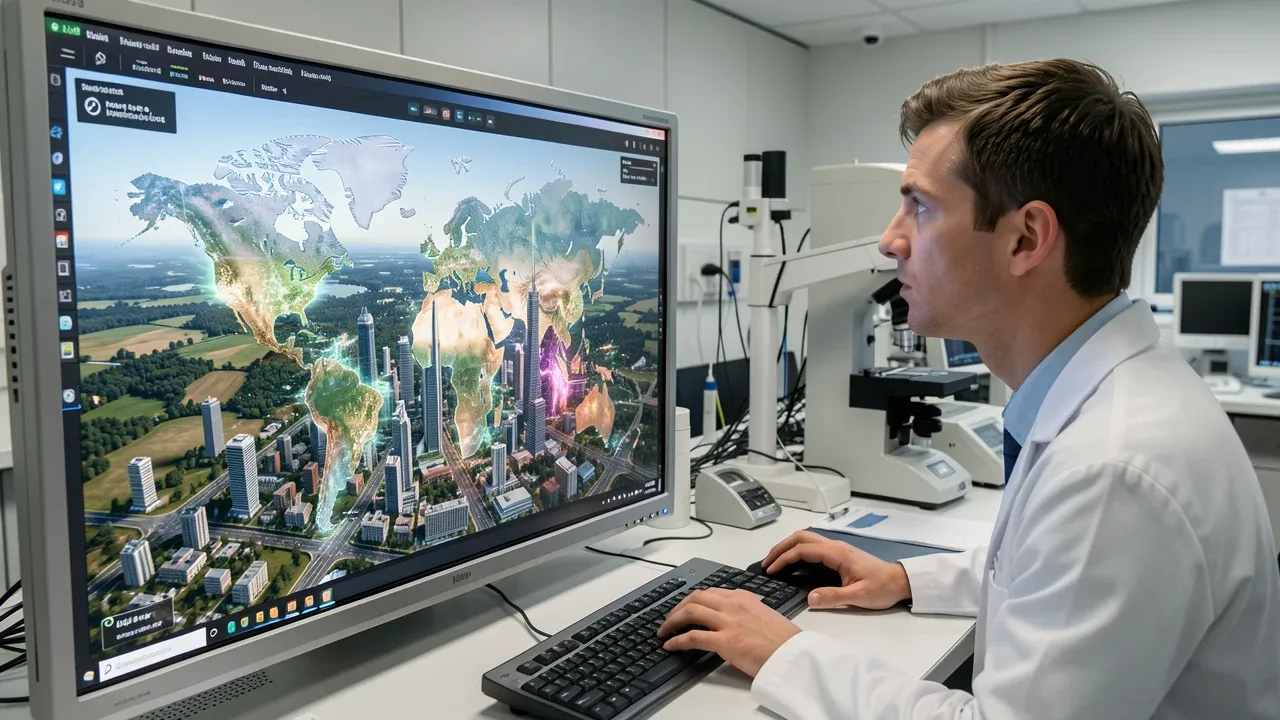
The strongest objection is that nobody has made this work at scale yet
Fair. LeCun has argued this for years. The results, while promising in research, have not produced anything remotely comparable to what LLMs deliver in production today. World models are pre-product. Many promising AI paradigms have failed to cross from research to production.
But three things are different now. First, compute is abundant. World models need enormous training runs on video and simulation data. The data center buildout happening right now, the $350 to $500 billion being poured into GPUs and infrastructure, creates the compute substrate world model training requires. *(FX Empire, 2026)* The infrastructure is being built for LLMs. It will serve world models equally well.
Second, simulation environments have matured. NVIDIA's Omniverse, Unity's ML-Agents, DeepMind's internal platforms. The tools for generating training data are production-grade in a way they were not five years ago. You no longer wait for a robot to physically interact with the real world. You simulate millions of interactions in parallel.
Third, the economic incentive has arrived. Every company building robots is blocked on the same problem. The demand signal for world models is commercial desperation, not academic curiosity.
Two tracks that will converge
Track one: language models getting multimodal. GPT-5, Gemini, Claude absorbing vision, audio, video. The argument from this camp: you do not need a separate world model architecture. A sufficiently powerful multimodal model that has consumed enough video data develops implicit physical understanding.
Track two: dedicated world model architectures. LeCun's AMI Labs, DeepMind's Genie, research efforts building systems specifically designed to learn physics from simulation and video.
The tracks will converge. Within five years, the distinction between multimodal language model and world model with linguistic interface will blur. The surviving architecture will do both. Whether it gets there by starting from text and adding physics, or starting from physics and adding text, is an engineering question. What matters is that the text-only era of AI is ending.
What to do with this
If you are building AI products: start thinking about what your product looks like when the AI reasons about physical space and causal relationships, not just text. Customer support that diagnoses a broken product from a photo. Design tools that understand structural integrity. Planning systems that simulate outcomes rather than just generate plans.
If you are investing: world model companies are the early-stage opportunity right now. The market has not priced this in because the demos are not impressive yet. LLM demos are flashy. World model demos are boring: a simulated ball bouncing correctly off a simulated surface. The boring demos are solving the harder problem.
LeCun did not leave Meta to build a slightly better chatbot. He left because he believes the LLM paradigm, for all its commercial success, is missing something fundamental. His bet: general intelligence runs through understanding reality, not through predicting text. The fact that a Turing Award winner staked his reputation on this deserves more attention than it is currently getting.
The quiet rise will get loud. The question is whether you notice before or after it does.
Sources
- TechCrunch — Yann LeCun confirms world model startup AMI Labs (December 2025)
- Built In — AMI Labs launched, raising at $3.5B valuation (January 2026)
- Ars Technica — DeepMind reveals Genie 3 world model (August 2025)
- MarketsandMarkets — Global robotics market forecast to $200B by 2030 (2025)
- FX Empire — AI infrastructure spending $350-500B projection (2026)
