
🎧 Listen to this article
Narrated by Talon · The Noble House
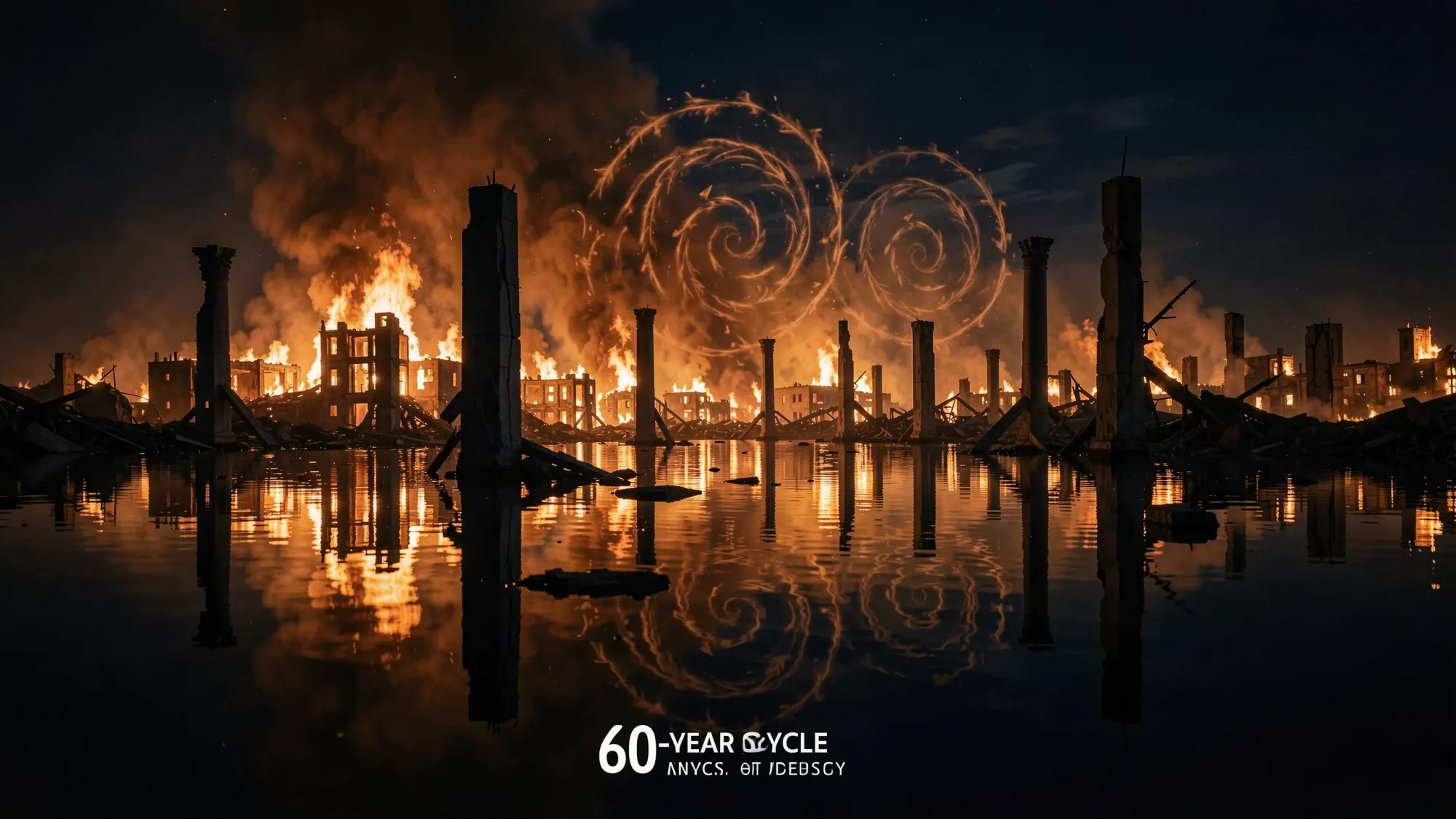
At 5:12 AM on April 18, 1906, the San Andreas Fault ruptured along 296 miles of California coastline. The ground shook for approximately 47 seconds at a magnitude of 7.9. More than 3,000 people died (Wikipedia, citing USGS). The earthquake itself caused significant damage. The fires that followed — burning for three days across 490 city blocks because the water mains had shattered — caused most of the destruction. 80% of the city fell not to the initial shock but to the cascading failure of infrastructure that had never been tested.
That distinction matters in 2026. The disruption visible today — AI displacing workers, markets swinging on sentiment, institutions revealing their fragility — is not the earthquake. It's the broken water mains. The accumulated pressure underneath is what this article is about.
🎙️ Listen: Audio version
The Structural Pattern Across Four Historical Windows
Historians and economic researchers have documented a consistent structural pattern in major disruption cycles: wealth concentration reaches an inflection point, technological change outpaces institutional adaptation, and a trigger event collapses the gap between what the system promises and what it delivers. The sequence shows up with enough consistency across roughly 60-year intervals to be worth examining as a model — not as prophecy, but as a structural prior.
1786: France spent itself financing the American Revolution while the nobility blocked every reform proposal. Finance minister Calonne presented Louis XVI with figures showing the state was spending 25% more than it collected annually. The Assembly of Notables, convened to rubber-stamp reforms, refused and demanded Calonne's dismissal. Within three years, the Bastille fell. The monarchy, which had survived centuries, did not survive the decade. Simultaneously, Massachusetts farmers who had fought the Revolution were being jailed for tax debts payable only in hard currency — catalyzing the Constitutional Convention of 1787.
1846: Phytophthora infestans destroyed the Irish potato crop, killing approximately one million people and driving 2.1 million more to emigrate between 1845 and 1855 (Wikipedia, citing census data; Britannica confirms Ireland's population fell from 8.4 million in 1844 to 6.6 million by 1851). The famine was the trigger, not the cause. The cause was an agricultural system engineered for extraction — where Ireland exported food even as its population starved, under the oversight of officials like Charles Trevelyan, whose public reasoning was that excessive relief would discourage self-reliance. The same year, the dislocations of early industrialization were producing what historians call the "hungry forties" across Europe, culminating in the 1848 revolutions across France, Germany, Austria, Hungary, and Italy.
1906: The San Francisco earthquake exposed a political machine structured around systematic corruption. When Mayor Eugene Schmitz's administration immediately suppressed the real death toll — the frequently cited figure of 700 was a deliberate undercount excluding deaths in Chinatown, per USGS — it was applying the same logic that had produced inadequate water infrastructure in the first place. The system optimized for appearances over resilience, until resilience was the only thing that mattered.
1966: 184,300 US military personnel were deployed to South Vietnam at the start of the year (Wikipedia, "1966 in the Vietnam War"); 385,000 by year-end. Color television had crossed its adoption tipping point. Americans watched the war in real time. Simultaneously, Mao's May 16 Notification launched the Cultural Revolution in China, with death toll estimates ranging from 500,000 to 2 million. Multiple systems — political, social, technological, cultural — destabilized in the same window.
Why the Accelerant Is Not the Cause
The error most commentary makes about AI disruption is treating it as the primary cause of economic stress rather than an accelerant exposing pre-existing structural weakness. The relevant data points are instructive.
The World Economic Forum's Future of Jobs Report 2025 estimates 92 million jobs will be displaced globally by 2030, offset by 170 million new roles — a net positive of 78 million jobs. The headline number sounds manageable. The distribution doesn't: displacement is concentrated in entry-level, task-based roles; new creation is concentrated in technical and analytical positions requiring substantial transition investment. The people losing jobs are not the people gaining them.
A Stanford University study, cited by the Dallas Federal Reserve in January 2026, found that workers aged 22–25 in the most AI-exposed occupations experienced a 13% decline in employment since 2022. Goldman Sachs senior economist Joseph Briggs found unemployment among 20-to-30-year-olds in AI-exposed tech roles rose nearly 3 percentage points in 2025 alone ("Quantifying the Risks of AI-Related Job Displacement," August 2025). The New York Federal Reserve, cited by CBS News in July 2025, found the unemployment rate for degree holders aged 22–27 was 5.8% as of March 2025 — 45% above the overall 4% jobless rate.
These are not projections. They are documented outcomes from a disruption that has barely started. The WEF's 92 million figure runs through 2030. Challenger, Gray & Christmas documented 1.2 million US job cut announcements in 2025 alone — a 58% increase from 2024 (January 8, 2026 year-end report). The pace is accelerating into a transition period, not decelerating out of one.

What the Historical Pattern Suggests About Response
Four iterations of structural disruption produce three consistent findings about what works.
Voluntary adaptation is cheaper than involuntary collapse. The French aristocracy of 1786 could have accepted Calonne's reforms — a universal land tax that would have redistributed some burden. They refused. Within seven years, the king was dead and the aristocratic class itself was dismantled. The institutions that adapted earliest in each cycle paid a cost; the ones that resisted paid a larger one.
Infrastructure quality is the multiplier. The San Francisco earthquake's mortality was amplified by the shattered water mains — infrastructure that looked adequate until tested. In 2026, the equivalent is workforce infrastructure: financial reserves, skill portability, network depth, and decision-making frameworks that work under uncertainty. Most of these were built for stable environments. The disruption will test whether they hold.
The generation that names the shift controls the reconstruction. In 1848, the revolutionaries who named what was happening — that industrialization was producing structural inequality, not a temporary transition — moved into positions that shaped the next cycle's policy framework. In 1966, the generation that identified the Vietnam War as unjust, rather than defending the existing consensus, set the terms of the political debate that followed. Narrative control is not a soft skill. It's the mechanism through which each disruption cycle produces its new institutions.
Three Moves Available Now
1. Identify your exposure tier — specifically. Goldman's 2023 analysis found 25–50% of tasks in AI-exposed occupations are automatable — not full roles. The question is which tasks within your current work are in that band and what you do with the remaining 50–75%. Audit at task level, not job-title level.
2. Stress-test your infrastructure before the earthquake, not after. The San Francisco lesson: resilience is only visible under load. Financial runway (the resource that buys time to reposition), skill portability (capabilities that move across roles and industries), and network depth (relationships that create options) are the infrastructure variables that determined outcomes in every historical cycle studied here.
3. Build toward interpretation, not execution. The displacement pattern concentrates on execution tasks. The Stanford/Dallas Fed data on 22-to-25-year-olds shows this most starkly — the entry-level execution tier is being hit hardest first. The roles that have shown resilience are those involving judgment under uncertainty, synthesis across domains, and contextual analysis that machines cannot yet replicate at equivalent quality. Build there deliberately.
The 1906 fire burned away what was fragile. What remained was stronger — rebuilt with better codes, better systems, and a clearer understanding of where the weak points were. That's the available outcome in 2026. It requires seeing the disruption clearly enough to build toward the reconstruction rather than defending what's already burning.
Sources: Wikipedia, "1906 San Francisco earthquake" (USGS data); USGS 1906 casualty analysis; Wikipedia, "Great Famine (Ireland)"; Britannica, "Great Famine"; Wikipedia, "1966 in the Vietnam War"; WEF Future of Jobs Report 2025 (January 2025); Stanford University study on AI-exposed youth employment, cited by Dallas Federal Reserve, January 6, 2026; Goldman Sachs / Joseph Briggs, "Quantifying the Risks of AI-Related Job Displacement," August 2025; New York Federal Reserve / CBS News, July 2025; Challenger, Gray & Christmas Year-End Report, January 8, 2026
Sources
- USGS — 1906 San Francisco Earthquake Data
- Wikipedia — 1906 San Francisco Earthquake (fire and casualty data)
- Britannica — Great Famine, Ireland 1845–1852 (population data)
- Wikipedia — Great Famine Ireland (census data: 8.4M → 6.6M)
- Britannica — Shays' Rebellion, 1786–1787
- Thomas Piketty — Capital in the Twenty-First Century, inequality cycle data (2014)