

🎧 Listen to this article
Narrated by Talon · The Noble House
In January 2026, MIT Sloan Management Review published its annual trends report. Trend number one, above everything else: deflation of the AI bubble and subsequent hits to the economy. The same week, Reuters reported on investor surveys identifying AI-driven inflation as 2026's most overlooked financial risk. Aviva Investors warned that central banks might reverse rate cuts as AI infrastructure spending generates price pressure across the economy. *(MIT Sloan Management Review, January 2026; Reuters, January 2026)*
The response from AI Twitter was predictable: denial, dismissal, accusations of not understanding the technology. The models keep improving. The capabilities keep expanding. How can this be a bubble if the technology actually works?
Here is how: because bubbles are not about whether the technology works. They are about whether the money matches the reality. Railroads worked. The railroad bubble still popped. The internet worked. Pets.com still died. AI works. Many companies spending billions on it will still fail. The deflation is coming. And it is the best thing that could happen to the people who are actually building.
$650 billion is a panic, not a plan
Big Tech's combined AI infrastructure spending for 2026 is projected at over $650 billion. Microsoft, Google, Amazon, Meta, each pouring tens of billions into data centers, GPU clusters, and cooling systems. Every earnings call features a CEO explaining why their AI capex is going up. The justification is always the same: we are in an arms race, and falling behind is worse than overspending. *(FX Empire, 2026)*
The mechanism of the bubble is straightforward. Company A announces massive AI spending. Stock rises because investors interpret spending as commitment. Company B announces larger spending. Stock rises again. The cycle continues until spending is driven by competitive signaling rather than demonstrated returns.
Goldman Sachs flagged this in 2025. Their research team published an analysis asking whether AI spending was generating proportional returns. The answer was: not yet. *(Goldman Sachs Top of Mind, 2025)* The industry response was: it is too early to judge. That is a reasonable answer in year one. By year three of a spending cycle with no clear path to proportional revenue, it starts sounding like something else.
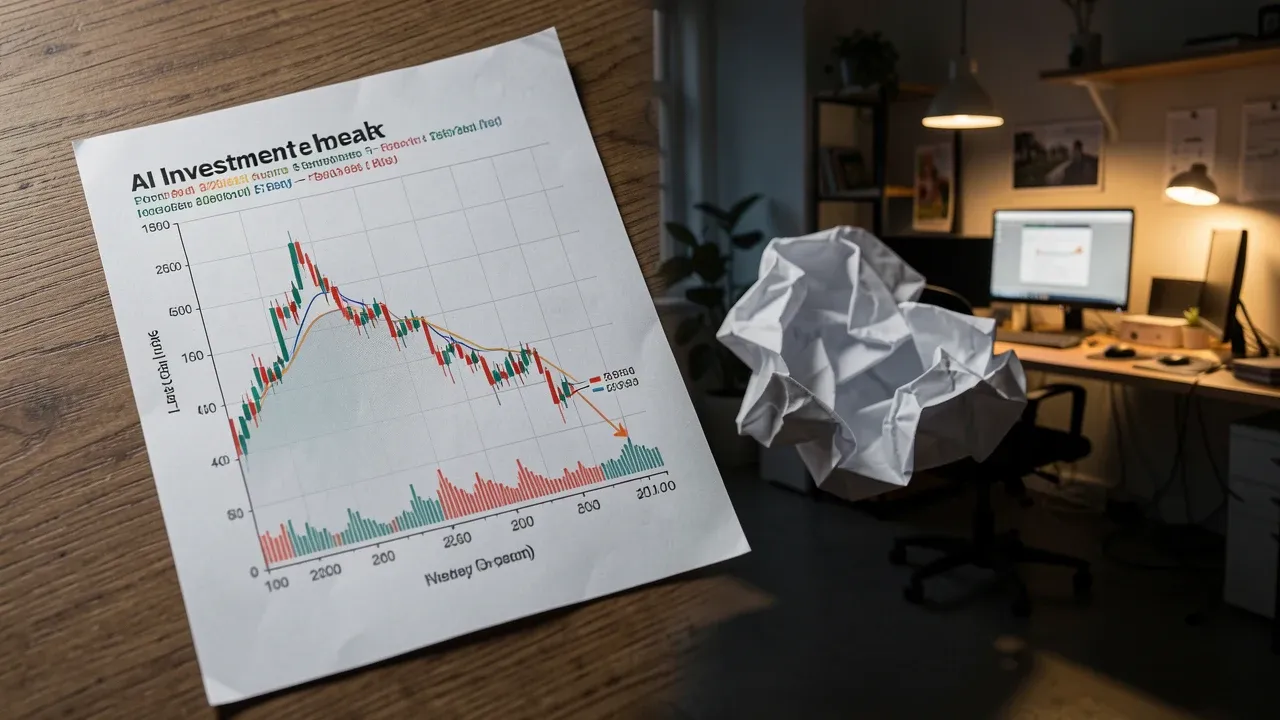
The correction will be selective, not universal
This is where the doomers get it wrong. The AI bubble deflating does not mean AI is overhyped. It means AI spending is misallocated. There is a difference between technology that works and companies that work.
The internet worked in 2000. Most internet companies did not. The survivors, Google, Amazon, eBay, were not the most heavily funded. They had business models connecting capability to revenue.
The same filter is coming for AI. Companies building products that solve specific problems for specific customers at prices those customers will pay: they will be fine. Companies building AI infrastructure on the premise that demand will materialize to justify the investment: some will not survive.
Carlota Perez documented this pattern across every major technological revolution. Installation is speculative, capital-intensive, bubble-prone. It builds the infrastructure. Then it crashes. Deployment follows: the infrastructure is repurposed, the surviving companies build real businesses, and the technology becomes productive rather than speculative. We are at the end of the installation phase. What comes after is better. It always is.

The strongest case for continued spending is geopolitics, and it deserves serious weight
The counterargument that matters is not economic. It is strategic. China is building AI infrastructure at a comparable pace. If American companies pull back, China does not. The technology has national security implications that transcend normal business logic.
This argument deserves respect. It is also the argument that justifies every military-industrial program in history. Using geopolitical competition to justify uncritical spending produces the same result it always does: enormous waste wrapped in patriotic language. The better response is targeted spending on capabilities that matter, not blanket capex increases designed to impress Wall Street.
The companies that will win the AI era are not the ones spending the most. They are the ones spending most effectively. The market is about to discover the difference.

Three things happen when bubbles deflate, and all three benefit builders
First: talent becomes available. During a bubble, every AI engineer is locked in with golden handcuffs. When funding tightens and companies restructure, talent moves. The best engineers from the 2000 crash built the companies that defined the 2010s. The next twelve months will be the best buyer's market for AI talent in a decade.
Second: infrastructure gets cheap. Bubbles produce overbuilding. All those data centers under construction right now will still exist after the correction. The companies that built them will need to fill them. GPU prices will drop. Cloud compute costs will decline. Amazon built AWS partly from excess capacity after its own overbuilding. The AI infrastructure surplus will produce similar opportunities.
Third: the noise clears. Right now, every company is an AI company. Every pitch deck leads with AI. When the bubble deflates, AI tourism stops. The companies left standing are the ones where AI is genuinely central to the value proposition. For builders operating on actual business models, the deflation removes the biggest obstacle they face: competing for attention with billion-dollar marketing budgets attached to vaporware.
What to do with this information
If you are building an AI product: stress-test your unit economics without assuming cheap capital. If your business model requires raising another round to survive, the correction will kill you. If it generates revenue that exceeds costs, the correction is your competitive advantage.
If you are an employee at an AI company: assess honestly whether your company has revenue that justifies its burn rate. Start building transferable skills and relationships now. Not because doom is certain, but because optionality is worth more during uncertainty.
If you are watching from the sidelines: the correction is when you get in. Not before, when everything is overpriced. Not after, when the winners have already consolidated. During. The window is opening now.
The AI bubble is not a sign the technology failed. It is a sign the money got ahead of the reality. Bubbles are for speculators. Deflations are for builders. Pick your side.
Sources
- MIT Sloan Management Review — Annual Tech Trends Report, AI bubble deflation as trend #1 (January 2026)
- Reuters — AI-driven inflation identified as overlooked financial risk (January 2026)
- Goldman Sachs Top of Mind — AI: in a bubble? (2025)
- FX Empire — Big Tech AI infrastructure spending $650B projection (2026)
- Carlota Perez — Technological Revolutions and Financial Capital (2002)
