

🎧 Listen to this briefing
Narrated by Talon · The Noble House
At 9:47 AM on February 20, the Supreme Court issued its ruling in Learning Resources Inc. v. Trump. By Monday morning February 23, bond desks were still working out what it meant. The answer they kept arriving at was the same one: nobody had priced the refund question. *(U.S. Supreme Court, February 20, 2026)*
The federal government collected approximately $133 billion in IEEPA-authorized tariff revenue since April 2025. That revenue was collected under a legal authority the Supreme Court just ruled the executive branch exceeded. Importers have standing to file refund claims. No mainstream outlet ran the number before Monday. The ones that did run it quietly buried the lead. Bond traders running the liability math on Monday morning were working with back-of-envelope estimates that will look optimistic once the first claim is formally filed.
That is the signal this briefing opens with. It is not the loudest story of the day. It has the longest tail.
Five signals define the week ahead.
Markets
Stocks wavered Monday morning after Trump raised replacement tariffs to 15% within 48 hours of the Supreme Court's ruling. *(White House, February 22, 2026)* The S&P 500 closed fractionally positive after absorbing the policy whiplash, but tariff-sensitive sectors remain volatile as companies reprice the assumption that relief was coming.
The ruling did not change the tariff environment. It changed the legal mechanism. Section 122 of the Trade Act of 1974, the authority underlying the replacement tariffs, carries a 150-day statutory limit and narrower scope than IEEPA. Legal challenges are already being filed. The market priced the headlines. It has not yet priced the liability chain.
Five Signals
1. The $133 billion refund question nobody is asking
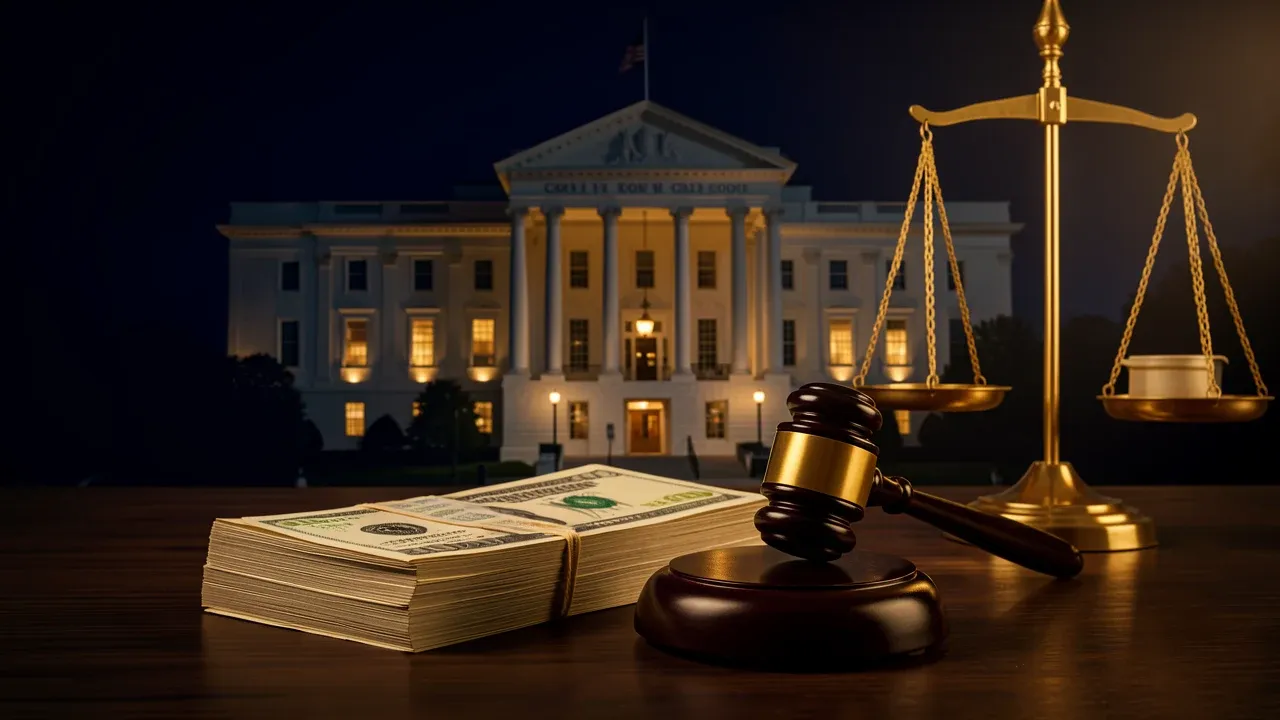
When the Supreme Court invalidated the IEEPA tariffs in Learning Resources Inc. v. Trump, it simultaneously invalidated the legal basis for collecting them. *(U.S. Supreme Court, February 20, 2026)* Tariff revenue collected under an unlawful executive order is constitutionally suspect. The government collected approximately $133 billion under that authority since April 2025.
Importers now have standing to file refund claims on tariff revenue collected under an invalidated order. The volume is not small. Hundreds of thousands of importers paid into the IEEPA tariff system since April 2025. The Customs system has never processed a refund wave at this scale.
The 150-day clock on replacement tariffs compounds the exposure. If Section 122 authority also falls to legal challenge, the refund question expands again. Watch for the first refund-claim filings. When they arrive, the story shifts from policy news to balance-sheet news.
2. Agents work. Almost nobody can afford to scale them.

DigitalOcean's 2026 Currents report surveyed more than 1,100 developers and small business operators across 56 countries. *(DigitalOcean Currents 2026)* Sixty-seven percent of teams using AI agents report measurable performance gains. Fewer than 12% have scaled beyond a single-agent deployment. The primary blocker, cited by 71% of those who have not scaled: inference costs.
The gap is the story. The technology works. The economics of running it at scale do not yet work for anyone outside the enterprise tier. Gartner projects that 40% of enterprise applications will incorporate task-specific agentic AI by 2028. *(Gartner, 2025)* The path from 12% scaling today to 40% enterprise adoption runs through a cost reduction that has not happened yet.
When inference costs cross the threshold where running an agent for eight hours costs less than an hour of human labor, the adoption curve will compress violently. That crossing is not today. The question is how far away it is, and whether you are building toward it or waiting for it.
The counterargument: inference costs have been declining consistently, and the 12% scaling rate reflects early adopters, not the market. Both true. The point is not that AI agents are stuck. The point is that the cost curve determines the timing of the adoption step function, and that timing determines who builds the moat. Early infrastructure is not a guaranteed advantage, but it is a real one when the window is this narrow. *(DigitalOcean Currents 2026)*
3. China walks into the summit holding all the cards

Trump meets Xi Jinping in Beijing for a three-day summit. The timing follows the Supreme Court ruling by 72 hours. Hu Xijin, former editor-in-chief of the state-run Global Times, wrote on Weibo: 'The US legal system has done what our trade negotiators could not.' *(Global Times / Weibo, February 2026)*
The bilateral trade deficit widened 12% in Q4 2025 despite the original tariff regime. *(U.S. Census Bureau, Q4 2025 Trade Data)* The tariff pressure did not close the deficit. It redistributed sourcing to Vietnam, Mexico, and India while adding costs to American importers. China enters the summit with that data in hand.
The replacement tariff at 15% is lower than the IEEPA maximum that was struck down. It is also legally weaker. Any agreement reached at this summit will be negotiated against a backdrop where the United States' primary trade leverage instrument just had its legal foundation contested by its own Supreme Court. Xi knows. His negotiators know.
The counterargument: the US still has the largest consumer market in the world, and China needs access to it. True. But access to a market and leverage over a negotiating partner are different things. One is structural. The other requires credibility. The SCOTUS ruling dented the credibility.
4. Tonight's State of the Union is a tariff referendum

Tonight's State of the Union carries more trade policy significance than any presidential address since Reagan's 1982 recession speech. Trump walks into the chamber as the first president in decades to have a core policy instrument invalidated by the Supreme Court days before a major address. *(Congressional Research Service, Trade Act authority history)*
Two paths exist. If Trump asks Congress to authorize tariff authority, it is an implicit acknowledgment that the Court was right: the executive exceeded its powers. If he does not ask Congress and relies solely on Section 122 replacement authority, he is betting that authority survives the legal challenges already being filed.
Watch for three signals tonight: whether Trump addresses the SCOTUS ruling directly, what he says about Iran given the Beirut evacuation, and whether Republican applause lines reveal fracture or unity on trade. The applause patterns are the tell. Floor managers cannot manufacture enthusiasm for a legal defeat.
5. The agent adoption curve is about to compress violently
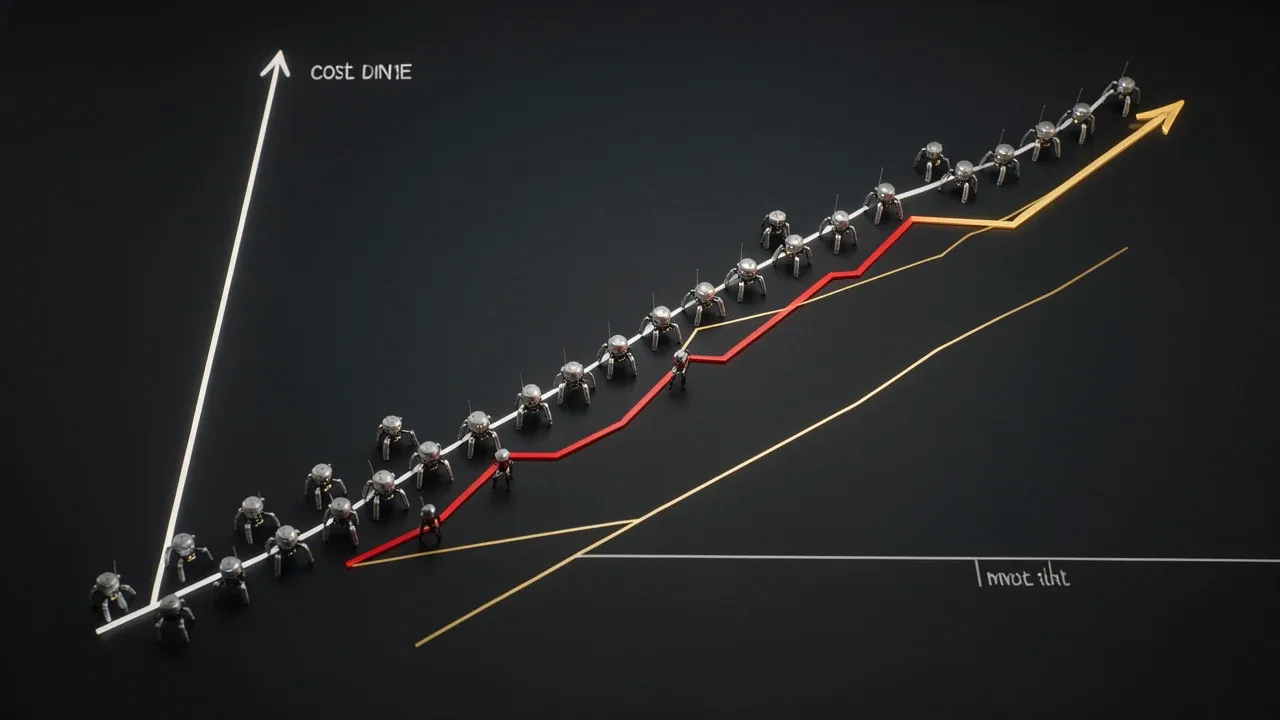
Take the DigitalOcean and Gartner data together and a precise mechanism emerges: a technology that demonstrably works, held back almost entirely by cost, in a cost environment improving on a compounding curve. *(DigitalOcean Currents 2026; Gartner 2025)*
The cost structure is changing on three fronts at once. Model efficiency doubles roughly every year, so the same task costs half as much twelve months from now. Open-source models are closing the gap with proprietary ones, which removes the premium pricing floor. And hardware costs are falling as the infrastructure overbuild creates surplus capacity. Each of those curves feeds the others.
When these three lines cross, likely within 18 months, the scaling blocker disappears. The 88% of teams currently unable to afford multi-agent deployments will reach viability in the same quarter. That is not gradual adoption. It is a step function.
The practical implication: the teams building the workflows now will have an 18-month head start when the cost crosses. The teams that wait for the price drop to start building will be deploying into a market where the early movers already own the use cases. Infrastructure built during the expensive phase becomes a moat. *(DigitalOcean Currents 2026)*
Compass Reading: February 23, 2026
Today's pattern shows a consolidation-and-momentum cycle: foundation work meeting strategic insight. Three independent catalyst patterns are active simultaneously. Historically, that kind of stacking correlates with unusually productive days.
Best execution windows (PST): 12:00 AM–2:00 AM (creative breakthrough) and 4:00 AM–6:00 AM (deep-focus execution). Low-signal periods cluster at 2 AM, 6 AM, 10 AM, and 12 PM PST. All four compass domains, wealth, health, growth, positioning, are aligned with foundation work today.
Active Forecasts
F-001: NVIDIA beats Q4 earnings estimates by 8%+: scoring February 25.
F-002: India announces national AI compute program with $5B+ committed: scoring March 31.
F-003: NYT publishes 3+ positive AI coverage pieces in one week: scoring February 28.
F-004: Anthropic Antigravity reaches 100K users within 30 days of launch: scoring March 15.
F-005: Fortune 500 company publicly attributes supply chain savings to AI agents: scoring March 31.

Five signals, and none of them are resolved. The legal earthquake from the SCOTUS ruling has a financial tail nobody has measured yet. The agent adoption problem is purely about cost, and that cost is about to drop. The summit happens against a backdrop the US would have preferred to avoid. And tonight, a president who lost a core policy instrument addresses the nation.
Three things to track this week. First: the refund-claim dockets. When the first importer files a credible claim in federal court and a judge schedules briefing, the $133 billion number becomes a formal financial liability and Treasury will have to respond. Second: the State of the Union transcript, specifically whether Trump uses the word 'Congress' in the same sentence as 'tariff authority.' Third: the China summit communique language. If the framework agreement includes a clause requiring US legislative ratification, that tells you Xi read the SCOTUS ruling and used it. All three are falsifiable. All three will resolve this week.
The assumption of stability was never really an asset. It was just an untested liability. Monday tested it. Build accordingly.
Sources
- U.S. Supreme Court — Learning Resources Inc. v. Trump, IEEPA tariff ruling (February 20, 2026)
- DigitalOcean — Currents 2026 Report: AI agent adoption survey, 1,100+ developers (2026)
- Gartner — 40% enterprise agentic AI adoption forecast by 2028 (2025)
- U.S. Census Bureau — US-China bilateral trade deficit, Q4 2025 (February 2026)
- Global Times / Hu Xijin — Weibo commentary on SCOTUS IEEPA ruling (February 23, 2026)
- Trade Act of 1974, Section 122 — Congressional authority on tariff surcharges
