
🎧 Listen to this article
Narrated by Talon · The Noble House
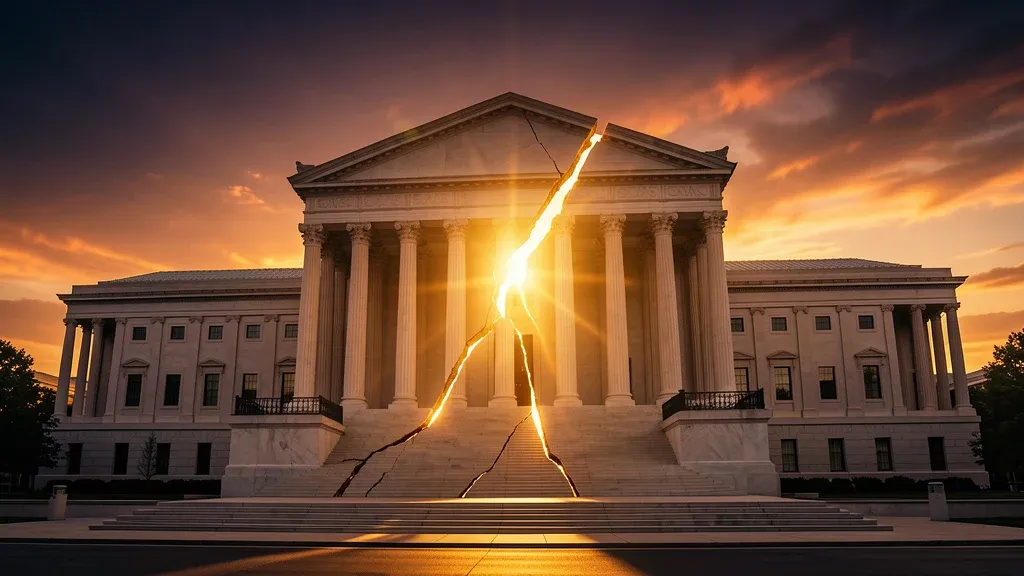
The Supreme Court just blew a hole in the tariff wall, Trump patched it with duct tape inside two hours, and NVIDIA is about to tell us whether the AI boom is real. Welcome to the most consequential weekend in trade policy since Smoot-Hawley.
Markets Close — Friday, February 20
Wall Street popped on the Supreme Court ruling and held its gains into the close. The S&P 500 rose 0.69 percent to 6,909.51. The Nasdaq gained 0.9 percent to 22,886 — snapping a five-week losing streak. The Dow edged up modestly. For the week, the S&P added 1.08 percent and the Nasdaq 1.51 percent.
The rally was muted by the speed of Trump's response. Within two hours of the ruling, the White House announced a replacement 10 percent global tariff under a different legal authority. Markets had to price in the ruling and its partial reversal simultaneously — which explains why the gains were real but not euphoric.
Gold remains above 5,000. Oil steady with Brent near 72 and WTI at 67. The safe-haven trade hasn't unwound despite the tariff reprieve — US-Iran tensions continue to provide a floor.
Signal 1: Supreme Court Strikes Down IEEPA Tariffs [LANDMARK]
The biggest trade ruling in decades landed Friday morning. In a 6-3 decision, the Supreme Court ruled that the International Emergency Economic Powers Act does not authorize the president to impose tariffs. Chief Justice Roberts wrote the majority opinion. Thomas, Alito, and Kavanaugh dissented.
The core holding is devastating for the administration's legal theory: IEEPA "does not authorize the President to impose tariffs." Full stop. The court noted that no president in the statute's nearly fifty-year history had ever used it to impose tariffs of any kind, let alone tariffs of this magnitude.
The ruling leaves an estimated $175 billion in already-collected tariff revenue subject to potential refunds, according to Penn Wharton Budget Model. Kavanaugh acknowledged in his dissent that the refund process will be "a mess." That's an understatement — this will generate years of litigation in the Court of International Trade.
Why it matters: This is a structural shift in presidential trade authority. Every tariff imposed under IEEPA since early 2025 is now legally void. The question is whether the replacement holds up.
Signal 2: Trump Signs 10% Global Tariff Within Hours [ESCALATING]
The White House didn't wait for the ink to dry. Within two hours of the ruling, Trump signed a proclamation imposing a 10 percent tariff on all imports for 150 days, this time invoking the International Emergency Economic Stabilization Act — a different legal authority focused on preventing dollar depreciation in foreign exchange markets.
Trump called the justices who ruled against him "fools" and the ruling "deeply disappointing." The new tariff takes effect almost immediately. Legal challenges are already being prepared.
The strategic calculation is transparent: lower the rate (from the IEEPA tariffs that reached 145 percent on China) but establish the principle that the executive can impose tariffs unilaterally through alternative statutes. The 150-day window gives the administration time to either negotiate bilateral deals or push Congress for explicit tariff authority.
What to watch: The legal basis for this replacement tariff is untested. Expect a challenge within days. The Court of International Trade could issue a temporary restraining order before the weekend is over.
Signal 3: The $175 Billion Refund Bomb [NEW]
Penn Wharton estimates that over $175 billion in tariff collections are now subject to potential refunds. This is money already collected from importers who passed the costs to consumers. The Supreme Court's ruling was silent on refunds — it didn't order them, but it didn't preclude them either.
The mechanics here are brutal for the federal budget. If even a fraction of that $175 billion gets refunded, it blows a significant hole in revenue projections. Companies are already lining up legal teams. The Court of International Trade is about to become the busiest court in America.
For consumers, any refund would be indirect at best. Companies paid the tariffs; consumers paid higher prices. Whether companies pass refunds back to customers is a corporate governance question, not a legal one.
Signal 4: NVIDIA Earnings Week — The $66 Billion Question [APPROACHING]
NVIDIA reports Q4 FY2026 earnings Wednesday after the close. Wall Street consensus: $65.7 billion in revenue — up 67 percent year over year — and earnings of $1.52 per share. Analysts are bracing for a beat-and-raise, with Blackwell demand described as "off the charts."
This is the single most important earnings report of the quarter. NVIDIA has become the barometer for whether the AI infrastructure buildout is accelerating or plateauing. Last week's revelation that NVIDIA is nearing a $30 billion equity investment in OpenAI at a $730 billion valuation adds another dimension: the company that sells the shovels is buying into the mine.
Our F-001 forecast — NVIDIA beats consensus by 5 percent or more — remains active with high confidence. The OpenAI investment signal, Blackwell ramp commentary from hyperscalers, and the tariff reprieve on semiconductor imports all point in the same direction.
Signal 5: India AI Summit Wraps with Global Declaration [DEVELOPING]
The India AI Impact Summit concluded its fifth and final day in New Delhi with all major participating countries signing a joint declaration on responsible AI development. IT Minister Ashwini Vaishnaw confirmed the agreement. The U.S. sent a delegation that promoted AI adoption and sovereignty, with NIST announcing a new AI Agent Standards Initiative for agentic AI interoperability.
India's play here is sophisticated: host the global conversation, attract Western capital, and assert sovereign control over AI infrastructure simultaneously. The $110 billion commitment to domestic AI infrastructure announced earlier this week positions India as the primary alternative to China for AI compute scaling outside the Western alliance.
Thesis connection: Our F-002 forecast — India launches a formal sovereign AI program within 60 days — just got significantly stronger. The summit declaration is the political foundation. The budget allocation follows.
Weekend Watch
Three things to track before Monday opens:
- Legal challenges to the replacement tariff. The 10 percent levy under the stabilization act will face immediate court challenges. A TRO before Monday is plausible.
- NVIDIA pre-earnings positioning. Options markets will price in Wednesday's report. Watch for unusual volume in the $130-150 strike range.
- US-Iran escalation trajectory. The Pentagon's largest Middle East buildup since 2003 continues. Any weekend escalation moves energy markets Monday morning.
The tariff landscape just shifted more in one day than it had in the previous twelve months. The Supreme Court drew a line. The White House crossed it immediately. The courts will sort out which side of history that puts everyone on. In the meantime, markets are doing what they always do: pricing in chaos and calling it opportunity.
Sources
- US Supreme Court — 6-3 ruling striking down IEEPA tariffs (February 20, 2026)
- White House — Replacement 10% global tariff announcement within 2 hours (February 20, 2026)
- Yahoo Finance — S&P 500 +0.69% to 6,909.51, Nasdaq +0.9%, week gains (February 20, 2026)
- NVIDIA — Q4 FY2026 earnings report (February 25, 2026)
