
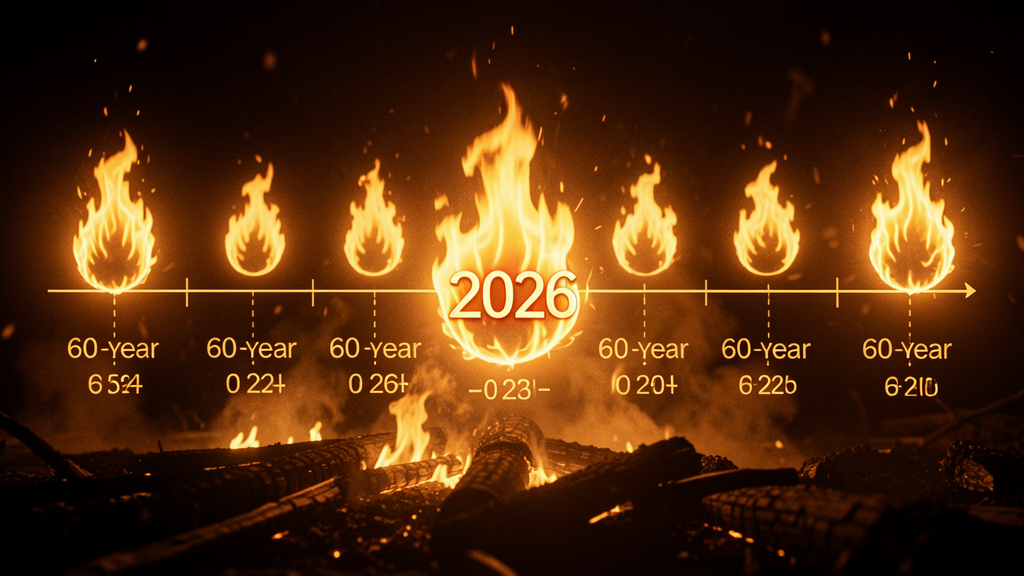
And Why 2026 Is the Year You Either Reinvent — Or Get Consumed
At 5:12 a.m. on April 18, 1906, a rupture along the San Andreas Fault shook San Francisco for forty-five seconds. By the time the ground stopped moving, the city's two major water mains had shattered. Fires ignited in dozens of locations simultaneously, and with no water to fight them, they burned for three days. When the smoke cleared, 80% of the city was rubble. Three thousand people were dead. Two hundred thousand were homeless. The most sophisticated American city west of Chicago had been reduced to a tent camp in Golden Gate Park — refugees lining up for military rations, sleeping on the ground, and staring at a skyline that no longer existed.
That was the last time the Fire Horse came.
Or rather, the last time before the last time.
In the Chinese metaphysical tradition — a system of understanding that predates Western science by millennia — time does not move in a line. It moves in cycles. The sexagenary cycle, the sixty-year engine that drives the Chinese calendar, pairs ten Heavenly Stems with twelve Earthly Branches in a sequence that repeats with mathematical precision. Every sixty years, the same elemental combination returns. And when Yang Fire meets the Horse — 丙午, Bing Wu — history has a pattern of catching fire.
Not metaphorically. Literally.
2026 is the Year of the Fire Horse. The first since 1966. The energy signature is unmistakable to anyone trained in the tradition: double Yang Fire with zero Water element in the chart. Extreme acceleration. Emotional and ideological polarization. Rapid, often irreversible decisions made under pressure. The classical texts describe it as a year of supreme testing — what is authentic survives the burning; what is artificial disintegrates.
The modern mind dismisses this as superstition. The historical record does not.
The Mechanism: Why Fire Horse Years Break Things
Here is the part most people miss. The Fire Horse is not a prediction. It is a pattern recognition framework — one that has been identifying nexus points in human civilization for over two thousand years. The question is not whether you believe in Chinese astrology. The question is whether the pattern holds.
It does. And the mechanism is not mystical. It is structural.
Every sixty years, the conditions that produce Fire Horse energy — excessive forward momentum, absence of moderating forces, institutional rigidity meeting unstoppable change — tend to coincide with moments when human systems reach their breaking point. The fire is not caused by the stars. It is caused by the accumulation of pressure that existing structures can no longer contain.
Think of it as a pressure cycle. Institutions calcify. Wealth concentrates. Technology advances faster than society can adapt. The gap between how things work and how people are told things work becomes unsustainable. And then something ignites the kindling that has been accumulating for decades.
That something is the Fire Horse.
Let us walk backward through the cycle and see what history has to teach the living.
1786: The Year the Old Regime Cracked
Sixty years before the earthquake. Two hundred and forty years before today.
In the fall of 1786, France was the wealthiest nation in Europe and functionally bankrupt. The country had spent itself into oblivion financing the American Revolution — a war fought to establish the very principles of liberty that France's own monarchy refused to extend to its people. Half of all government revenue was consumed by debt service. The cost of bread had become unaffordable for the working class. And the aristocracy, which controlled most of the nation's land, paid almost no taxes at all.
Finance Minister Charles-Alexandre de Calonne knew the math. He proposed a universal land tax that would strip the nobility of their exemptions. He convened the Assembly of Notables — an aristocratic body that had not met in over a century — and asked them to approve the reforms.
They refused.
The same year, the Anglo-French Commercial Treaty of 1786 — the Eden Agreement — locked in free trade between Britain and France. The theory was that open markets would benefit everyone. The reality was that French food prices spiked as grain was exported to chase higher prices abroad, while cheap British manufactured goods flooded the French market and destroyed domestic industry. The working class could not afford to eat. The middle class could not compete. And the aristocracy would not pay.
1786 was the last year the Old Regime functioned normally. Within three years, the Bastille had fallen. Within seven, the king was dead, executed by the nation he had failed to reform. The Revolution consumed not just the monarchy but the entire social order — clergy, nobility, and eventually the revolutionaries themselves. The Reign of Terror killed tens of thousands. The Napoleonic Wars that followed killed millions.
The lesson: When institutions refuse to adapt to structural pressure, the pressure does not disappear. It detonates. And the detonation does not discriminate between the guilty and the innocent. The aristocrats who blocked Calonne's reforms thought they were protecting their privilege. They were building their own guillotine.
1846: The Year the Ground Gave Way
One hundred and eighty years ago. Three turns of the wheel.
In 1846, a fungal blight called Phytophthora infestans destroyed the potato crop across Northern Europe. The devastation was worst in Ireland, where potatoes were not a preference but a necessity — the only food most of the population could afford. Over the next five years, more than a million Irish people starved to death. Another two million fled the country, most to America, in ships so overcrowded and disease-ridden they were called "coffin ships."
But the famine was not the whole story. It was the detonator.
Across Europe, the crop failure of 1846 collided with the dislocations of the Industrial Revolution to produce what historians call the "hungry forties." The old agrarian economy was dying. The new industrial economy was not yet mature enough to absorb the displaced workers. Food prices spiraled while wages stagnated. By 1847, in some German towns, three-quarters of the population was classified as poor. Over four hundred food riots erupted across France between 1846 and 1847.
The technology that was supposed to lift humanity — mechanized production, steam power, the factory system — was instead creating a new class of urban poor who had traded the hardships of the farm for the horrors of the sweatshop. Children as young as five worked sixteen-hour shifts in textile mills. Workers who organized were fired, blacklisted, or arrested. The gap between the promise of progress and the reality of lived experience became so vast that an entire continent erupted.

In 1848, two years after the Fire Horse, revolutions swept through France, Germany, Austria, Hungary, Italy, and dozens of other nations in what became known as the "Springtime of the Peoples." Kings abdicated. Constitutions were written. And Karl Marx, watching from exile, published The Communist Manifesto — a document that would shape the next century and a half of human history.
The lesson: Technological transformation without social infrastructure creates a vacuum. And vacuums get filled — often by forces more radical than anyone anticipated. The industrialists of 1846 believed that economic growth would solve the problems growth had created. They were wrong. Growth without distribution is not progress. It is a fuse.
1906: The Year the City Burned
One hundred and twenty years ago. Two turns of the wheel.
The San Francisco earthquake of 1906 was a 7.9-magnitude event that ruptured 296 miles of the San Andreas Fault. But the earthquake itself was not what destroyed the city. The earthquake broke the infrastructure — the water mains, the gas lines, the communication networks — and without that infrastructure, the city could not respond to what came next. The fires burned for three days because there was no water to put them out. Thirty thousand buildings were destroyed. The property damage exceeded $10 billion in today's dollars. Half the city's population became refugees overnight.
What followed is instructive.
The political and business elite immediately began downplaying the damage. They feared — correctly — that honest reporting would scare away the outside investment needed to rebuild. Insurance companies fought claims. The U.S. military took over governance. Martial law was declared, and soldiers were authorized to shoot looters on sight. The Chinatown district, home to thousands of Chinese immigrants, was deliberately left to burn — its residents' deaths went unrecorded for decades.
But San Francisco did rebuild. And it rebuilt differently. The catastrophe forced innovations in earthquake-resistant construction, urban planning, and emergency response that would not have happened without the crisis. The city's emergency firefighting water system — built in direct response to the broken mains — remains operational today. The scientific study of the earthquake produced the elastic-rebound theory of seismology, which fundamentally changed how humanity understands earthquakes.
The fire burned away what was fragile. What remained was stronger.
The lesson: Infrastructure failure is the multiplier. The earthquake was the shock, but the broken water mains — the failed systems — turned a disaster into a catastrophe. When your systems are built on unexamined assumptions, the first real test does not reveal a problem. It reveals every problem, simultaneously.
1966: The Year Everything Changed at Once
Sixty years ago. The last turn before ours.
The Year of the Fire Horse in 1966 did not produce a single cataclysmic event. It produced something more dangerous: simultaneous disruption across every dimension of human life.
In China, Mao Zedong launched the Cultural Revolution — a decade-long convulsion that would destroy the country's intellectual class, its educational system, and its cultural heritage. Tens of millions were persecuted. Hundreds of thousands died. An entire generation lost access to education, to opportunity, to the accumulated wisdom of their civilization. The damage took forty years to recover from. Some of it never recovered.
In the United States, the Vietnam War escalated past the point of containment. By year's end, 250,000 American troops were deployed. The civil rights movement — which had achieved landmark legislation in 1964 and 1965 — was fracturing under the weight of unmet promises. Martin Luther King Jr. was struck by a rock while marching in Chicago. James Meredith was shot while walking across Mississippi. The Black Power movement emerged, enlarging the aims of civil rights to include economic self-sufficiency and anti-imperialism — and splitting the movement's coalition in the process.
In Japan, the Fire Horse superstition was so powerful that the birth rate dropped 25% in a single year. Couples avoided having children or terminated pregnancies rather than raise a Fire Horse child. The demographic crater created by that decision is still visible in Japan's population data six decades later.
And in living rooms across America, the first generation raised on television watched all of it unfold in real time. The Beatles played their final concert. LSD was outlawed. The first mass shooting from a university tower killed fifteen in Austin, Texas. Walt Disney died. The old world — its certainties, its hierarchies, its unexamined assumptions — was disintegrating at a speed that no institution could match.
The lesson: The most dangerous disruptions are not the ones that break one thing. They are the ones that break everything at once. When political, social, technological, and cultural systems all destabilize simultaneously, the cascading effects are non-linear. Each crack accelerates every other crack. And the human capacity to process multiple simultaneous crises is far more limited than we like to believe.
2026: The Fire Horse Returns
Now. Your turn.
You are reading this in the Year of the Fire Horse, and the pattern is already visible. The kindling has been accumulating for years. The ignition has begun.
In the first eleven months of 2025, over 1.17 million Americans were laid off — the highest total since the pandemic year of 2020. Roughly 55,000 of those job cuts were explicitly attributed to artificial intelligence, a 400% increase from the previous year. Amazon eliminated 30,000 roles. Salesforce replaced 4,000 customer support workers with AI systems. Microsoft cut 15,000 positions while simultaneously announcing that 30% of its code was now written by AI.
These are not projections. These are last year's numbers.
The World Economic Forum estimates that 92 million jobs will be displaced globally by 2030. Employment among college graduates aged 22–25 in AI-exposed fields has already dropped 13% since late 2022. Entry-level job postings — the stepping stones that have traditionally built careers — have declined 15% year over year. Anthropic's own CEO has warned that AI could eliminate half of all entry-level white-collar jobs within five years.
But here is the part that changes everything.
The disruption is not the technology. The technology is the accelerant. The disruption is the gap between the speed of technological change and the speed of institutional adaptation — the same gap that destroyed the Old Regime in France, that starved Ireland while grain was exported for profit, that burned San Francisco because no one had tested the water mains, that fractured American society in 1966 because the institutions of the 1950s could not contain the forces of the 1960s.
AI is not the earthquake. AI is the broken water main.
The earthquake is the accumulated pressure of forty years of wage stagnation, wealth concentration, institutional distrust, and a social contract that has been slowly unraveling since the 1980s. AI did not create these conditions. But AI will ensure that every structural weakness is exposed — simultaneously, at scale, and at a speed that makes gradual adaptation impossible.
This is the Fire Horse mechanism. Excessive forward momentum. Absence of moderating forces. Structures that cannot bend, and therefore break.

What the Cycle Teaches
Four Fire Horse years. Four patterns. One instruction.
In 1786, the institutions that refused to reform were destroyed by revolution. The lesson is that voluntary adaptation, however painful, is always cheaper than involuntary collapse. The aristocrats who blocked tax reform did not avoid disruption. They guaranteed it would be catastrophic rather than manageable.
In 1846, technological transformation without social infrastructure created human suffering at a civilizational scale. The lesson is that the creation of new capabilities does not automatically create new opportunity. Capability without access is a weapon, not a tool. The factories existed. The jobs existed. But the systems to connect displaced workers to new livelihoods did not.
In 1906, the real disaster was not the initial shock but the failure of systems that had never been tested. The lesson is that the resilience of your infrastructure is only as strong as your weakest untested assumption. San Francisco had water mains. It had never tested whether those mains could survive an earthquake. The answer cost three thousand lives.
In 1966, simultaneous disruption across every domain overwhelmed the capacity of individuals and institutions to respond coherently. The lesson is that cascading crises require integrated responses, and integrated responses require preparation that precedes the crisis. You cannot build the fire department after the fire starts.
How to Navigate the Fire
If the disruption is structural, the response must be structural. Individual hustle is not enough. Positive thinking is not enough. Even reskilling — the solution most often proposed — has a fatal flaw: AI can learn any new skill faster than you can. The reskilling treadmill leads to exhaustion, not security.
What works is strategic repositioning — moving from where the fire is heading to where it cannot reach.
First: Understand what fire cannot burn.
AI automates tasks, not judgment. It processes information, not wisdom. It optimizes for defined objectives, not for the undefined complexity of human values. The roles that survive are the ones that require what AI structurally cannot provide: contextual judgment under genuine uncertainty, ethical reasoning in novel situations, the ability to hold multiple stakeholders' conflicting interests simultaneously, and the capacity to build trust through authentic human presence.
These are not soft skills. They are the hardest skills in existence. And they are the ones that traditional education has systematically undervalued for a generation.
Second: Build your infrastructure before the earthquake.
The people who survived 1906 were not the ones with the biggest buildings. They were the ones with the most resilient systems. In 2026, your resilient systems are: financial reserves that buy you time to adapt, a professional network that extends beyond your current industry, skills that compound across multiple domains rather than narrowing into a single specialty, and a framework for making decisions under conditions of radical uncertainty.
That last one is the critical piece. Most people's decision-making frameworks were built for a stable environment. They optimize for efficiency within known parameters. The Fire Horse year does not operate within known parameters. It operates at the edge of chaos, where the rules change faster than the rule-followers can update their playbooks.
Third: Study the pattern. Trust the cycle.
Every Fire Horse year produces destruction and transformation. San Francisco in 1906 was rebuilt stronger, with innovations that would not have been possible without the crisis. The upheavals of 1966 — as devastating as they were — produced the civil rights infrastructure, the environmental movement, and the technological revolution that shaped the modern world. Even the French Revolution, for all its horror, established principles of democratic governance that became the foundation of Western political life.
The fire does not only destroy. It clears the ground for what comes next. And the people who build on that cleared ground — the ones who understand the cycle, who prepare before the crisis, who position themselves to serve the needs that emerge from disruption — are the ones who define the next era.
The Question the Fire Horse Asks
There is a question that sits at the center of every Fire Horse year, asked not by any astrologer but by history itself:
When the structures you depend on prove inadequate for the forces bearing down on you, will you cling to what is failing — or will you build what is needed?
The aristocrats of 1786 chose to cling. The industrialists of 1846 chose profit over people. The city planners of 1906 chose to trust untested systems. The institutions of 1966 chose to pretend the old world was still intact.
In every case, the choice to resist adaptation did not prevent change. It only ensured that change, when it came, was more violent, more chaotic, and more destructive than it needed to be.
You are not powerless in this. History is not purely deterministic. The Fire Horse does not dictate your fate — it reveals the stakes. Some of what is coming cannot be stopped. The technological displacement is real. The institutional lag is real. The cascading effects across employment, housing, healthcare, education, and civic life are real and accelerating.
But the part you can control — your positioning, your preparation, your capacity to make good decisions in bad conditions — is the difference between being consumed by the fire and being forged by it.
The Fire Horse has come four times in living memory of the historical record we have examined. Each time, it burned away what could not adapt. Each time, what emerged from the ashes was stronger, more resilient, and more aligned with the actual conditions of its era.
The fire is here.
The only question left is what you intend to build when the smoke clears.
This article is part of The Noble House series exploring the intersection of ancient wisdom, modern technology, and human development. The Fire Horse year of 2026 represents the beginning of a critical transition period — one that rewards preparation, punishes rigidity, and demands the kind of strategic thinking that has traditionally been available only to those with access to the right frameworks. That access is changing.
