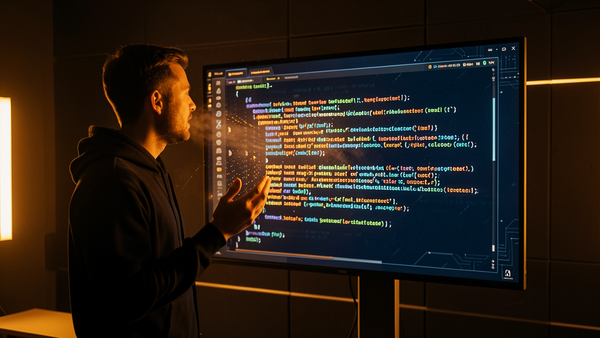
Vibe Coding and the Literacy Inversion

Vibe Coding and the Literacy Inversion

Collins Dictionary named 'vibe coding' its 2025 Word of the Year. MIT Technology Review called generative coding a breakthrough technology for 2026. Something structural is happening: the ability to build software is decoupling from the ability to write code. This changes who gets to create, an...


The Vanishing Junior

The Vanishing Junior

In 2026, entry-level programming tasks are handled by AI agents. Cursor, Claude Code, and Copilot write the boilerplate, the tests, and the glue code. The work that junior developers used to cut their teeth on is disappearing. This creates a pipeline problem nobody is talking about seriously.

Your AI Runs on Someone Else's Computer

Your AI Runs on Someone Else's Computer

Open-source models now match cloud performance for most tasks. A MacBook with 48GB of RAM runs Llama 70B. The question isn't whether local AI is viable — it's whether you can afford the risk of not owning your cognitive infrastructure.

The Attention Tax

The Attention Tax

A TechCrunch report found that early AI adopters are burning out faster than holdouts. Their to-do lists expanded to fill every hour AI freed up, and then kept going. The problem isn't the technology. The problem is that nobody updated the expectations.

The Open Source Model That's Smarter Than Its Name

The Open Source Model That's Smarter Than Its Name

Alibaba's Qwen team released a model called Qwen3-Coder-Next. The name says coding. The benchmarks say something much bigger. Why open-source naming conventions are hiding the real revolution.

Andrew Yang Is Right (And It's Already Too Late)

Andrew Yang Is Right (And It's Already Too Late)

Yang says AI will kick millions of white-collar workers to the curb in 12-18 months. He's being generous. The layoffs aren't coming — they're already here, moving in slow motion under names like 'efficiency gains' and 'not backfilling.'

The Dark Side of AI Just Hit Wall Street

The Dark Side of AI Just Hit Wall Street

Wall Street just discovered what builders already knew — AI doesn't create value for incumbents. It destroys their moats. The February 2026 selloff isn't about technology failing. It's about the market finally pricing in a world where most existing business models become obsolete.

The $650 Billion Misdirection

The $650 Billion Misdirection

Big Tech is spending $650 billion building AI infrastructure in 2026. The biggest beneficiaries won't be the companies writing the checks.